Current in a Current Carrying Conductor (OCR AS Physics): Revision Note
Exam code: H156

Mean Drift Velocity of Charge Carriers
In a conductor, the current is due to the movement of charge carriers
The charge carriers can be negative or positive, however, the current is always taken to be in the same direction
In conductors, the charge carrier is usually free electrons
However, these electrons only travel a small difference before colliding with a metal ion
This means they have a relatively slow drift velocity, v
In the diagram below, the current in each conductor is from right to left but the charge carriers move in opposite directions shown by the direction of the drift velocity v
In diagram A (positive charge carriers), the drift velocity is in the same direction as the current
In diagram B (negative charge carriers), the drift velocity is in the opposite direction to the current
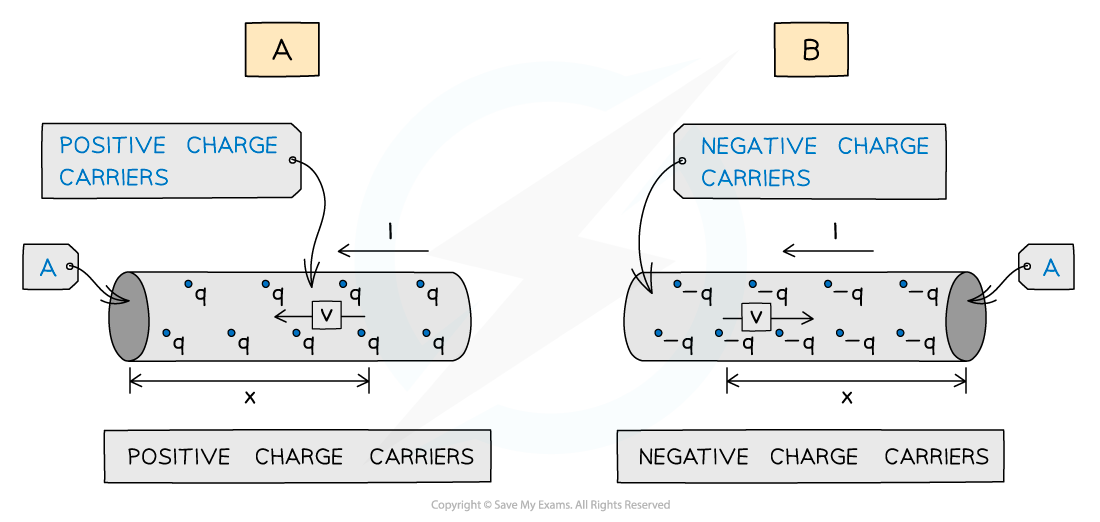
Conduction in a current-carrying conductor
The drift velocity is the average velocity of the charge carriers travelling through the conductor
You will find this value is relatively slow (∼ 10-3 m s-1)
However, since the number density of charge carriers is so large, the current flow still seems to happen instantaneously
Calculating Current in a Current Carrying Conductor
The current can be expressed in terms of the number density (number of charge carriers per unit volume) n, the cross-sectional area A, the drift velocity v and the charge of the charge carriers q

Current in a conductor equation
The same equation is used whether the charge carriers are positive or negative
The minus sign will indicate current in the opposite direction to the charge carriers
The charge q will be e for electrons (-1.60 × 10⁻¹⁹ C)
The number density n represents the number of free charge carriers (electrons) per unit volume
Conductors, such as metals, have a high value of n
Insulators, such as plastics, have a small value of n
The cross-sectional area A of a wire is the area of a circle
A = πr2
Where:
r = radius of the wire (m)
This equation shows:
v is inversely proportional to n meaning more charge carriers per unit volume will slow down their speed through the conductor
I is directly proportional to n since greater n means greater charge is flowing and therefore a larger current I. When the value of n is lower, the charge carriers must travel faster to carry the same current
Worked Example
A copper wire has 9.2 × 1028 free electrons m-3. The wire has a current of 3.5 A and a cross-sectional area of 1.5 mm2.Calculate the average drift speed of the electrons.
Answer:

Examiner Tips and Tricks
Remember that the cross-sectional area is in m2, the drift velocity is in m s-1 and the number density is in m-3. Therefore, sometimes unit conversions from cm or mm may be required, so make sure you're comfortable with these.

Unlock more, it's free!
Join the 100,000+ Students that ❤️ Save My Exams
the (exam) results speak for themselves:

Was this revision note helpful?
Build on this topic
