Resolving Vectors (OCR AS Physics): Revision Note
Exam code: H156

Resolving Vectors
Two vectors can be represented by a single resultant vector
Resolving a vector is the opposite of adding vectors
A single resultant vector can be resolved
This means it can be represented by two vectors, which in combination have the same effect as the original one
When a single resultant vector is broken down into its parts, those parts are called components
For example, a force vector of magnitude F and an angle of θ to the horizontal is shown below

The resultant force F at an angle θ to the horizontal
It is possible to resolve this vector into its horizontal and vertical components using trigonometry

The resultant force F can be split into its horizontal and vertical components
For the horizontal component, Fx = F cos θ
For the vertical component, Fy = F sin θ
Example: Forces on an Inclined Plane
Objects on an inclined plane is a common scenario in which vectors need to be resolved
An inclined plane, or a slope, is a flat surface tilted at an angle, θ
Instead of thinking of the component of the forces as horizontal and vertical, it is easier to think of them as parallel or perpendicular to the slope
The weight of the object is vertically downwards and the normal (or reaction) force, R is always vertically up from the object
The weight W is a vector and can be split into the following components:
W cos (θ) perpendicular to the slope
W sin (θ) parallel to the slope
If there is no friction, the force W sin (θ) causes the object to move down the slope
The object is not moving perpendicular to the slope, therefore, the normal force R = W cos (θ)
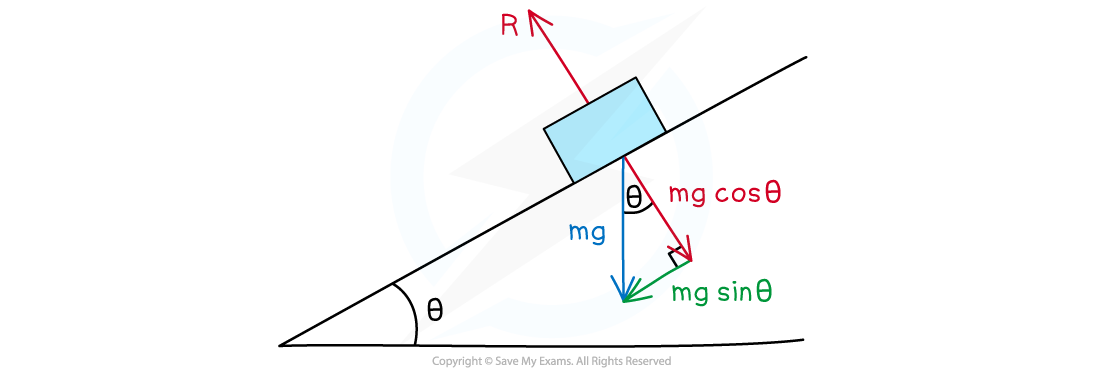
The weight vector of an object on an inclined plane can be split into its components parallel and perpendicular to the slope
Worked Example
A helicopter provides a lift of 250 kN when the blades are tilted at 15º from the vertical.
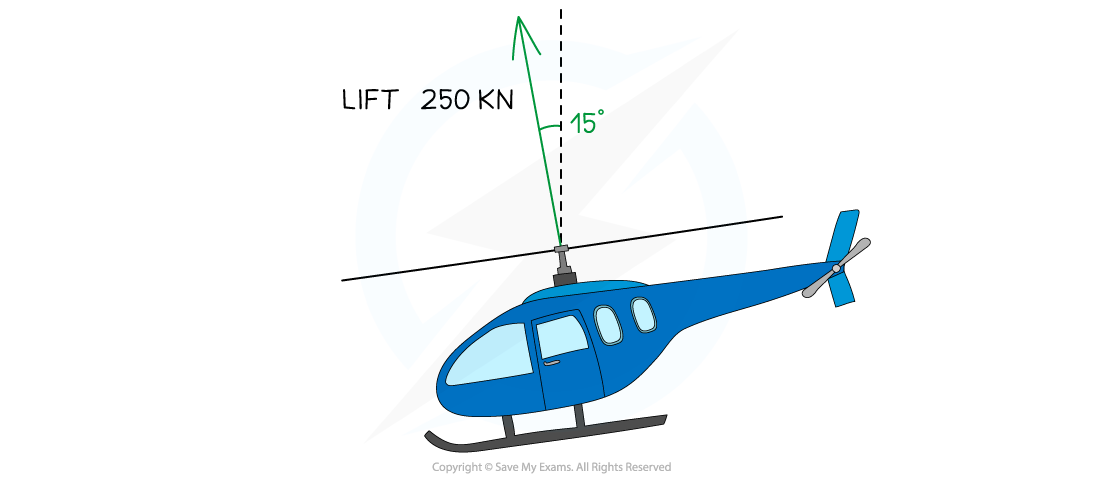
Calculate the horizontal and vertical components of the lift force.
Answer:
Step 1: Draw a vector triangle of the resolved forces
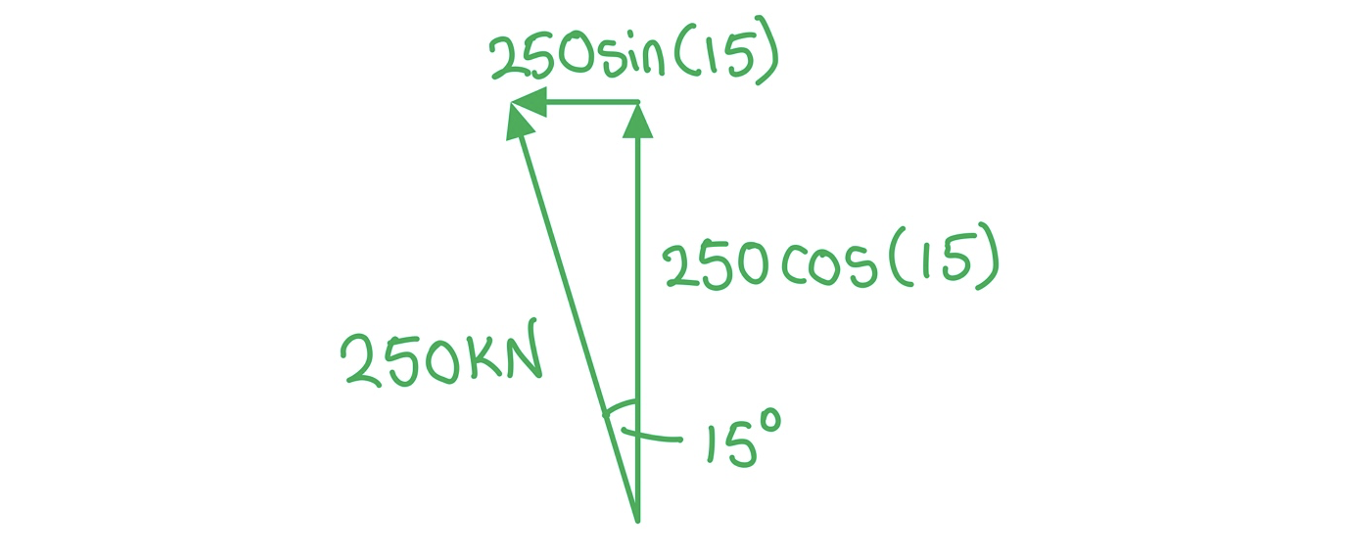
Step 2: Calculate the vertical component of the lift force
Vertical = 250 × cos(15) = 242 kN
Step 3: Calculate the horizontal component of the lift force
Horizontal = 250 × sin(15) = 64.7 kN
Examiner Tips and Tricks
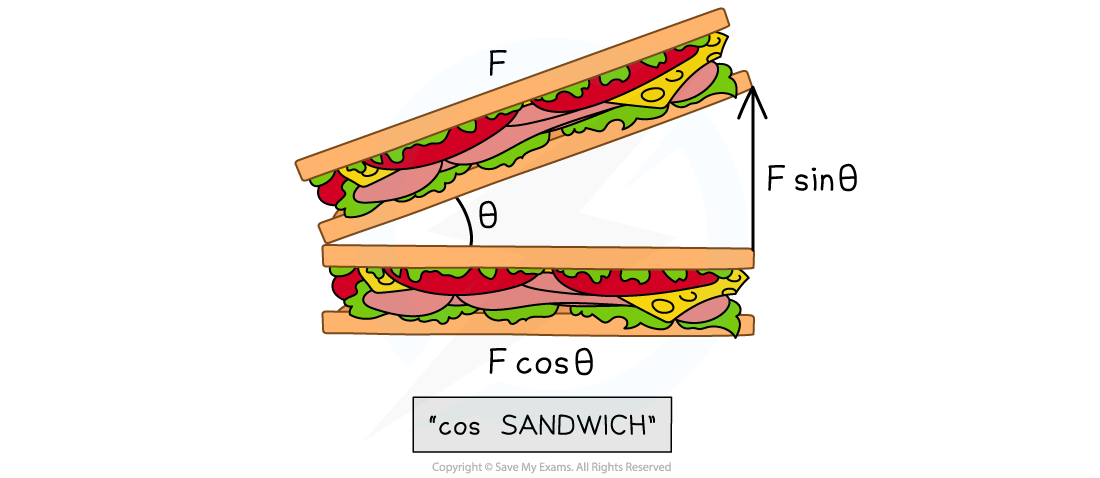
If you're unsure as to which component of the force is cos θ or sin θ, just remember that the cos θ is always the adjacent side of the right-angled triangle AKA, making a 'cos sandwich'

Unlock more, it's free!
Join the 100,000+ Students that ❤️ Save My Exams
the (exam) results speak for themselves:

Was this revision note helpful?
Build on this topic
