Short-term Effects of Exercise (OCR GCSE Physical Education (PE)): Revision Note
Exam code: J587

Short-term effects of exercise
Exercising has various effects on the body
Some of these effects are immediate and occur within the first few minutes of exercise
Others will take place in the short-term, between 24 and 36 hours after exercise
These effects include:
Increased muscle temperature
An increase in muscle contractions during exercise will release more heat energy
The effects of this can be seen in sweating which releases heat energy at the skin surface by evaporation of sweat
An increase in muscle contractions during exercise will release more heat energy. This means the muscles will be more elastic, increasing their range of movement and decreasing the risk of injury
Increased heart rate, stroke volume and cardiac output
Increased blood flow, oxygen and nutrient delivery to the working muscles. Waste products are also removed quicker
Redistribution of blood flow to the muscles
The body redistributes blood so that more of it goes to the working muscles and less of it goes to other body organs such as the digestive system
This redirection of blood flow is caused by a mechanism (or process) called the vascular shunt mechanism
Vasodilation is the widening of the arteries increase blood flow to the working muscles
Vasoconstriction is the narrowing of the arteries to restrict blood flow to tissues and organs such as the gut, kidneys and liver that are not vital during exercise
Increased breathing frequency (f), tidal volume (TV) and minute ventilation (VE)
The increase in the depth and frequency of breathing happens to bring more air/oxygen into the lungs
Increased exhalation also removes water and carbon dioxide more quickly
Supplying oxygen to the working muscles
The heart works harder to get blood flowing with more pressure to the working muscles
Increased oxygen availability increases energy production and waste product removal
Lactic acid production
Working muscles produce lactic acid and carbon dioxide as waste products during high intensity exercise
This causes fatigue and pain in the muscles
The increased blood flow does help to reduce this build up however without time to recover there will be a decrease in performance
Worked Example
The table below shows the redistribution of blood during exercise.
Destination | Rest | Maximal exercise |
|---|---|---|
Skeletal muscles | 18% | 84% |
Major organs | 72% | 9% |
Skin | 10% | 7% |
Using the data in the table, analyse the redistribution of blood to the skin during exercise
It decreases by 3%
Worked Example
Figure 1 below shows the respiratory rate of a hockey player before, during and after a match.
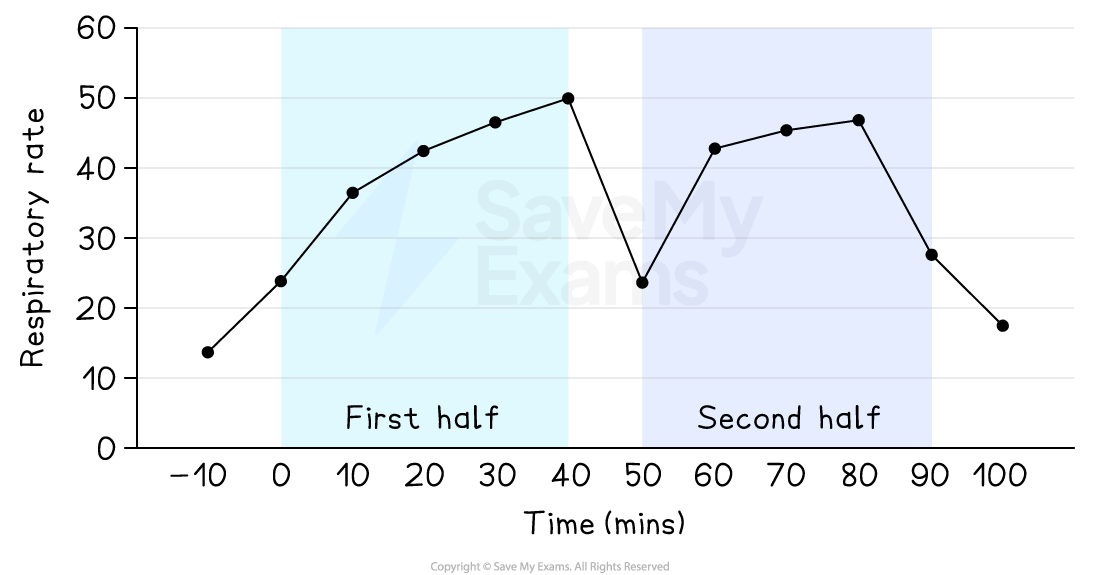
Using the information in the graph, analyse how the respiratory rates compare in the first half and second half of the game and give reasons for their difference.
First half became more intense than the second half
First half got gradually more intense as the match progressed but the second half was consistently intense until the last 10 minutes
Performance in the first half was intense until the half-time whistle but the second half tailed off 10 minutes before the end
This may be caused by a change in team possession of the ball / change of strategy / decline in motivation due to the scoreline/ tiredness and fatigue / injury / had a team mate sent off
Explain why the respiratory rate dropped significantly between 40 and 50 minutes.
This would have been the half time break so the player had a lower demand for oxygen

Unlock more, it's free!
Join the 100,000+ Students that ❤️ Save My Exams
the (exam) results speak for themselves:

Was this revision note helpful?