Bones in the Human Body (OCR GCSE Physical Education (PE)): Revision Note

Exam code: J587
Emma Mulhern

Written by: Emma Mulhern

Reviewed by: Ruth Brindle

Updated on

Location of major bones 

  • There are many bones which make up the skeleton that shapes the framework of the body

  • Infants are born with around 300 bones in their skeleton to provide extra flexibility

  • During childhood, many bones fuse together meaning that by adulthood there are typically 206 bones in the adult skeleton
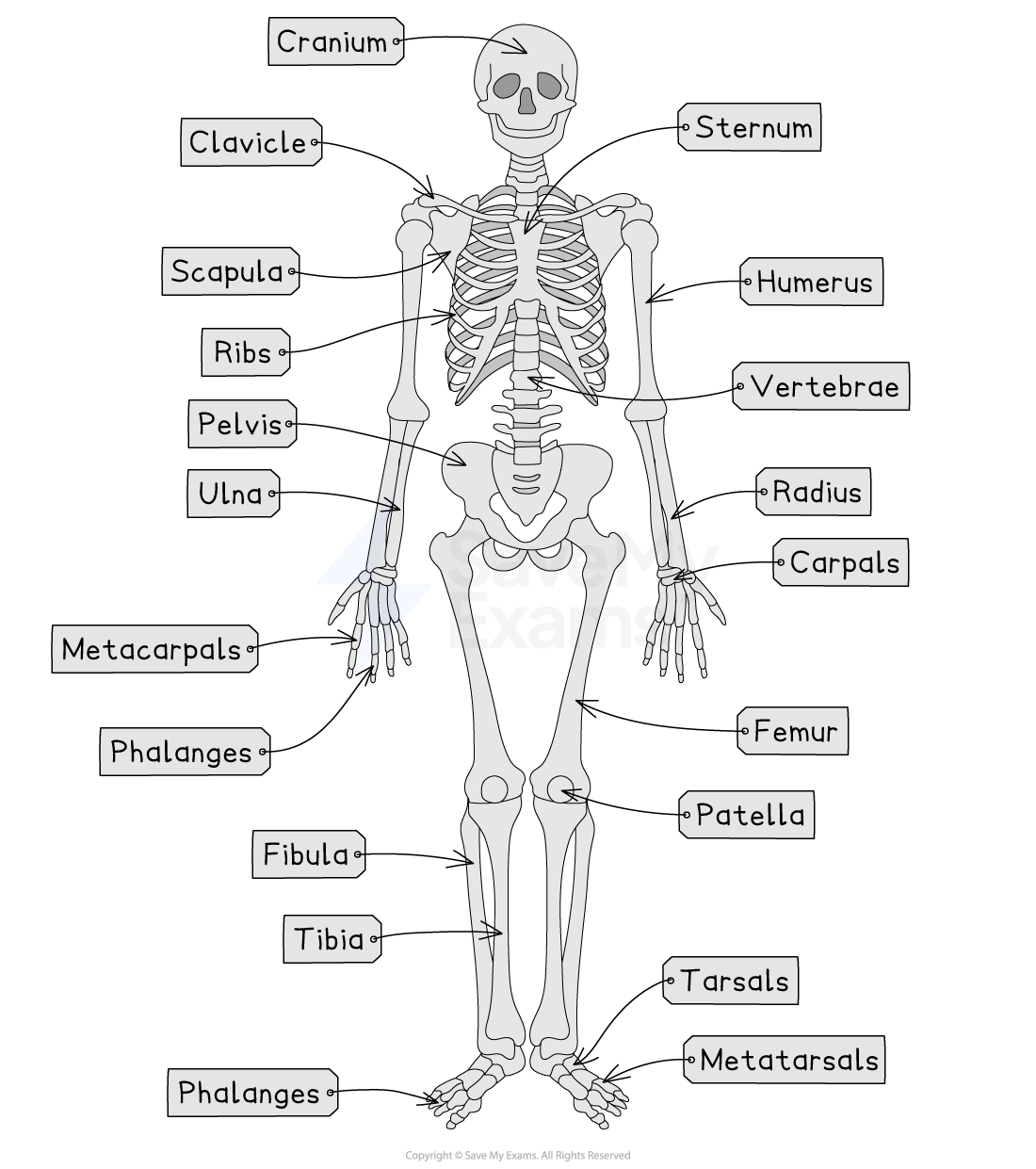
Diagram of human skeleton with labels for bones, including cranium, vertebrae, ribs, pelvis, femur, tibia, clavicle, and phalanges.
Human skeleton

Examiner Tips and Tricks

Whilst you do not need to learn the names of all 206 adult bones of the body, you do need to be able to name and locate the major bones of the body as listed in the diagram above.

Although many bones have commonly used names, stick to the technical terminology to gain full marks – for example, cranium not skull, clavicle not collarbone and patella not the kneecap. 

Unlock more, it's free!

Join the 100,000+ Students that ❤️ Save My Exams

the (exam) results speak for themselves:

Emma Mulhern

Author: Emma Mulhern

Expertise: Content Writer

Emma is currently Head of Physical Education at her school, with over 14 years’ experience in education, specialising in GCSE and A-level teaching across multiple exam boards. Alongside her teaching, she has worked as an examiner at both GCSE and A-level, giving her a detailed understanding of assessment criteria and what students need to succeed. This insight enables her to support students in mastering key content and exam technique, helping them maximise their potential and achieve outstanding results.

Ruth Brindle

Reviewer: Ruth Brindle

Expertise: Biology Content Creator

Ruth graduated from Sheffield University with a degree in Biology and went on to teach Science in London whilst also completing an MA in innovation in Education. With 10 years of teaching experience across the 3 key science disciplines, Ruth decided to set up a tutoring business to support students in her local area. Ruth has worked with several exam boards and loves to use her experience to produce educational materials which make the mark schemes accessible to all students.