Mechanical Advantage in Sport (OCR GCSE Physical Education (PE)): Revision Note
Exam code: J587

Lever systems in sport
A lever has a mechanical advantage if its effort arm is longer than its load arm
A lever with mechanical advantage is more efficient and will be able to move heavier loads with relatively little effort
We can calculate the mechanical advantage by applying the following equation:
mechanical advantage = effort arm length ÷ resistance arm length
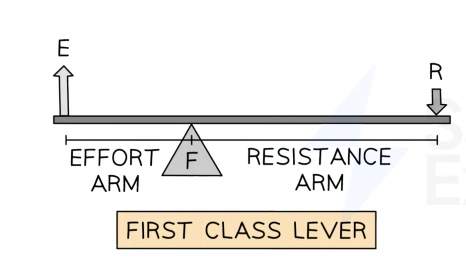
Mechanical advantage in first class levers
First class levers must have the fulcrum nearer to the load than the effort for it to have a mechanical advantage. The nearer it is, the greater the advantage
Mechanical advantage in second class levers
Second class levers have the best mechanical advantage as the effort is always further from the fulcrum than the load
This means they can move a heavy load with relatively small effort
E.g. at the ankle joint the effort of the gastrocnemius muscle can easily move and lift the large load of a persons body weight off the floor

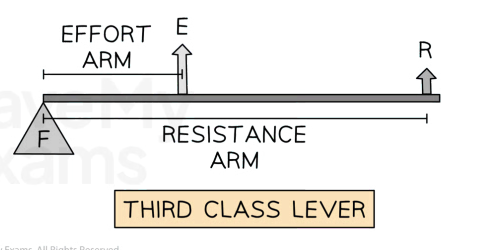
Mechanical advantage in third class levers
Third class levers are said to work at low mechanical advantage (less than 1 ) as the effort is always closer to the fulcrum than the load
This means it requires higher effort to move a load
Despite a mechanical disadvantage the shorter effort arm and longer load arm enables:
Faster movement
A wider range of movement
Light loads to move faster over greater distances
E.g. When swinging a baseball bat the shoulder or elbow acts as the fulcrum, with the hand applying force in the middle, while the bat (load) swings
Worked Example
The image below shows three different levers, labelled A, B and C.

Identify which of A, B or C represents a second class lever with the biggest mechanical advantage. Justify your answer
Answer: B shows a second class lever with the biggest mechanical advantage
Justification:
B is a second class lever as the resistance, or load, is located in the centre / between the fulcrum and the effort
B shows the biggest mechanical advantage because the length of the effort arm is the longest in relation to the length of the resistance arm
Examiner Tips and Tricks
You need to be able to label the effort arm and the resistance arm on lever drawings and determine the mechanical advantage of that lever

Unlock more, it's free!
Join the 100,000+ Students that ❤️ Save My Exams
the (exam) results speak for themselves:

Was this revision note helpful?