Factors Affecting Engagement Patterns (OCR GCSE Physical Education (PE)): Revision Note

Exam code: J587

Emma Mulhern

Written by: Emma Mulhern

Reviewed by: Ruth Brindle

Updated on

Factors affecting participation in physical activity & sport

  • Engagement patterns is a term used to describe the different rates of sports participation between different social groups

  • Different factors affect the levels of participation and engagement of different social groups in exercise and sport
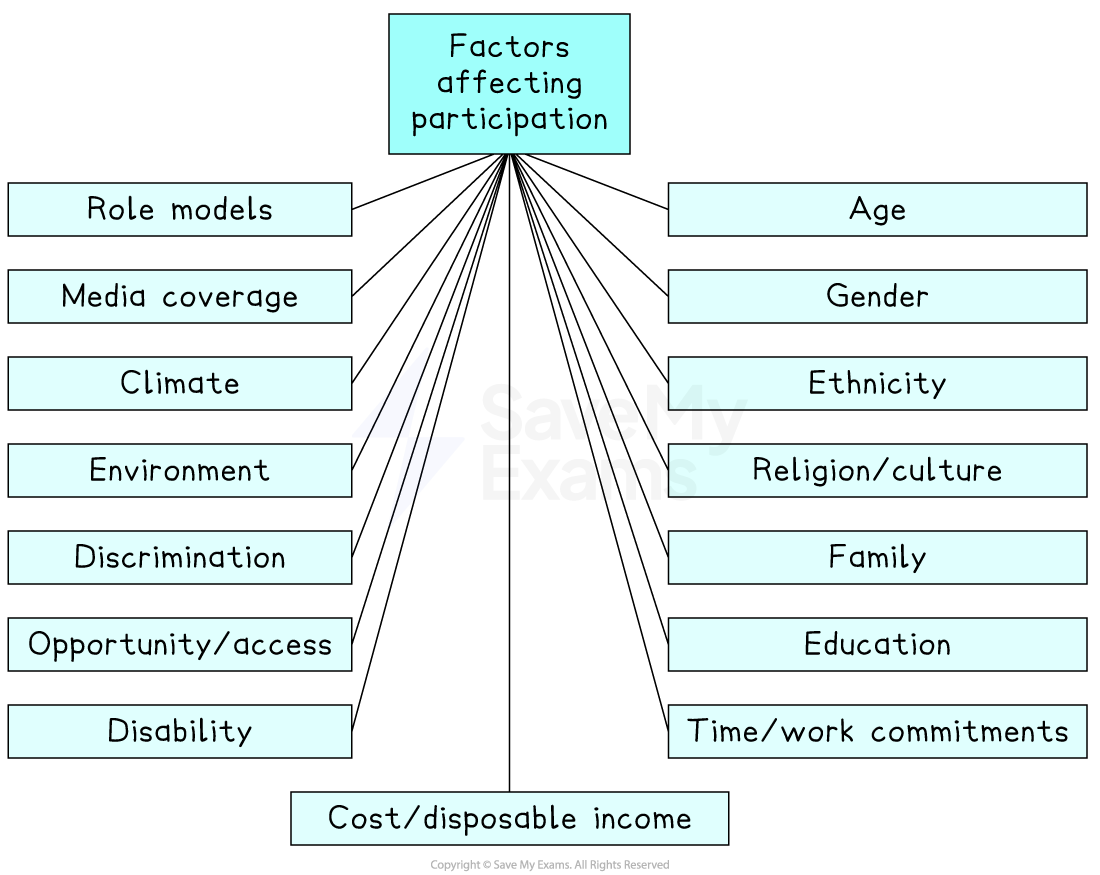
Diagram showing factors affecting participation, including age, gender, ethnicity, culture, family, education, income, time, disability, access, discrimination, environment, climate, media, and role models.
Different factors affect the levels of participation and engagement of different social groups in exercise and sport

Age

  • Age can be a factor that affects engagement patterns in sport

  • Typical trends show that younger people tend to partake in team sports whilst older generations partake more in individual sporting activities such as swimming or golf

  • Some of the factors that can affect participation are:

Factor

Affect on level of participation

Education

  • Young people's participation is usually high during curriculum time as physical education (PE) is compulsory

  • After leaving school, participation levels drop (post-school drop-out), especially in girls

  • Teacher preferences may mean that some sports are more familiar to young people than others; people are more likely to participate in familiar sports

Time/work commitments

  • Leisure time may be limited by work

  • More time during retirement

Family commitments

  • Working parent's have less time to families

  • Less time due to grandchildren

Cost/Disposable income

  • Financial commitments increase as people get older

Opportunity/Access

  • Elderly may need help with transport

  • Not all clubs and memberships are available to all ages

Media coverage

  • Coverage focuses on younger people

  • Encourages elderly to be spectators only

Role models

  • Fewer elderly role models

Discrimination

  • Stereotype that sports are for young people and you are too old if you are over a certain age

  • This impact confidence levels

Gender

  • Due to historical prejudices it's a well established fact that boys and men are more likely to participate in physical activities and sport than girls and women

  • Women were originally perceived as weaker and were excluded from many sports

    • For example The British Boxing Board of Control refused to issue licenses to women until 1998. Women’s boxing did not make its debut as an official, competitive sport until the 2012 London Olympic Games

  • Some of the factors that can affect participation are:

Factor

Affect on level of participation

Discrimination

  • Gender stereotyping still exists in sport -biological sex determines the activities they engage in, as well as how they are treated in these activities

  • Sexist or stereotypical attitudes may affect how comfortable women feel about taking part

  • Women’s sport is often sexualised by the media and public

  • They may also feel judged on how they look

Media coverage

  • Women’s sport has a lower status and receives less media coverage - judged to be 5% of male sports coverage

Role Models

  • There are fewer women athletes in the media therefore young performers may find it hard to find a female role model they can look up to

Opportunity/Access

  • Boys monopolise play and play aggressively – girls may prefer not to be involved

  • Most sports clubs now cater for both men and women, but some can still be largely male dominated, e.g. golf clubs

Family

  • Women with families may also find they have less time to dedicate to sports

Time/Work commitments

  • Less spare time due to childcare and domestic responsibilities

Education

  • Limited choices in PE and school sport

  • Children are often pushed into ‘gender-appropriate’ sports

Cost/Disposable income

  • Females tend to have less disposable income

  • Females receive lower levels of prize money and salaries

Ethnicity

  • An ethnic group is a social group that shares the same cultural traditions, religions and other factors

  • The UK has a wide variety of different ethnic minority groups who have different levels of participation in sport and physical activity

    • For example, over 50% of members of black and minority ethnic (BME) communities do no sport or physical activity

  • The reasons are caused by several influences - there is no one single reason

  • Some of the factors that can affect participation are:

Factor

Affect on level of participation

Religion and culture

  • Different cultures place different emphases on sport

  • Some ethnic groups have high regard for certain  sports, e.g. India and cricket, and this can influence participation in other sports

  • Certain religions require specific clothing that may make participation harder to achieve

  • Fasting during Ramadan may effect participation levels

Family

  • Some cultural groups and families may place greater emphasis on academic success over sport

Discrimination

  • Racism by other sportspeople or spectators can affect people’s decision to participate in a sport

  • Some religious discrimination may prevent performers from wearing a hijab, or finding swimming hats to accommodate natural black hair, for example

Role Models

  • Disproportionately fewer non-white role models in sports

  • Very few non-white role model in some sporting admin roles

Accessibility

  • Some people from ethnic minority groups may feel they ‘don’t belong’ in certain sports due to perceived prejudice

  • There are inequalities in all areas – leadership, management, coaching, officiating and volunteering

Cost/Disposable income

  • Economic deprivation that exists in some cultural groups may limit access to some sports, e.g.sports that are more expensive, such as skiing or horse riding

Disability

  • A person with some form of impairment, affecting ability to take part in an activity - about 1 in 6 of the population

  • Three main categories of disability:

    • mobility impairments

    • sensory impairments

    • mental impairments

  • Much lower participation of people with disabilities in sport than non-disabled people – all age groups

  • There is currently some disagreement about whether disabled participants should integrate into their sport alongside non-disabled participants, or whether it is better to have adapted sports for disabled sportspeople

    • Some new sports have been developed to allow for the integration of people of all abilities, such as boccia and goalball

  • Some of the factors that can affect participation are:

Factor

Affect on level of participation

Discrimination

  • Some performers may feel that there is a negative stereotype against those with a disability

Media coverage

  • Although there has been an increase in coverage since London 2012 Paralympic Games it is still a small fraction compared to that of mainstream sports

Role models

  • Due to a lack of media coverage there is alack of diverse role models to aspire to

Opportunity/Access

  • Lack of clubs and facilities in local areas

  • Lack of specialist and fully qualified coaches

  • Some facilities may not have suitable access for wheelchair users

Cost/Disposable income

  • Disability may impact ability to work full-time so less disposable income for participation in sport

  • Specialist equipment can be expensive

  • Transport to and from specialist facilities can be costly

Two runners take part in a race; one has running blades and the other does not

Integrated sports include both disabled and non-disabled participants competing and playing in the same events

Family

  • Influence of family and friends on participation can be both positive and negative

  • Some of the factors that can affect participation are:

Factor

Affect on level of participation

Time/Work commitments

  • When adults start a family, childcare or children’s activities often become a priority over their own exercise needs which reduces their time for exercise

  • Jobs often demand more time as people become more experienced or senior in their roles

  • Young people maybe need to look after younger siblings

Role models

  • Active parents are more likely to have active children

  • Children will often become interested in those sports that other family members participate in

  • Some cultural families may place greater emphasis on academic success over sport

  • If family members have a negative view of sports then this could be a barrier to participation

Education

  • Some families may not know what is available to them in their local area

Cost/Disposable income

  • Family income and affluence may influence which types of sports you can access

  • May not be able to provide financial support for equipment, kit and transport E.g. running is a free activity, but swimming often requires the money for swimming pool entry

Unlock more, it's free!

Join the 100,000+ Students that ❤️ Save My Exams

the (exam) results speak for themselves:

Emma Mulhern

Author: Emma Mulhern

Expertise: Content Writer

Emma is currently Head of Physical Education at her school, with over 14 years’ experience in education, specialising in GCSE and A-level teaching across multiple exam boards. Alongside her teaching, she has worked as an examiner at both GCSE and A-level, giving her a detailed understanding of assessment criteria and what students need to succeed. This insight enables her to support students in mastering key content and exam technique, helping them maximise their potential and achieve outstanding results.

Ruth Brindle

Reviewer: Ruth Brindle

Expertise: Biology Content Creator

Ruth graduated from Sheffield University with a degree in Biology and went on to teach Science in London whilst also completing an MA in innovation in Education. With 10 years of teaching experience across the 3 key science disciplines, Ruth decided to set up a tutoring business to support students in her local area. Ruth has worked with several exam boards and loves to use her experience to produce educational materials which make the mark schemes accessible to all students.