Muscles & Movement (OCR GCSE Physical Education (PE)): Revision Note
Exam code: J587

The roles of muscle in movement
At each joint, multiple different muscle groups work together to cause movement in two or more directions
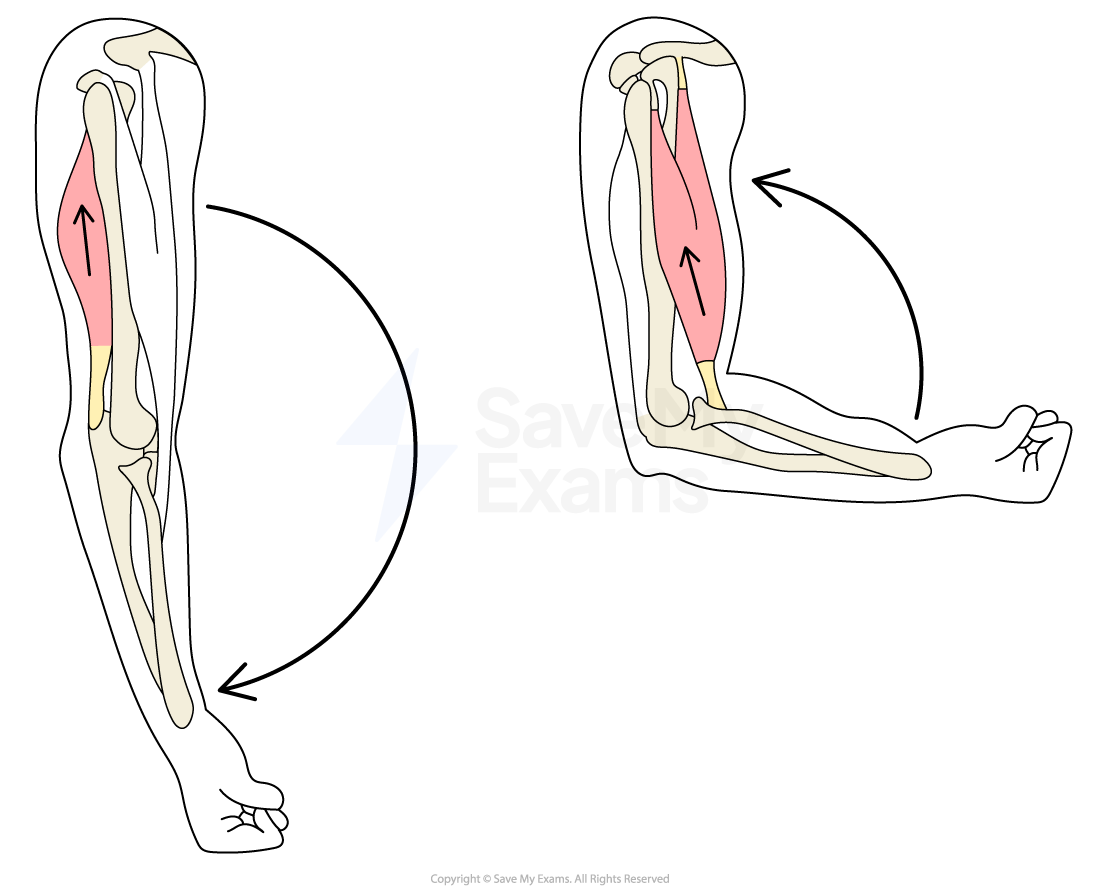
Muscles are attached to bones by tendons and when they contract, they move our bones by pulling on them
Muscles can only pull; they cannot push therefore the major muscles of the body work in antagonistic pairs
Agonist muscles contract and therefore shorten, pulling the bone at the joint and causing the movement, this can also be called the prime mover
Antagonist muscles relax during a movement and therefore lengthen
To allow antagonistic pairs to work efficiently, a fixator muscle assists by stabilising the joint, body part or limb to prevent unintended movements
The major muscles and muscle groups working together at each major joint are the:
Elbow: Biceps and triceps
Knee: Hamstrings and quadriceps
Shoulder: Latissimus dorsi and pectorals
Hip: Hip flexors and gluteals
Joint | Agonist muscle | Movements produced | Example of use during sport |
|---|---|---|---|
Elbow | Biceps | Flexion | Chest pass in netball |
Triceps | Extension | Releasing a javelin | |
Knee | Hamstrings | Flexion | Pulling leg back when preparing to kick a football |
Quadriceps | Extension | Execution phase of kicking a football | |
Shoulder | Deltoids | Abduction | Lifting arms during outwards phase of a star jump |
Pectorals | Adduction | During the release of a discus | |
Latissimus dorsi | Adduction | Bring the arms down towards the body during a star jump | |
Hip | Hip flexors | Flexion | Performing a tuck jump in gymnastics |
Gluteals | Extension | The rear leg during the drive phase when sprinting | |
Ankle | Tibialis anterior | Dorsi flexion | Knee-to-Wall Stretch |
Gastrocnemius | Plantar flexion | Swimming (flutter kick) |

Unlock more, it's free!
Join the 100,000+ Students that ❤️ Save My Exams
the (exam) results speak for themselves:

Was this revision note helpful?