Red Blood Cells (OCR GCSE Physical Education (PE)): Revision Note

Exam code: J587

Emma Mulhern

Written by: Emma Mulhern

Reviewed by: Ruth Brindle

Updated on

The role of red blood cells

  • The main function of blood is to transport nutrients and oxygen to the cells of the body

  • Blood consists of four main components:

    • red blood cells – these transport oxygen around the body

    • white blood cells - serve to fight infection

    • platelets - these clot to prevent blood loss during injury

    • plasma - contain nutrients essential for energy production
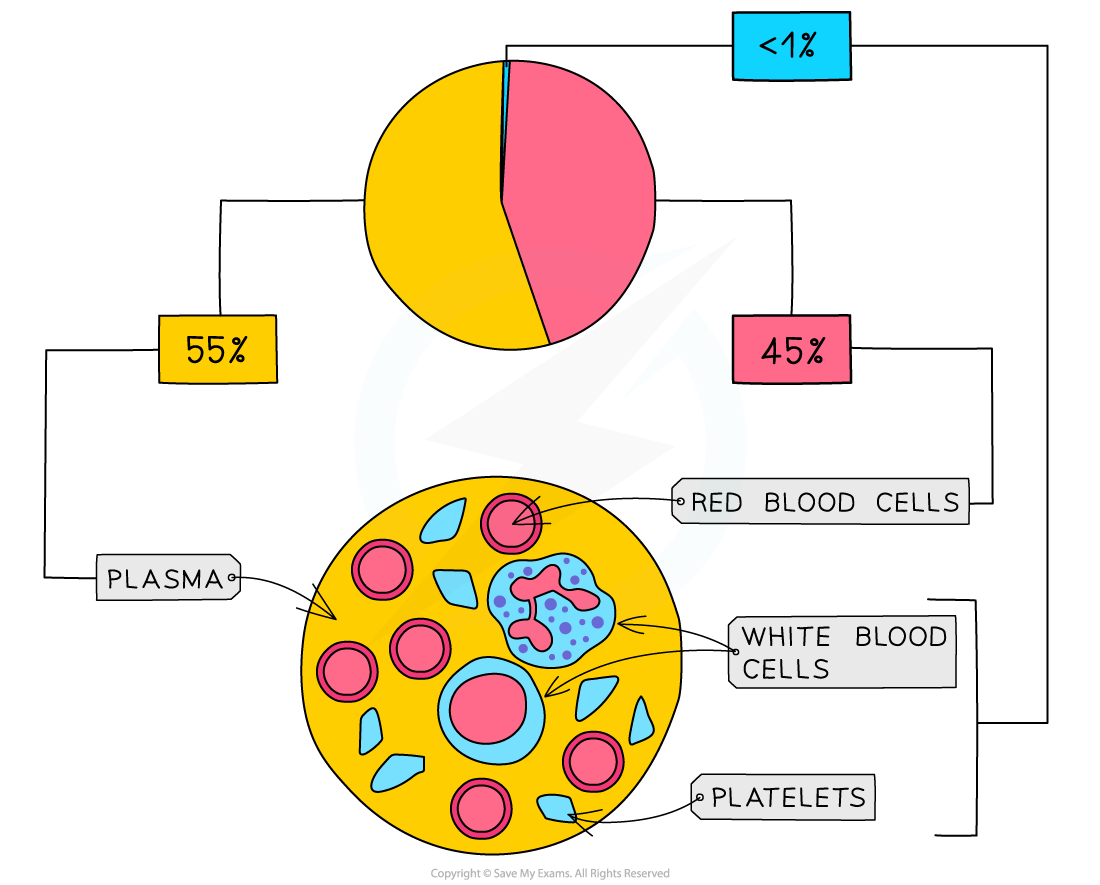
Pie chart of blood composition: 55% plasma, 45% red blood cells, and less than 1% platelets and white blood cells.
Components of the blood

Red blood cells

  • Red blood cells are disc-shaped cells with no nucleus

  • Their flattened shape gives a relatively large surface area which increases the speed of diffusion (gaseous exchange) as they pass through the lungs 

  • Red blood cells are very important for sport and physical activity because they contain haemoglobin  

    • After diffusing into the blood oxygen binds to haemoglobin within red blood cells to form oxyhaemoglobin: oxygen + haemoglobin→ oxyhaemoglobin 

      • Haemoglobin can also bind to carbon dioxide, aiding the transport of waste carbon dioxide (CO2) from the muscles back to the lungs where it can be exhaled 

  • Aerobic training increases the volume of red blood cells in the body

    • This means there is more haemoglobin and as a result the efficiency of oxygen transport for aerobic energy production increase
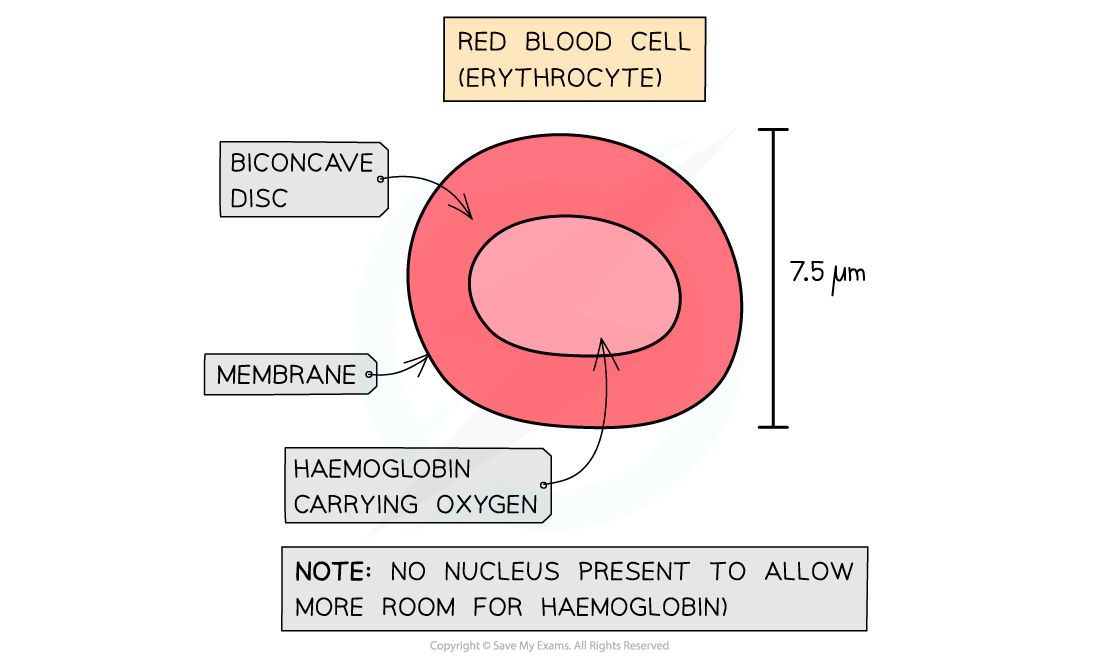
Diagram of a red blood cell, showing its biconcave disc shape, membrane, and haemoglobin content. Size indicated as 7.5 micrometres.
The structure of a red blood cell

Unlock more, it's free!

Join the 100,000+ Students that ❤️ Save My Exams

the (exam) results speak for themselves:

Emma Mulhern

Author: Emma Mulhern

Expertise: Content Writer

Emma is currently Head of Physical Education at her school, with over 14 years’ experience in education, specialising in GCSE and A-level teaching across multiple exam boards. Alongside her teaching, she has worked as an examiner at both GCSE and A-level, giving her a detailed understanding of assessment criteria and what students need to succeed. This insight enables her to support students in mastering key content and exam technique, helping them maximise their potential and achieve outstanding results.

Ruth Brindle

Reviewer: Ruth Brindle

Expertise: Biology Content Creator

Ruth graduated from Sheffield University with a degree in Biology and went on to teach Science in London whilst also completing an MA in innovation in Education. With 10 years of teaching experience across the 3 key science disciplines, Ruth decided to set up a tutoring business to support students in her local area. Ruth has worked with several exam boards and loves to use her experience to produce educational materials which make the mark schemes accessible to all students.