Data for Fitness Testing (OCR GCSE Physical Education (PE)): Revision Note
Exam code: J587

How data is collected for fitness testing
Fitness test scores are typically measured and recorded using specific units
This is known as quantitative data
involves numerical measurements or counts obtained
This includes objective data such as time taken to complete a task, distance covered, number of repetitions or level achieved in a test
Comparing Quantitative Data to National Averages:
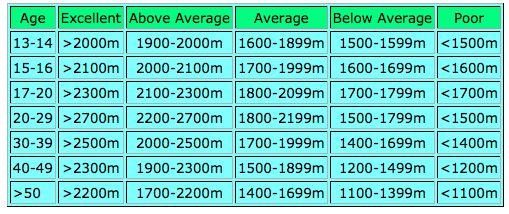
All the fitness tests provide quantitative data which can be compared to normative scores
These are indicators of how the participant has performed in comparison to the general population
This comparison allows performers to:
Assess performance: Evaluate an individual's performance relative to their peers or national standards
Identify strengths and weaknesses: Identify areas of strength and areas needing improvement based on benchmark data
Set goals: Establish realistic goals for improvement based on where an individual's performance falls in relation to national averages
Comparing fitness test scores to national averages provides valuable context and helps guide training programs
Participants can use the data collected in their fitness tests and evaluations to develop performance enhancement strategies and to set future goals
Elite athletes may find that normative comparisons are no longer relevant to their own progress as they are much beyond these levels
they will instead compare their fitness data to other athletes and specifically to their own previous fitness test performances
Example of Normative figures table for Cooper 12 minute run/walk test
Drawing conclusions to inform training requirements table
Name of test | Method of measurement | Drawing conclusions |
Cooper 12 minute run/walk test | Distance in metres or kilometres The quantitative score can provide a prediction of an individual’s VO2 max |
|
Multi-stage fitness test | Level and shuttle The quantitative score can provide a prediction of an individual’s VO2 max |
|
Press-up test | Number of press-ups |
|
Sit-up test | Number of sit-ups |
|
30m sprint test | Time taken in seconds |
|
Grip strength dynamometer test | Kg score on dynamometer |
|
1 Repetition Maximum (RM) | Kg lifted once |
|
Standing jump/Vertical jump Test | The observer records the quantitative score as the height jumped in cm. The score is compared to normative averages |
|
Sit and reach test | Centimetres (cm) |
|
Illinois agility test | Time taken in seconds |
|
Stork stand test | The time held in seconds |
|
Wall throw test | Number of catches |
|
Reaction time ruler test | Centimetres (cm) |
|
Worked Example
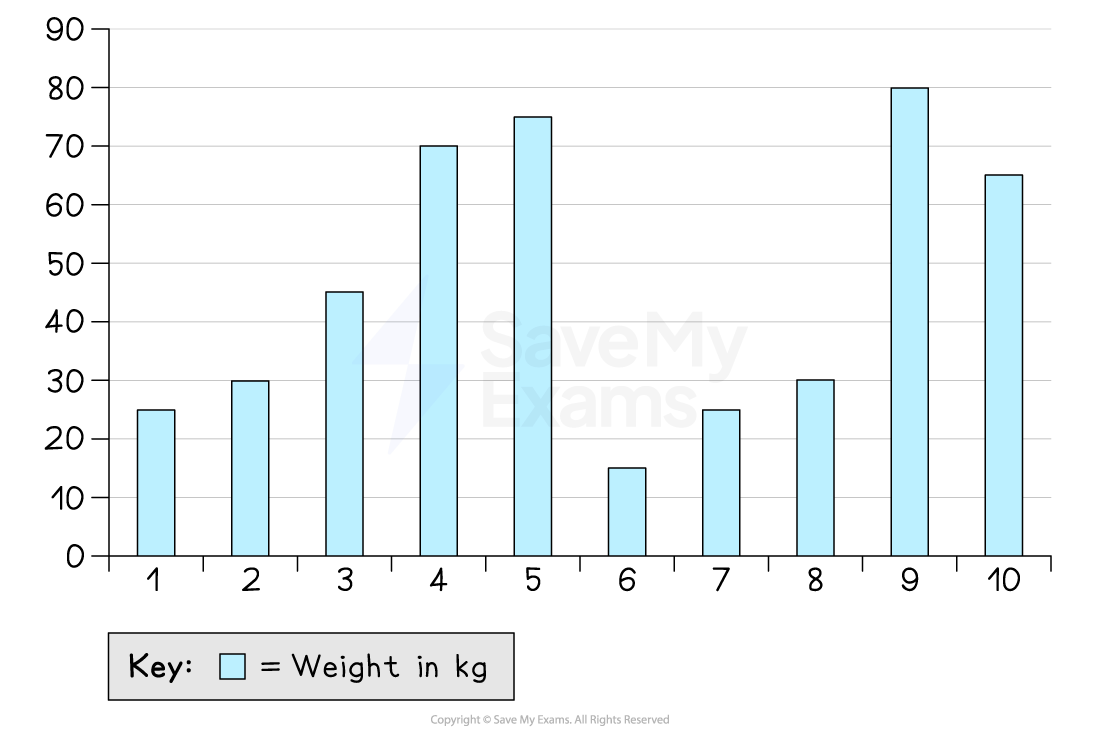
The data below show the results of 10 classmates who have completed a one rep max test.
Turn the data into a bar graph.
Classmate Number | |
|---|---|
1 | 25 kg |
2 | 30 kg |
3 | 45 kg |
4 | 70 kg |
5 | 75 kg |
6 | 15 kg |
7 | 25 kg |
8 | 30 kg |
9 | 80 kg |
10 | 65 kg |
Worked Example
Table 1 shows the results of the Stork stand balance test in participants of different ages.
Age | Balance time (seconds) |
20-29 | 42 |
30-39 | 42 |
40-49 | 40 |
50-59 | 37 |
60-69 | 28 |
70-79 | 13 |
Describe the relationship between age and balance time (2 marks)
As age increases, balance time decreases (1 mark)
Between the ages of 20-39 there is no change in balance time (1 mark)

Unlock more, it's free!
Join the 100,000+ Students that ❤️ Save My Exams
the (exam) results speak for themselves:

Was this revision note helpful?