The Components of Fitness (OCR GCSE Physical Education (PE)): Revision Note
Exam code: J587

Cardiovascular stamina, muscular endurance, speed & strength
Fitness can be broken down into different components or parts
To be successful in any sport, a performer needs to work very hard at improving certain components of their fitness
This will depend on the types of movement required
For example, a rugby player will need to focus on speed and agility in order to be able to dodge around players on the field whereas a gymnast will need to develop their flexibility and power in order to do complex tumble moves during a floor routine
There are many different components of fitness that a performer can develop and improve through training
Fitness testing is an essential feature of all fitness training to assess which components are well developed and which ones need further improvement
It will be used before training begins, during the training programme and again at the end of the training programme
Cardiovascular endurance (stamina)
This is the ability to continue exertion while getting energy from the aerobic system used to supply the body with energy
This is particularly important in events which require endurance or stamina
For example it is needed for long distance runners and triathlon, playing a whole football or rugby match all need good cardio to be able to supply enough oxygenated blood to the working muscles for a prolonged period of time
It can be measured using the:
Cooper 12 minute run
multi-stage fitness test
Cooper 12 minute run
The testing protocol is as follows:
Equipment required:
A flat, measured track (400m track preferred)
A timing device e.g. stopwatch or smart watch
Procedure:
Participants aim to cover as much distance as possible in 12 minutes
You can slow down, walk, or stop if needed—but the goal is maximum distance
Record the total distance covered in in metres or kilometers and compared with national averages
Expected performance is based on gender and age
Multi-stage fitness test
Often referred to as the 'bleep' or 'beep' test
The testing protocol is as follows:
Equipment required:
A flat running surface, cones, an assistant and a measuring tape of at least 20m in length are required to set up the test
An audio recording of the multi-stage fitness test is also required at the start
Procedure:
Start running when you hear the initial bleep from the audio recording
You must run 20 metres to reach the other cone before the next bleep sounds
The time interval between bleeps gets progressively shorter, requiring faster shuttle runs between the cones
Failure to reach the cone before the bleep twice in a row ends the test, and the last properly completed level should be recorded
The score is recorded as a level and bleep number, for example level 6, beep 3
The score can be used to predict the aerobic capacity, or VO2 max

Muscular endurance
The ability to move your body and muscles repeatedly without fatiguing
This component of fitness is closely linked to dynamic strength
Exercises like push-ups, sit-ups, or high-repetition weightlifting improves muscular endurance
Specific sporting examples include a long distance track cyclist where their quadriceps are continuously contracting to push the bike forwards or a rower repeatedly pulling their oar against the water to propel the boat towards the line
There are two suitable tests for this component:
press-up test
sit-up test
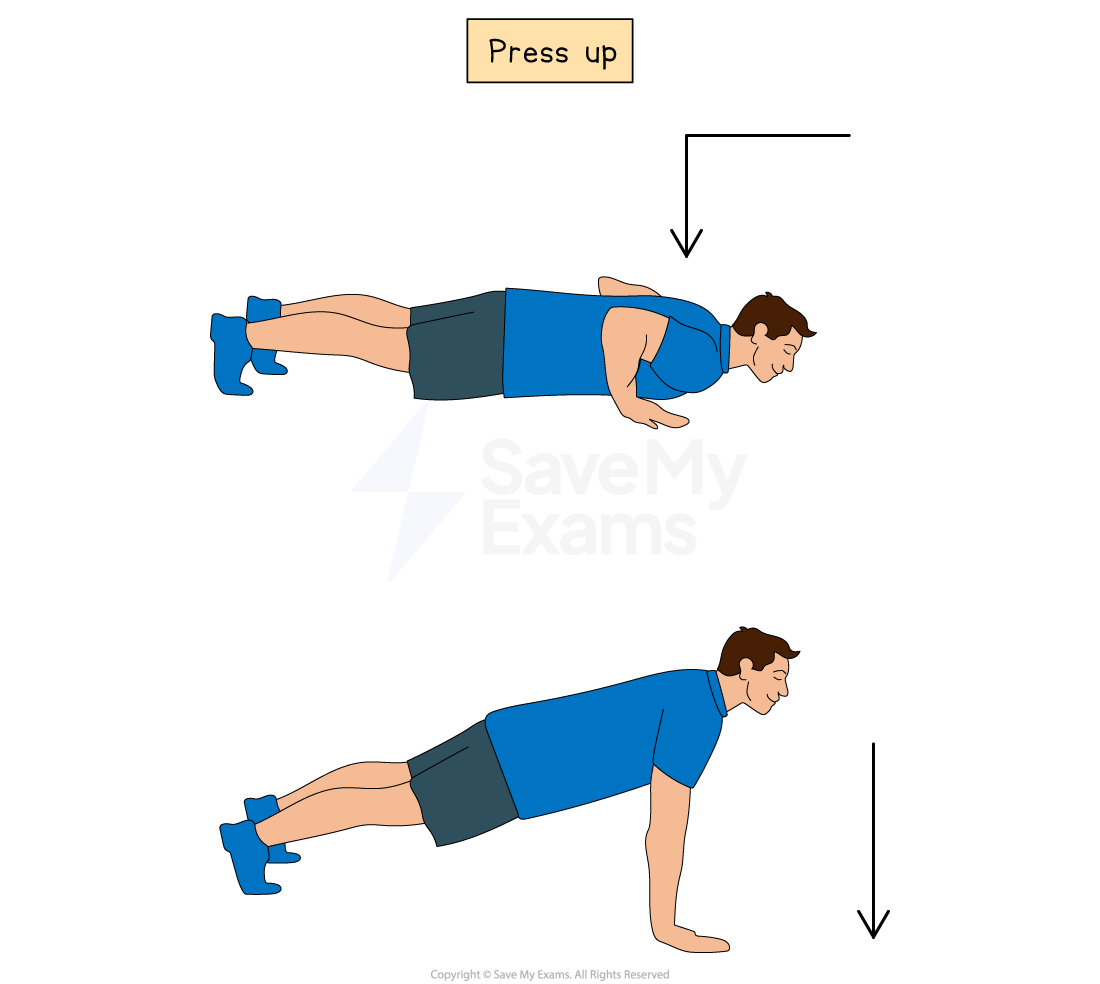
Press-up test
Measures the muscular endurance of the chest and shoulder muscles
Equipment required:
a flat area and a stopwatch
Procedure:
Using the correct technique, participants start with their arms extended
Perform as many press-ups in one minute as they can
Resting is permitted only in the raised position
The score is recorded and performance is measured according to age and gender
Sit-up test
Also known as the abdominal curl conditioning test
The testing protocol is as follows:
Equipment required:
Standardised audio recording of progressively faster bleeps
An assistant to support the ankles
Procedure:
Lie down on the back with knees bent, feet flat on the floor, and hands crossed over the chest or behind the head
When ready, start the timer and initiate the test by performing a sit-up
The aim is to complete one full sit-up (raising the upper body) every time a bleep is heard
Lower your upper body back down to the starting position before the next bleep
As a maximal test, the sit ups continue until the participant can no longer keep time with the bleeps
A score is recorded as the number of sit-ups completed before the participant can no longer keep up with the bleep

Speed
Speed refers to the ability to move quickly across the ground or move limbs rapidly through movements
It is calculated as distance divided by time
Lots of sports require whole body speed and/or speed in body parts or limbs in order to perform them effectively
For example leg speed in sprinting and speed skating, arm speed in boxing and whole body speed in racquet sports such as badminton when a player has to move forward quickly from the back alley to reach a drop shot close to the net
A suitable test for this component is the 30 metre sprint test
30 metre sprint test
This fitness test measures speed
The testing protocol is as follows:
Equipment required:
Two cones, a tape measure, a stopwatch and an assistant
The cones need to be measured out at a distance of 30 metres apart and placed on a flat running surface
Procedure:
Procedure:
Allow a static start to the sprint
Start the stopwatch or timing device as soon as the participant passes the start line
The participant sprints as fast as possible along the 30-metre distance
Stop the stopwatch or timing device as soon as the participant crosses the finish line
Record the time in seconds (s)

Strength
This is the maximum force a muscle/group of muscles can apply against a resistance
Many physical activities require strength for example:
A weightlifter performing a clean and jerk; putting the shot; a boxer punching a right hook; a rugby player in a scrum pushing against the opposition pack
There are two suitable tests for this component:
grip strength dynamometer test
1 Repetition Maximum (RM)
Handgrip dynamometer test
The testing protocol is as follows:
Equipment required:
A handgrip dynamometre set up for the individual's hand size
Procedure:
Hold the handgrip dynamometer in the dominant hand keeping the elbow at 90 degrees
Squeeze the handgrip dynamometer with maximum effort for a few seconds (usually 3-5 seconds)
Record the grip strength measurement in kilograms (kg)
Repeat the test two more times with adequate rest (about 1-2 minutes) between each attempt to reduce the effects of fatigue and obtain a reliable average score

One rep max test
This test can be carried out using a range of different types of exercise e.g. bench press, leg press or deadlift
The testing protocol is as follows:
Equipment required:
Free weights or machine weights alongside a spotter to help the performer during the test
Procedure:
To begin load the barbell or weight machine with a realistic weight and practices the bench press movement
Lift the weight for one repetition with maximum effort, maintaining proper form throughout the movement
If successful, rest for 2-3 minutes and then increase the weight for the next attempt
Continue increasing the weight gradually with each attempt until the participant can no longer lift one rep using the proper technique
This final result is the performer's One Rep Max (1 RM) and is measured in kilograms


Unlock more, it's free!
Join the 100,000+ Students that ❤️ Save My Exams
the (exam) results speak for themselves:

Was this revision note helpful?