The Major Muscle Groups (OCR GCSE Physical Education (PE)): Revision Note
Exam code: J587

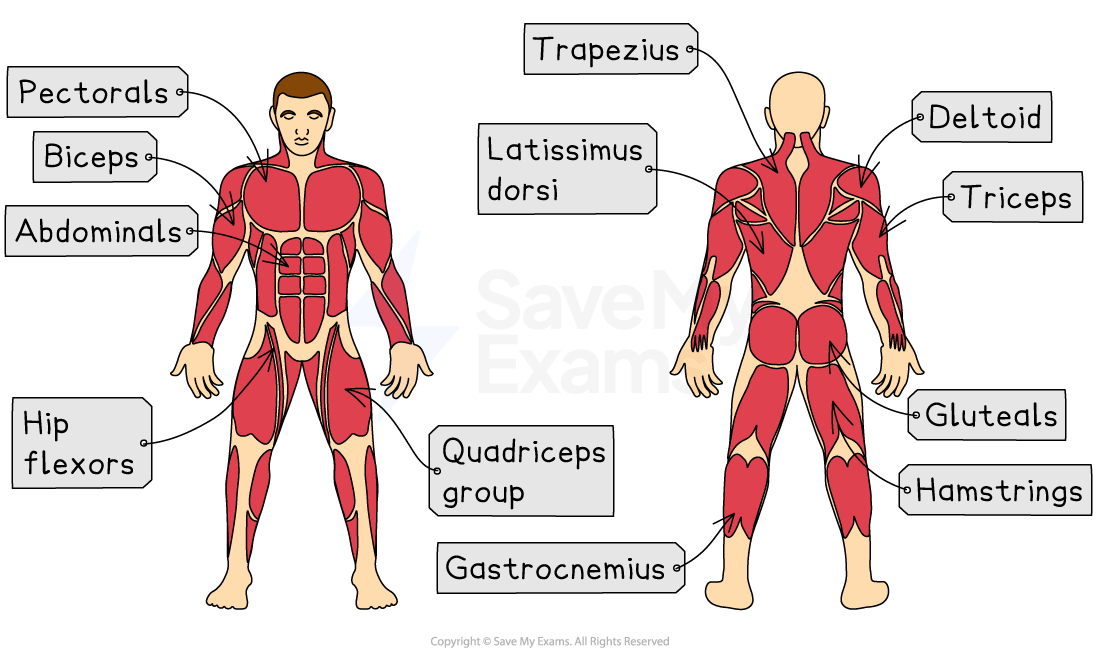
Location of major muscle groups
Our bodies are made up of bones, muscles, connective tissue, organs, and fatty tissue
Muscles attach to the skeleton and help to create movement by generating a force when contracting
This force is transferred to the bone by the tendons and causes the bone to move to a different position
Muscle Group | Function | Sporting example |
Deltoid | Flexion, extension and abduction of the shoulder (Lifting the arm at the shoulder both out to the side and upwards) | Holding crucifix position on the rings in gymnastics; lifting the arms to block in volleyball |
Trapezius | Abduction of the shoulder in a horizontal plane (moving the arms out from the chest) | Bringing the arm back during the preparation phase of a discus throw |
Latissimus dorsi | Adduction of the shoulder (moving the arm down towards the mid-line of the body) | Pulling the arms back toward the body during the breast stroke in swimming |
Pectorals | Adduction and flexion of the shoulder in a horizontal plane (moving the arms forwards in front of the body) | A rugby player making a tackle |
Biceps | Flexion of the arm at the elbow (bending the arm) | Upwards phase of a biceps curl |
Triceps | Extension of the arm at the elbow (straightening the arm) | Follow through when throwing a dart |
Abdominals | Flexion of the vertebral column (bending forwards at the hip) | Performing a sit up or a forward roll |
Quadriceps | Extension of the leg at the knee (straightening the leg) | Execution phase of kicking a football; upward phase of a squat |
Hamstrings | Flexion of the leg at the knee (bending the lower leg back towards the hip) | Preparation phase of kicking a football; downward phase of a squat |
Gluteals | Extension and adduction of the hip (moving the femur backwards) | Pulling leg back at the hip during the drive phase when running |
Gastrocnemius | Plantar flexion of the ankle (pointing the toes downwards) | Pushing off the floor during the take off phase of a lay-up in basketball |
Examiner Tips and Tricks
All of these muscle examples are listed in your specification so you may be asked to label them on a diagram in an exam. Although many muscles have abbreviated terms stick to the technical terminology to gain full marks – for example, quadriceps not ‘quads’, abdominals not ‘abs’ and pectorals not ‘pecs’

Unlock more, it's free!
Join the 100,000+ Students that ❤️ Save My Exams
the (exam) results speak for themselves:

Was this revision note helpful?