Planes of Movement & Axes of Rotation (OCR GCSE Physical Education (PE)): Revision Note
Exam code: J587

Planes of movement & axes of rotation
There are three planes and three axes of movement used whilst performing sporting actions
A plane of movement is an imaginary flat surface across which the body moves in an action
An axis of movement is an imaginary line through the body, about which the body rotates
Planes of movement
Movements are parallel to the plane in which they take place
Body parts can move on one of three different planes:
Frontal plane:
a vertical place that divides the body into front and back
Abduction and adduction movements occur in this plane
E.g. cartwheel, jumping jacks, reaching out to the side to receive a netball pass
Transverse plane:
a horizontal plane that divides the body into top half and bottom half
Rotation types of movement occur in this plane
E.g. twisting in a discus throw, pivoting in netball, spinning in ice skating or ballet
Sagittal plane:
a vertical plane that divides the body into right and left sides
Flexion and extension types of movement occur in this plane
E.g. running, jumping, squatting, kicking a football, throwing a shot put
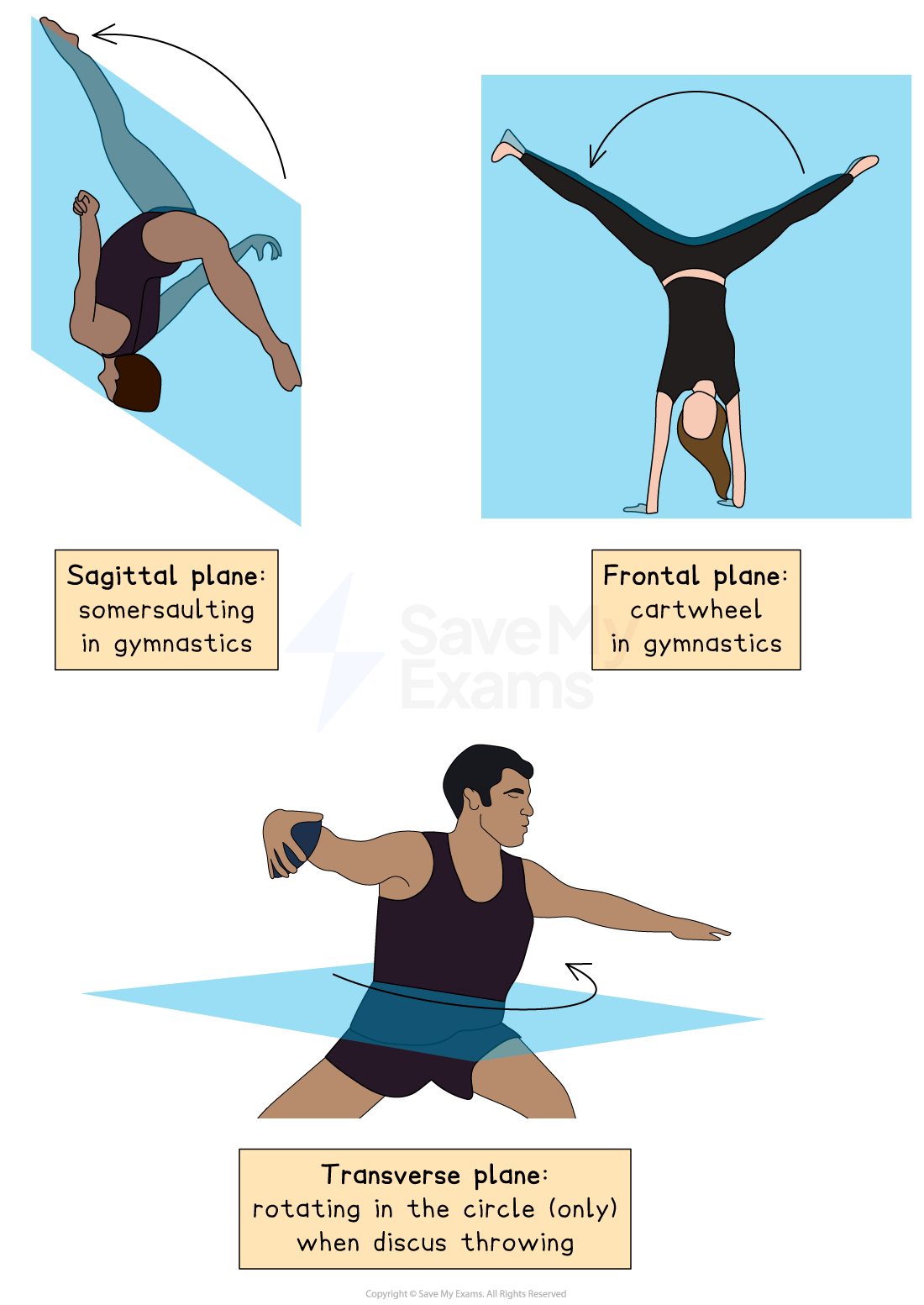
Body parts can move on one of three different planes
Axes of rotation
There are three axes of rotation:
Frontal axis:
The axis is a horizontal line that passes through the body from front to back
Movements in a frontal plane take place around this frontal axis
E.g. a gymnast performing a cartwheel
Transverse axis:
The axis is a horizontal line that passes through the body from side to side
Movements in a sagittal plane take place around a transverse axis
E.g. a front somersault in trampolining
Longitudinal axis:
The axis is a vertical line that passes through the body from top to bottom
Movements in a transverse plane take place around a longitudinal axis
E.g. an ice skater performing a full 360-degree twist
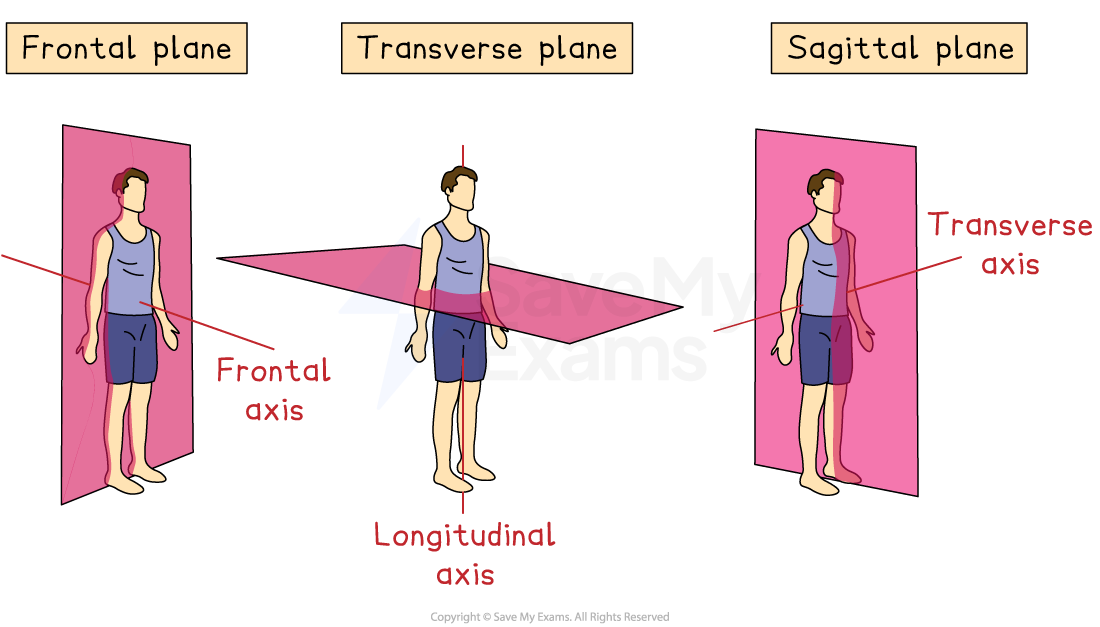
Plane | Axis | Movement type | Direction of movement | Sporting action |
|---|---|---|---|---|
Frontal | Frontal | Abduction, adduction | Side to side | Cartwheel, jumping jacks |
Transverse | Longitudinal | Rotation | Turning | Pivoting in basketball, discus throw, pirouette in dance |
Sagittal | Transverse | Flexion, extension | Forward or backward | Running, forward somersault |
Examiner Tips and Tricks
Movements occur in a plane and around an axis, so the plane and the axis for a movement should be revised together as pairs and you must be able to apply this knowledge to sporting examples

Unlock more, it's free!
Join the 100,000+ Students that ❤️ Save My Exams
the (exam) results speak for themselves:

Was this revision note helpful?