Khrushchev & Peaceful Co-existence (Edexcel IGCSE History: Paper 1: Depth Studies): Revision Note
Exam code: 4HI1

Summary
After Stalin died in 1953, a power struggle in the Soviet Union ended with Nikita Khrushchev emerging as leader by 1956
Khrushchev criticised Stalin's harsh rule in a 'secret speech' to Communist Party leaders and suggested the Soviet Union could pursue peaceful co-existence with the West
This meant living side by side in peace rather than open conflict
This process, known as de-Stalinisation, encouraged people across the Soviet satellite states to push for more freedom
Hungary had suffered under the harsh rule of Matyas Rakosi
In October 1956, Khrushchev allowed the reformer Imre Nagy to take over
Nagy then went further than Khrushchev had expected, proposing that Hungary leave the Warsaw Pact altogether
De-Stalinisation therefore created a real dilemma for Khrushchev
He wanted to encourage just enough change to keep the satellite states stable, without letting any of them break away from Soviet control
Khrushchev and peaceful co-existence
New leaders
From 1953, both the USA and the Soviet Union had new leaders
The USA
Dwight Eisenhower was elected president of the USA in 1952 and took office in January 1953
His election campaign had focused on defeating Communism
Both he and his secretary of state, John Foster Dulles, were strongly anti-Communist
Eisenhower was determined to block any attempt at Communist expansion
However, he was also aware of the dangers created by nuclear weapons
He was willing to listen to Soviet proposals for negotiation
The Soviet Union
The Soviet Union's dictator Joseph Stalin died on 5 March 1953
Stalin's death triggered a three-year power struggle between various politicians in the Soviet Union
It was not until 1956 that Nikita Khrushchev emerged as the effective leader of the country
Khrushchev's new approach
Khrushchev's actions indicated that the Soviet Union wanted to improve relations with the West
The two powers met at the Geneva Summit in 1955
The USA, the Soviet Union, Britain and France met to discuss:
Germany
Disarmament
European security
The superpowers failed to agree on the issues of disarmament and what should happen to Germany
However, the atmosphere was positive and collaborative between the USA and the Soviet Union
To the world, Khrushchev marked a change in the leadership style of the Soviet Union
At the 20th Party Congress in 1956, Khrushchev denounced Stalin's leadership
The three-hour "Secret Speech" accused Stalin of abusing his power
Khrushchev stated the need for "peaceful co-existence" with the West
Khrushchev began a process called "de-Stalinisation"
He released a large number of political prisoners
He lifted some censorship of information
He increased the number of consumer goods in the Soviet Union
Examiner Tips and Tricks
Do not take peaceful co-existence to mean the end of the Cold War. Khrushchev still believed Communism would eventually triumph. Peaceful co-existence meant competing without fighting directly, not giving up the ideological rivalry.
Issues with peaceful co-existence
The improvement in relations was short-lived
In May 1955, West Germany joined NATO
This alarmed the Soviet Union and led directly to the formation of the Warsaw Pact
Khrushchev's own criticism of Stalin encouraged satellite states to push for more independence
This created new tensions within the Eastern Bloc
The Soviet invasion of Hungary in November 1956 showed the limits of peaceful co-existence and ended hopes of better relations
The impact of Soviet rule on Hungary: Rakosi and de-Stalinisation
Hungary under Rakosi
Since 1945, when the Red Army freed Hungary from German occupation, Hungary had been under strict Soviet control
Non-Communist political parties were banned
Key officials in the government, police and army were chosen by Stalin
The leader of the Hungarian Communist Party, Matyas Rakosi, was a firm supporter of Stalin and dealt harshly with opponents of Communist rule
Between 1949 and 1956:
Around 200,000 Hungarians were sent to prison
More than 2,000 were executed
Living standards fell
Hungarian food, coal and oil were sent to the Soviet Union
Industry made heavy goods rather than consumer goods
Russian was compulsory in schools
The government persecuted the Catholic Church
Rakosi's secret police, the AVH, terrorised opponents
How de-Stalinisation reached Hungary
After the Secret Speech, Khrushchev removed Rakosi in July 1956, but replaced him with another hardliner, Erno Gero, which angered reformers
In Poland, the new leader, Wladyslaw Gomulka, introduced a series of moderate reforms
This encouraged Hungarians to push for changes of their own
In October 1956, there were violent protests in Hungary's capital, Budapest
Hungarian students led a peaceful demonstration asking for more political and personal freedom
Hungary's secret police arrested protestors and used tear gas to end the march
When the students attempted to free the arrested, the police shot at the protestors
Soldiers joined the student protestors
The Hungarian Communist government requested military support from the Soviet Union
Khrushchev sent the Red Army into Hungary to restore order
To restore order, Khrushchev agreed to make Imre Nagy prime minister
Nagy was:
a former prime minister who had been expelled from the Communist Party after arguing with Rakosi
a Communist, but he believed that there could be more personal freedom within a Communist system
What reforms did Nagy propose for Hungary?
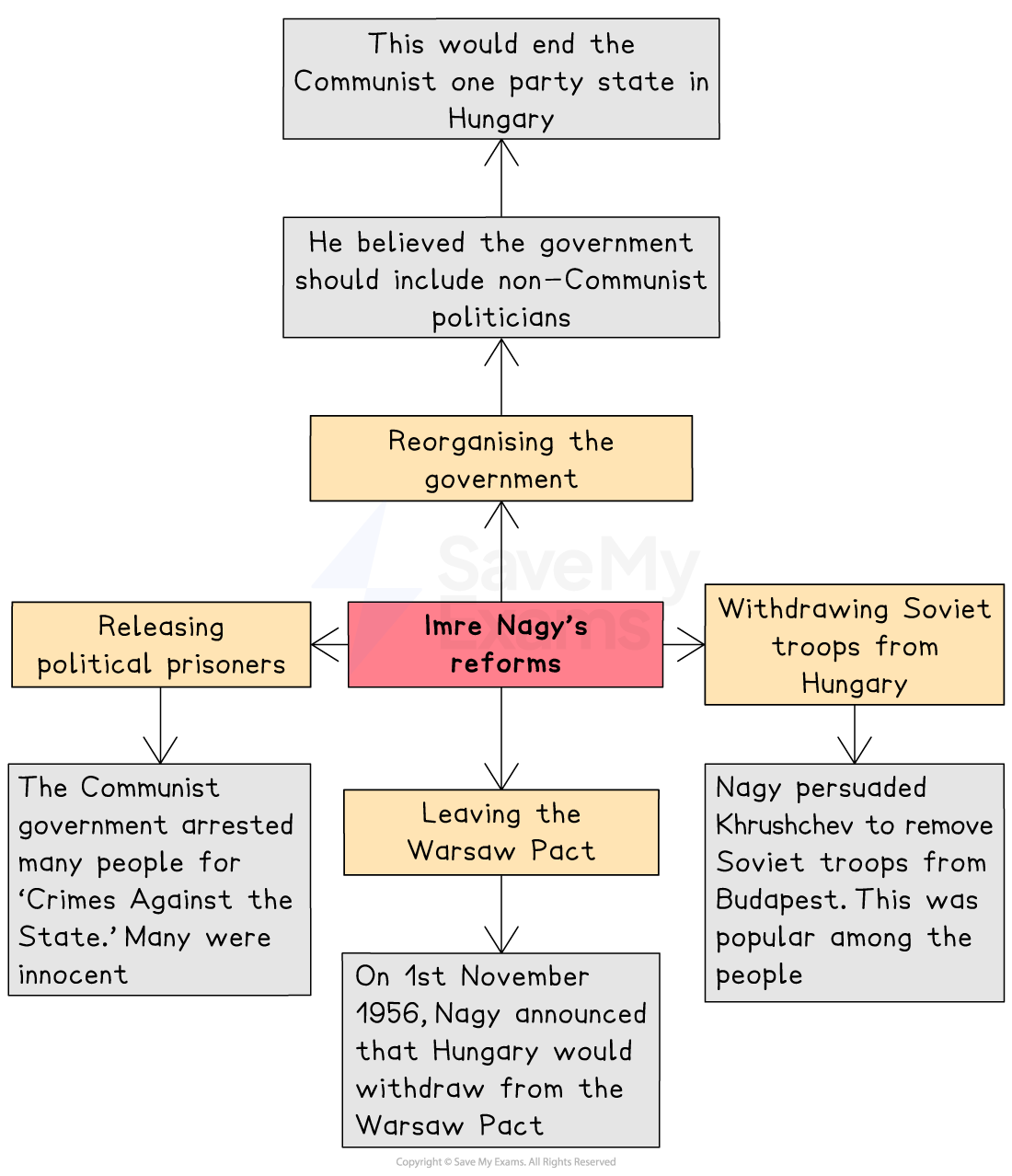
Nagy and many of his supporters believed that Khrushchev's criticism of Stalin would lead to a genuinely "softer" Soviet approach towards the satellite states
Khrushchev's reaction would prove them wrong
How far did de-Stalinisation threaten Soviet control of Eastern Europe?
Evidence that it was a serious threat
De-Stalinisation directly encouraged protest movements in Hungary and Poland
This increased the danger that unrest could spread across the whole Eastern Bloc at once
Within months of the Secret Speech, de-Stalinisation had led to Rakosi's removal and then Nagy's return as prime minister
If Hungary had been allowed to leave the Warsaw Pact successfully, it would have shown every other satellite state that Soviet control could be broken
This could have unravelled the whole Eastern Bloc
Evidence that Soviet control was not seriously threatened
In Poland, the threat was managed peacefully
Gomulka remained totally loyal to the Warsaw Pact and to Communism
The Red Army did not need to invade
Khrushchev kept control of the process throughout
He chose to send the Red Army into Hungary in October, and he chose to withdraw it once Nagy was in place
De-Stalinisation was always meant to be limited
Khrushchev criticised Stalin's methods, not Communism itself or Soviet control of Eastern Europe
A degree of satellite-state unrest was a cost he may have been willing to accept, as long as it stayed within bounds
Conclusions
De-Stalinisation threatened Soviet control more seriously than Khrushchev had expected
It is very difficult to control exactly how far a demand for change will go once it has started
The crisis over Hungary became so much more serious than the crisis over Poland
Even though both began with the same cause of de-Stalinisation, Nagy's proposals, especially leaving the Warsaw Pact, went too far
Worked Example
Explain two effects of Khrushchev's policy of peaceful co-existence
(8)
Partial answer:
One effect of peaceful co-existence was that it led to a process of de-Stalinisation across the Soviet Union's satellite states. Khrushchev's 1956 speech to the Communist Party Congress publicly criticised Stalin's use of terror and repression, which gave the leaders of satellite states room to relax some of Stalin's harshest controls without appearing to abandon Communism itself. As a result, Eastern European governments that had ruled largely through fear now had official Soviet permission, for the first time since 1945, to loosen their grip without being accused of betraying Communism.
Examiner Tips and Tricks
An answer that deals with only one effect is capped at 4 marks.
A strong approach to this question would be one positive effect of peaceful co-existence and one negative effect. However, you would be credited for either two positive, or two negative, effects.
Support each effect with a precise detail, such as Khrushchev's 1956 Secret Speech, and then trace it forward to an outcome.

Unlock more, it's free!
Join the 100,000+ Students that ❤️ Save My Exams
the (exam) results speak for themselves:

Was this revision note helpful?