Hitler & the Early Nazi Party, 1919–23 (Edexcel IGCSE History: Paper 1: Depth Studies): Revision Note
Exam code: 4HI1

Timeline & Summary
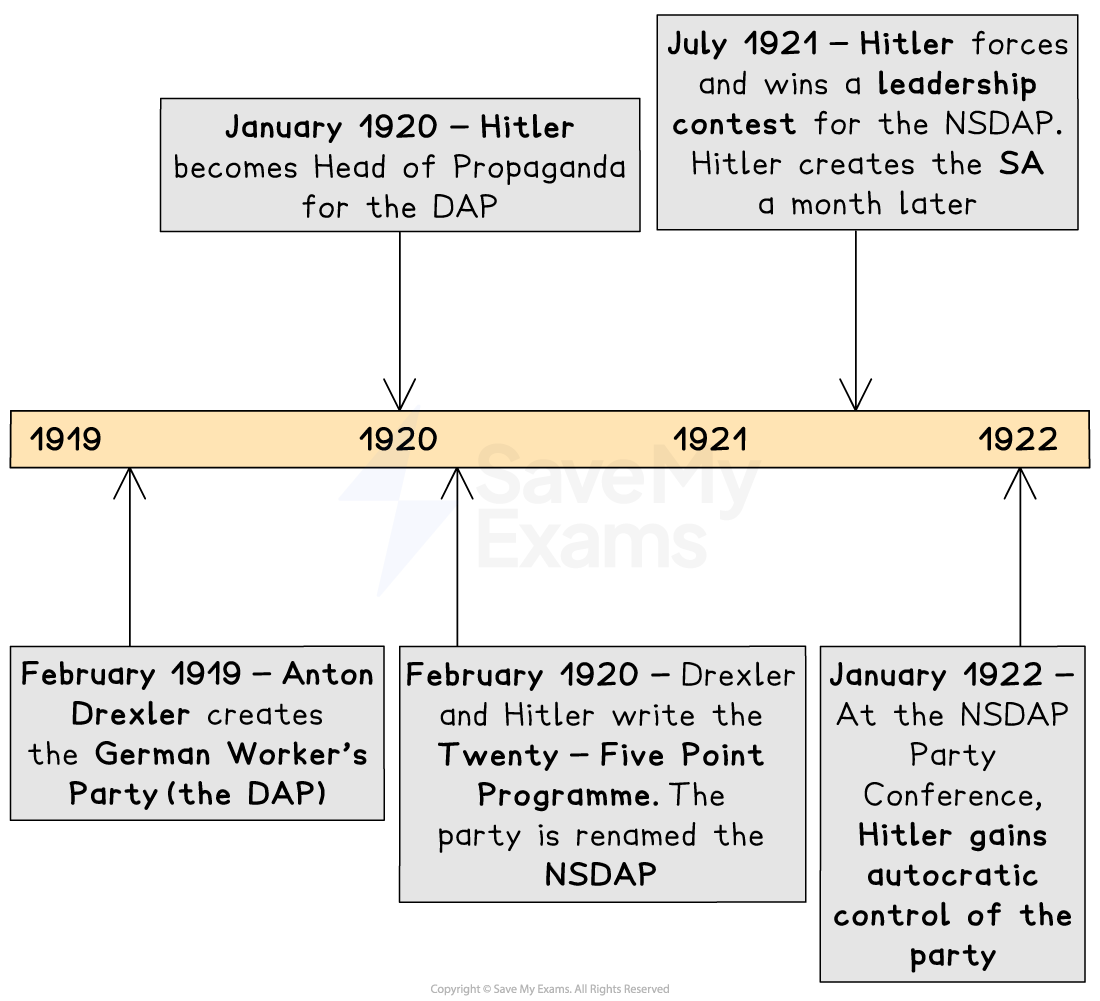
After the First World War, Adolf Hitler, a decorated but angry soldier, joined the tiny German Workers' Party (the DAP) in September 1919
The party was renamed the National Socialist German Workers' Party (the NSDAP), or Nazi Party
The party set out its aims in the Twenty-Five Point Programme of 1920
Hitler's talent for propaganda and public speaking helped him become the party's leader by 1921
Hitler created a paramilitary force, the SA, to protect its meetings and intimidate its opponents
By 1923, the party had grown from a few dozen members to around 20,000
It remained just one of many small extremist groups in Germany, based mainly in Bavaria
Hitler and the German Workers' Party (DAP)
From soldier to spy
Hitler joined the army and served as a soldier on the Western Front in France
He was promoted to corporal and awarded the Iron Cross for bravery
Like many other German soldiers, Hitler could not believe the news that Germany had lost the war
Post-war Munich and the DAP
After the war, lots of extremist political groups formed
From 1919, Hitler worked for the army monitoring the activities of these groups in Munich
One of the groups he was sent to observe was the German Workers' Party (the DAP)
Anton Drexler had founded it in January 1919
It was a right-wing party that targeted the working classes
It had only a few dozen members at the time
Hitler attended the party's meetings to gather information, but over time he came to realise that he agreed with its views
Hitler joined the German Workers' Party in September 1919
What the DAP believed
The party's core beliefs were that:
democracy was weak, and Germany needed a powerful leader to rebuild its strength
Jewish people were to blame for making Germany weak
Communists and Socialists had caused the fall of the Kaiser
the socialist Weimar politicians had betrayed Germany by signing the Treaty of Versailles
Examiner Tips and Tricks
Learn these four beliefs precisely, because they are the seeds of everything you will study later in the course.
You will meet the same ideas again, developed much further, in Hitler's book Mein Kampf and in Nazi policy after 1933.
Being able to trace an idea back to this founding moment is a strong way to show depth of knowledge
Changes to the Party, 1920–22

Propaganda chief
In January 1920, Drexler put Hitler in charge of propaganda for the German Workers' Party
A new name and new aims
In the same year, adopted new aims in the Twenty-Five Point Programme
The party was renamed the National Socialist German Workers' Party, or NSDAP, better known as the Nazi Party
Hitler becomes leader
By 1921, Hitler had ousted Drexler and become the party's undisputed leader
The party's aims were kept deliberately vague, so that they would appeal to many different groups in Germany:
nationalists were attracted by the promise to destroy the Treaty of Versailles
people looking for someone to blame for Germany's problems and defeat were attracted by the party's anti-Semitism
the middle classes and big businesses were attracted by Hitler's anti-communist ideas
Hitler's growing role
Hitler was a talented speaker and attracted many new members to the party
He surrounded himself with loyal supporters, including Ernst Röhm, Hermann Goering and Rudolf Hess
He also built a friendship with General Ludendorff, Germany's former army commander in the First World War
This gave the party valuable respectability
By the end of 1920, party membership had increased to around 1,100
The party could afford to buy its own newspaper, the Völkischer Beobachter (the People's Observer)
The Twenty-Five Point Programme and the role of the SA
Key demands of the programme
In February 1920, Hitler and Drexler wrote the Twenty-Five Point Programme, which formalised the aims of the DAP
It demanded:
the union of all Germans in a "Greater Germany"
the ending of the Treaty of Versailles and the Treaty of Saint-Germain
land and territory to feed the German people and settle its "extra population"
that only people "of German blood" could be members of the German nation
The origins of the SA
Many ex-soldiers, including former Freikorps members, were attracted to Hitler's ideas
They shared his nationalism and resented the settlement imposed after the First World War
In 1921, Hitler set up the Sturmabteilung, or SA, sometimes called the "stormtroopers"
SA members wore brown shirts, so they became known as the "Brownshirts"
They received uniforms, meals and hostel accommodation from the party
The SA was a paramilitary force, created to disrupt the meetings of rival political parties and to control crowds at Nazi meetings
The SA became problematic
By 1922, there were 800 Brownshirts, and numbers were rising
Ernst Röhm became the leader of the SA in 1923
The SA was not under Hitler’s direct control
Ernst Röhm was popular amongst the stormtroopers
To combat this, Hitler created the Stosstrupp or ‘Shock Troop’
These were Brownshirts specially selected by Hitler as his bodyguards
Examiner Tips and Tricks
Students often confuse the SA with the SS. Both were paramilitary forces. However:
the SA was under the control of Ernst Röhm
This would become a big issue for Hitler later in the course
the SS were directly loyal to Hitler
How much support did the Nazi Party have by 1923?
Evidence that the party had support
Party membership had grown from about 50 in 1919, to around 1,100 in 1920, to about 20,000 by 1923
The party had its own newspaper, its own paramilitary wing, and its own distinctive symbol (the swastika) and salute
It had attracted notable figures, including Röhm, Goering and Hess
It had won the friendship of the respected war hero General Ludendorff
Evidence that the party was small
The party's support was based mainly in Bavaria
It remained just one of many extremist groups, including the Communists and other nationalist parties, competing for the same voters
Despite its growth, the party had no seats in the Reichstag and no national profile by 1923
Conclusions
By 1923, the Nazi Party was locally significant in Bavaria and organisationally impressive for its size
Nationally, it was relatively unknown
Local strength, together with the national crisis of 1923, led Hitler to judge that November 1923 was the moment to try to seize power by force
This led to the Munich Putsch
Worked Example
Explain two effects of Hitler's leadership on the Nazi Party in the years 1920–1923.
(8)
Partial answer:
One effect of Hitler's leadership was that the Nazi Party grew rapidly in size and organisation. Hitler was a gifted public speaker, and his message that Germany needed a strong leader appealed to people who blamed the government for the "stab in the back" and the Treaty of Versailles. Under his direction, the party rewrote its aims in the Twenty-Five Point Programme of 1920 and was renamed the National Socialist German Workers' Party. As a result, membership grew from around 1,100 at the end of 1920 to around 20,000 supporters by 1923, and the party developed a clear identity, with its own symbol, the swastika. This transformed the Nazis from a tiny political group in Munich into an organisation that Hitler believed was strong enough to attempt to seize power.
Examiner Tips and Tricks
Try to create a chain of consequences when explaining the effects of a person or an event.
In the example above, Hitler's personality and his aims led to the party gaining support, which put it in a position to try to take power in Germany.

Unlock more, it's free!
Join the 100,000+ Students that ❤️ Save My Exams
the (exam) results speak for themselves:

Was this revision note helpful?
