The Treaty of Versailles & German Reactions, 1919 (Edexcel IGCSE History: Paper 1: Depth Studies): Revision Note
Exam code: 4HI1

Summary
Germany expected a fair peace based on Woodrow Wilson's Fourteen Points
However, the Treaty of Versailles, signed in June 1919, was harsh
Germany could not take part in the negotiations
Its representatives called the treaty a "diktat", meaning a dictated peace
The terms:
stripped Germany of territory, colonies and armed forces
forced it to accept War Guilt under Article 231
made Germany pay reparations, later fixed at of £6,600 million
Most Germans rejected the treaty as unfair
The treaty did its worst damage to German politics, because opponents branded the politicians who signed it as the "November Criminals"
Extremist parties used the "stab in the back" myth against them
The terms of the Treaty of Versailles
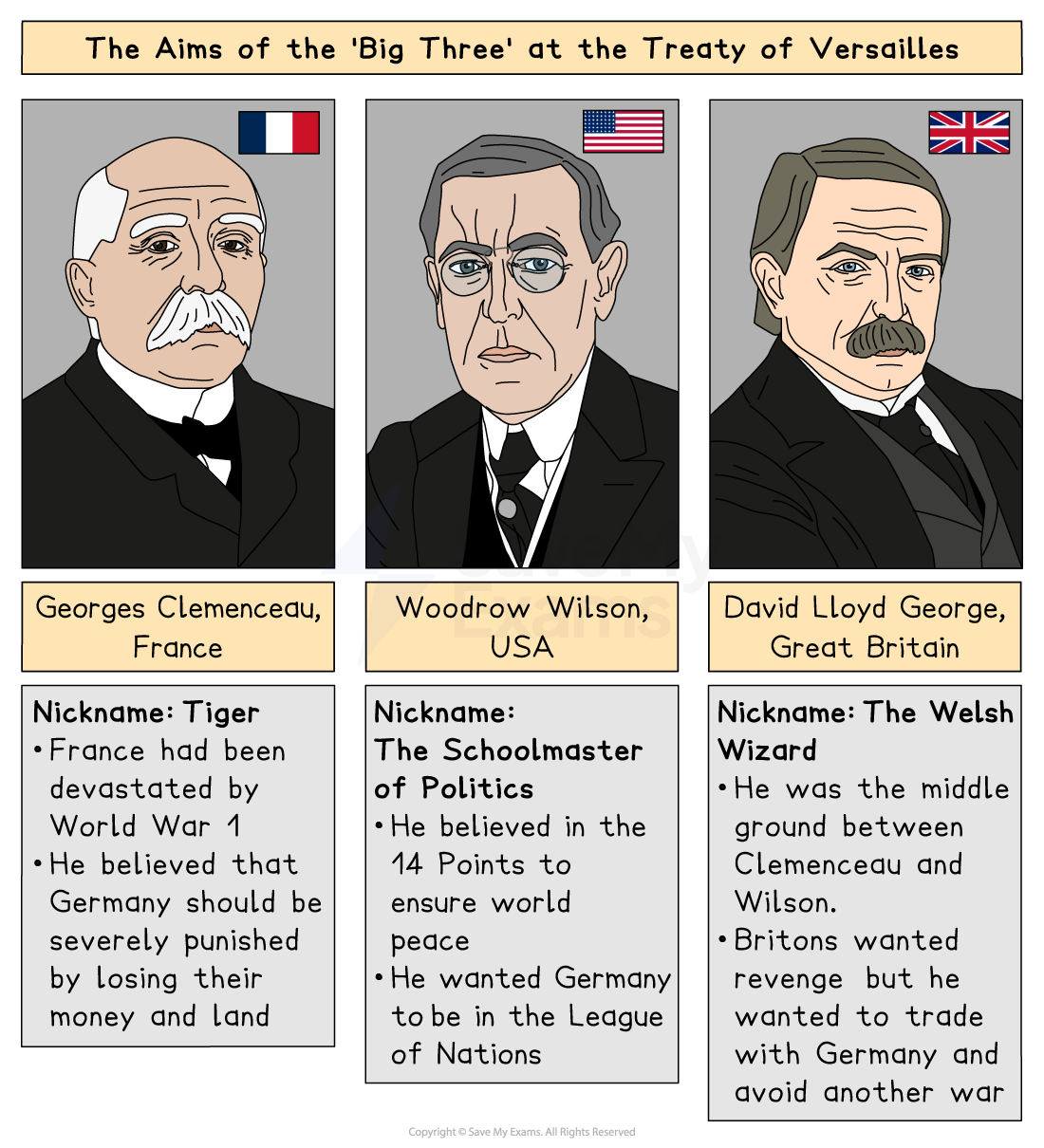
The motives and aims of the peacemakers
Woodrow Wilson of the USA wanted a fair settlement
He feared that harsh terms would make Germany want revenge
No fighting had occurred on US soil
Georges Clemenceau of France wanted a harsh treaty
Most of the fighting had taken place in France
France and Germany had a long history of conflict with each other
David Lloyd George of Britain took a middle line between the USA and France
He wanted to avoid another war, so he didn't want to be too harsh
However, his government won the 1918 election by promising to "squeeze the German lemon"
Territorial terms
Germany lost land to several neighbours:
Alsace-Lorraine went to France
Eupen and Malmedy went to Belgium
Posen and West Prussia went to Poland
This created a "Polish Corridor" that gave Poland access to the sea but cut East Prussia off from the rest of Germany
Danzig became a free city outside German control
The treaty demilitarised the Rhineland
The coal-rich Saar was run by the League of Nations for 15 years and France took its coal
In total, Germany lost about 13% of its European territory
The territorial loss also equated to losing roughly half of its iron reserves and about 15% of its coal
It lost all 11 of its colonies which the League of Nations handed to the Allies to run as mandates
After plebiscites:
Upper Silesia was split between Germany and Poland in 1922
North Schleswig joined Denmark
Military terms
The treaty capped the German army at 100,000 men and banned conscription
It limited the navy to:
six battleships
six cruisers
twelve destroyers
twelve torpedo boats
It also banned Germany from having tanks, submarines or an air force
Financial and moral terms
Article 231, the War Guilt Clause, forced Germany to accept sole blame for causing the war
In 1921, the Allies fixed reparations at £6,600 million
This was about 132 billion gold marks
German reactions to the Treaty of Versailles
The diktat
The Allies shut Germany out of the negotiations and simply presented it with the finished terms
The German government at first refused to sign
The Allies threatened to restart the war, so Germany signed under protest on 28 June 1919
German representatives called the treaty a "shameful diktat", because they saw it as a dictated and humiliating peace
War Guilt and the "November Criminals"
Article 231 caused the deepest anger
Germans believed that all the powers should share the blame for the war
Opponents branded the politicians who signed the treaty as the "November Criminals" and treated them with contempt
Extremist politicians spread the "stab in the back" myth
This is the idea that Germany's own government had betrayed it, rather than that its army had lost on the battlefield
Nationalists assassinated politicians who defended the decision to sign, including Erzberger in 1921
Examiner Tips and Tricks
Examiners reward precise terms. Use "diktat" and "November Criminals" in your answers and explain what each meant rather than just calling the treaty unfair.
If you struggle to remember these, you could create a glossary with these terms and their definitions.
Why was the Treaty of Versailles so unpopular in Germany?
Moral grievance
Germans saw War Guilt under Article 231 as an unjust humiliation
They resented the fact that it justified the unreasonable reparations
The "diktat" gave Germany no say in the settlement
They had expected a peace based on Wilson's Fourteen Points
When this did not happen, many Germans felt betrayed
Economic grievance
Reparations placed a huge burden on an economy that was already close to bankruptcy
Many Germans believed that the Allies had designed the bill to destroy the country for a generation
The land Germany lost contained important coalfields and iron reserves
This made the reparations bill even harder to pay
National grievance
The treaty placed millions of German-speakers under foreign rule
This left them feeling like they did not belong
The 100,000-man army left Germany feeling defenceless
The other powers did not disarm, which made this feeling worse
Political grievance
Germans took out their anger on the Weimar politicians who had signed the treaty
This gave the Republic's enemies, including Hitler and the Nazi Party, a lasting propaganda weapon
Examiner Tips and Tricks
In a 16-mark essay, you can turn these grievances into four ready-made paragraphs. Set out your criterion, for example how many Germans each grievance affected or how long it lasted, and use it to justify which mattered most.
Worked Example
Study Extract C.
Extract C: From a history of Germany, published in 2004.
"No one was prepared for the peace terms… All of this was greeted with incredulous horror by the majority of Germans. The sense of outrage and disbelief… was almost universal. Germany's international strength and prestige had been on an upward course since unification in 1871… now, suddenly, Germany had been brutally expelled from the ranks of the Great Powers and covered in what they considered to be undeserved shame. Versailles was condemned as a dictated peace, unilaterally imposed without the possibility of negotiation."
What impression does the author give about the Treaty of Versailles?
You must use Extract C to explain your answer.
(6)
Partial answer:
The author gives the impression that the Treaty of Versailles came as a total shock to Germany and that Germans felt it was a deep and undeserved humiliation. They say that Germany was "brutally expelled from the ranks of the Great Powers and covered in… undeserved shame". The emotive words "brutally" and "undeserved" make the treaty sound cruel and unfair, which is the view the author wants the reader to take.
Examiner Tips and Tricks
To reach the top level for this question, you must analyse the author's choices: comment on the effect of one or two emotive words, and explain what the author has chosen to stress. You can also point out what the author has left out, but only if you explain how the omission strengthens the impression.

Unlock more, it's free!
Join the 100,000+ Students that ❤️ Save My Exams
the (exam) results speak for themselves:

Was this revision note helpful?
