Stresemann's Foreign Policy Successes, 1924–29 (Edexcel IGCSE History: Paper 1: Depth Studies): Revision Note
Exam code: 4HI1

Timeline & Summary
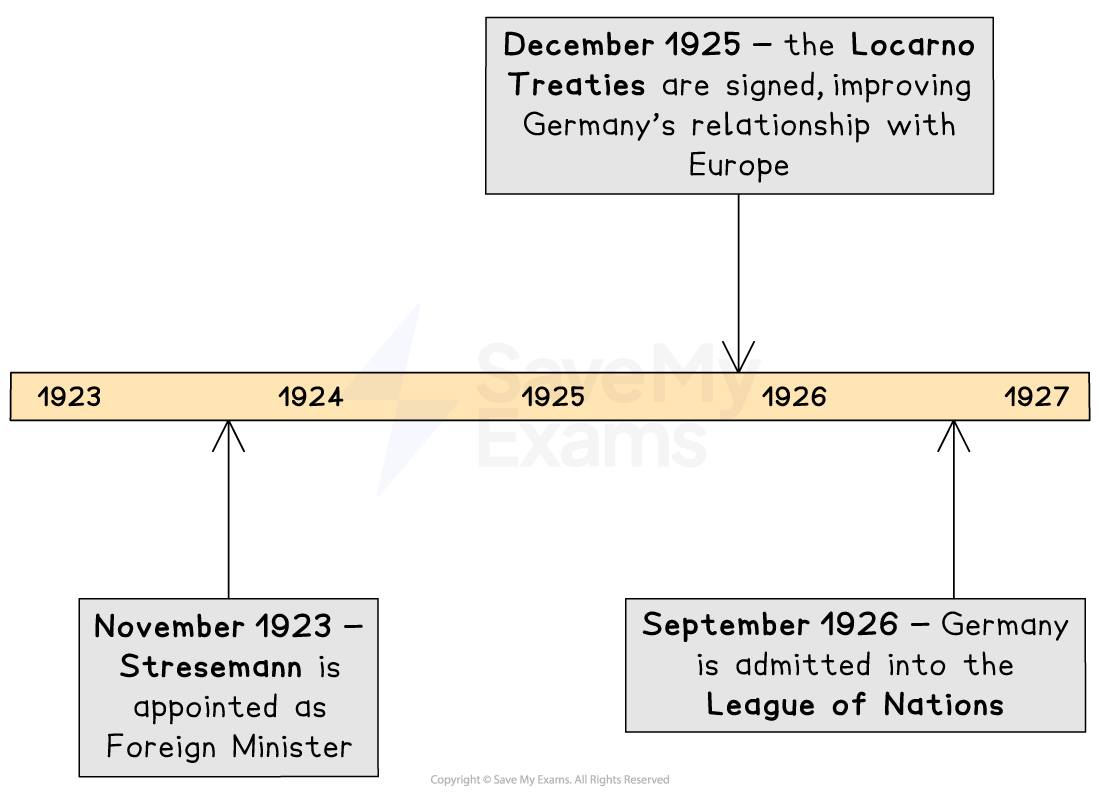
As Foreign Minister from 1923 to 1929, Stresemann used diplomacy, rather than force, to rebuild Germany's position in Europe
The Locarno Treaties of 1925 settled Germany's western borders by agreement and were negotiated by Germany as an equal partner
In 1926, Germany was allowed to join the League of Nations with a permanent seat on the League Council, alongside the other great powers
In 1928, Germany joined more than sixty other countries in signing the Kellogg-Briand Pact, which renounced war as a way of settling disputes
However:
Germany's eastern borders and disarmament were left unresolved
Nationalists at home attacked Stresemann for cooperating with the Allies
The Locarno Treaties, 1925
What was agreed
In 1925, Germany, France, Belgium, Britain, Italy, Poland and Czechoslovakia negotiated a set of seven treaties, known as the Locarno Pact
The talks were held in Locarno in Switzerland, and the treaties were signed in London
The key terms were:
Germany accepted its western borders with France and Belgium, including the loss of Alsace-Lorraine and the demilitarised Rhineland, as permanent
Britain and Italy guaranteed those borders, promising to act if any side attacked
Germany did not accept its eastern borders as fixed
Stresemann deliberately refused to recognise the loss of land to Poland as permanent
He only agreed not to use force to change it
Why Locarno mattered
It made another French invasion, like the occupation of the Ruhr in 1923, very unlikely
This gave Germany security in the west
Germany had negotiated as an equal, not been handed terms as at Versailles
This restored German self-respect
It led directly to Germany joining the League of Nations in 1926
Stresemann and the French Foreign Minister Aristide Briand were awarded the Nobel Peace Prize
Criticism in Germany
Nationalist parties and groups were angry that Stresemann had formally accepted the loss of Alsace-Lorraine and the Rhineland terms
Many Germans believed that Locarno was a trick
France still posed a considerable threat to Germany

Examiner Tips and Tricks
Paper 1 does not have any source questions. However, historians look at sources, like the one above, to form their opinion about the past. Keep this in mind for Question (a) when considering the author's impression of an historical event.
Germany and the League of Nations
Why was Germany left out of the League of Nations?
The League of Nations was set up after the First World War so that countries could settle disputes by discussion instead of war
Germany, like the other defeated nations, was not invited to join when the League was founded
Many Germans saw the League as part of the hated Treaty of Versailles
Joining in 1926
In September 1926, largely as a result of the Locarno Treaties, the other great powers agreed to admit Germany to the League of Nations
Germany was given a permanent seat on the League Council, the small body that took the most important decisions
Countries that sat on the Council included Britain, France, Italy and Japan
This showed that Germany was accepted again as a leading power, only seven years after the humiliation of Versailles
The Kellogg-Briand Pact, 1928
What was the Kellogg-Briand Pact?
In August 1928, Germany signed the Kellogg-Briand Pact with the USA, France and other countries
Over 60 countries eventually signed
The pact was named after:
the US Secretary of State, Frank B. Kellogg
the French Foreign Minister, Aristide Briand
The countries that signed promised not to use war to settle disputes with one another
Why the Kellogg-Briand Pact mattered for Germany
Only ten years after the war, Germany was taking part in international peace-making as an equal partner, not as a defeated outsider
It was further proof that the moderate politicians of the Weimar Republic could win Germany respect abroad
Limits of the Kellogg-Briand Pact
The pact had no way of forcing a country to keep its promise, so it changed little in practice
Some Germans pointed out that it did nothing to remove the Treaty of Versailles, which was still their main grievance
How successful was Stresemann's foreign policy?
Evidence of foreign policy success
The French left the Ruhr in 1925 and agreed under the Young Plan to leave the Rhineland by 1930
Locarno gave Germany secure western borders, guaranteed by Britain and Italy
Germany joined the League of Nations in 1926 with a permanent seat on the Council
This confirmed its return to great-power status
Germany was once again a respected partner in European diplomacy
What Stresemann did not achieve in foreign policy
Germany's eastern borders with Poland were still disputed, and no land had been recovered
Germany remained disarmed under the Treaty of Versailles
Stresemann secretly continued military cooperation with the Soviet Union
There was no union with Austria (Anschluss), which the treaty forbade
The Treaty of Versailles as a whole was still in force, so the central nationalist grievance remained
Stresemann's cooperation with the Allies angered the nationalist right and helped it to grow, especially during the campaign against the Young Plan in 1929

Conclusions
Stresemann achieved his most important aim
He restored Germany's security and its status as a great power
He did so without a war Germany could not have won
However, he did not overturn the Treaty of Versailles or settle the eastern borders
The nationalist backlash against his methods was a serious long-term cost
Worked Example
'Stresemann's foreign policy between 1924 and 1929 was a complete success for Germany.'
How far do you agree? Explain your answer.
You may use the following in your answer:
the Locarno Pact (1925)
Germany joining the League of Nations (1926).
You must also use information of your own.
(16)
Partial answer:
Stresemann's biggest achievement was the Locarno Pact of 1925. Germany agreed to accept its western border with France and Belgium as permanent, and in return Britain and Italy guaranteed that border. This mattered because it made a second French invasion, like the occupation of the Ruhr in 1923, very unlikely. Also, Germany had negotiated the agreement as an equal rather than having terms forced on it as at Versailles. The following year, partly because of the Locarno treaties, Germany was allowed to join the League of Nations with a permanent seat on the Council, next to Britain, France and Italy. This showed that Germany was accepted once again as a great power.
Examiner Tips and Tricks
You must cover at least three aspects: the two prompts and at least one point of your own. If you don't, your answer can't reach Level 4 and is capped at 10 marks.
To reach Level 4 in the 16-mark question, set out how you will judge whether Stresemann's foreign policy was a complete success, for example whether it made Germany secure and whether it restored Germany's status as a great power. State it in your introduction and use it to reach your conclusion.

Unlock more, it's free!
Join the 100,000+ Students that ❤️ Save My Exams
the (exam) results speak for themselves:

Was this revision note helpful?
