The Fall of the Kaiser & the German Revolution, 1918–19 (Edexcel IGCSE History: Paper 1: Depth Studies): Revision Note
Exam code: 4HI1

Timeline & Summary
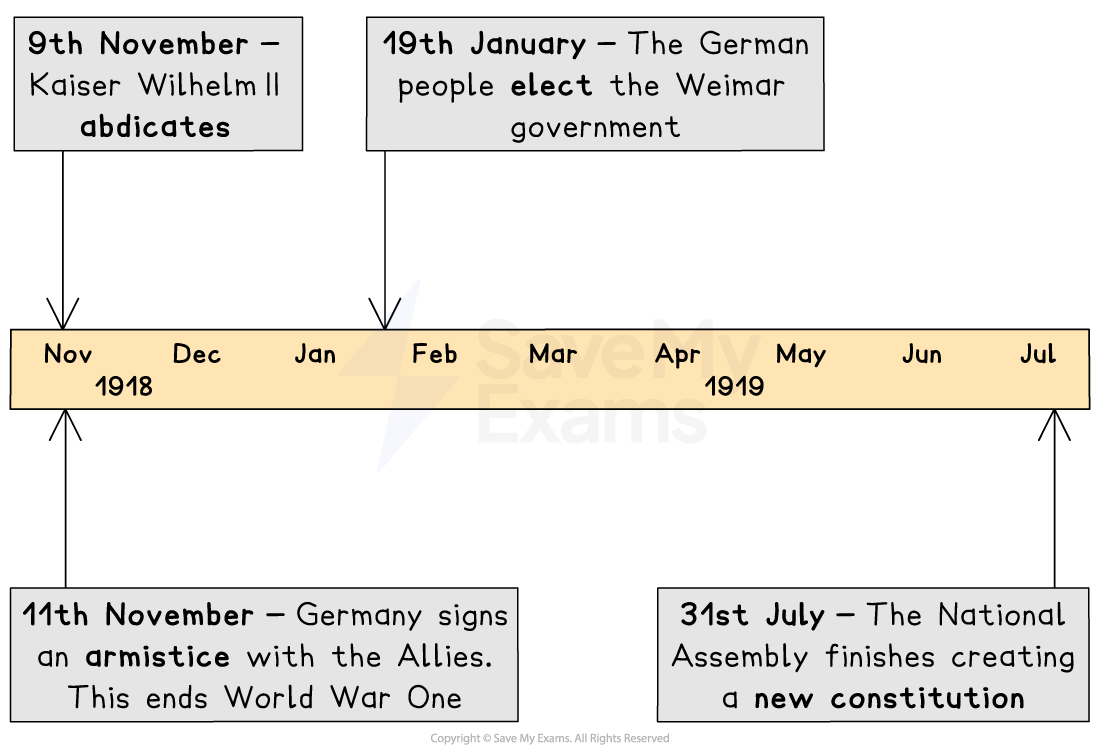
By November 1918 Germany was exhausted and defeated after four years of the First World War
Food shortages, military retreat and the Kiel Mutiny triggered the unrest known as the German Revolution
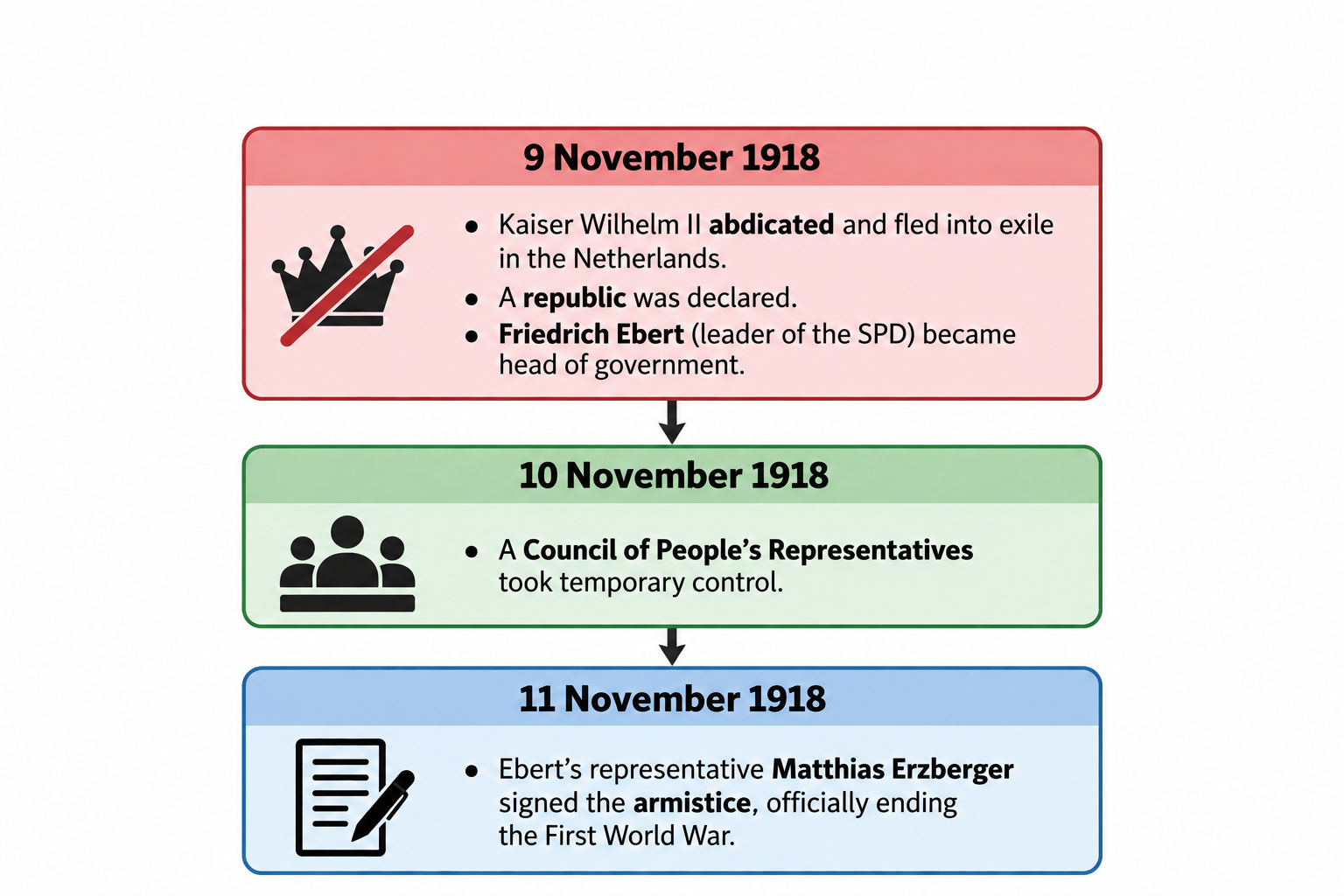
On 9 November 1918, Kaiser Wilhelm II abdicated and fled to the Netherlands
Power passed to Friedrich Ebert, leader of the Social Democratic Party (SPD)
On 11 November 1918, Germany signed the armistice that ended the war
A National Assembly met in the town of Weimar in 1919 and drew up a new constitution
It created a parliamentary democracy — the Weimar Republic
The constitution was highly democratic but had serious weaknesses, such as proportional representation and Article 48
The impact of defeat in the First World War on Germany
Germany entered the war in 1914 expecting a quick victory
Instead, it faced a long, costly war on the Western Front
Impact on soldiers
Of about 11 million men who were mobilised, roughly:
1.8 million killed
1 million taken prisoner or missing
4 million wounded, many permanently disabled
Impact on the home front
The war caused terrible suffering for German civilians
Low productivity in Germany and the Allied naval blockade caused severe food shortages
Around 750,000 civilians died from starvation and disease, including a flu epidemic
End of the First World War
By early November 1918, German troops had been forced to retreat and the country faced invasion if the war continued
The Allies insisted there would be no peace until the Kaiser abdicated
Kaiser Wilhelm II refused to stand down
The Kiel Mutiny
By late October 1918, naval commanders ordered the fleet to attack the British navy
The commanders knew that defeat was inevitable
Sailors mutinied and refused to fight
Widespread protests
Over the next two weeks, strikes and protests spread across Germany and soldiers in other units mutinied against their officers
Many Germans blamed the Kaiser for the defeat
Ordinary people set up their own workers' councils rather than obey the Kaiser's officials
The abdication of the Kaiser and the German Revolution, 1918–19
The abdication and the revolution
The creation of Weimar Germany
Elections for a National Assembly were held on 19 January 1919
82% of people turned out to vote
Moderates won most seats, with the Social Democratic Party (SPD) getting around 40% of the vote
Ebert's approach to government
Ebert tried to regain control of Germany by:
keeping old civil servants in post
telling industrialists that private industry was safe from state control
promising trade unions an eight-hour day
However, many Germans objected to the new government
Some senior army officers and judges remained loyal to the Kaiser
Many people, inspired by the Russian Revolution of 1917, wanted a communist revolution
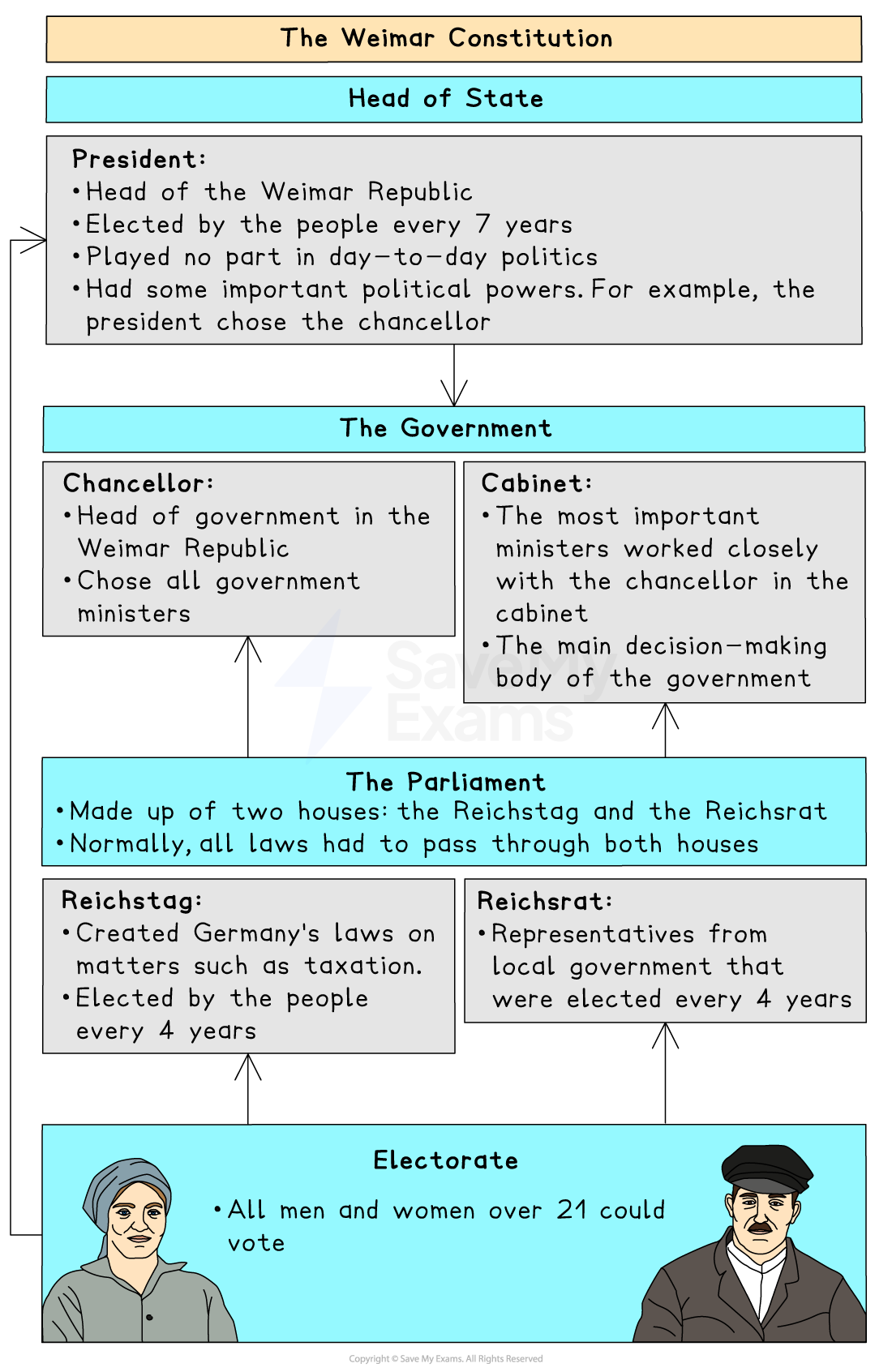
The structure of the Weimar Constitution
The National Assembly met in February 1919 to write the constitution
They met in the town of Weimar because of the unrest in Berlin
This is where the term "Weimar Republic" comes from
The constitution took six months to complete
Examiner Tips and Tricks
Students often mix up the President and the Chancellor.
The public elected a President every seven years. The President held the emergency powers under Article 48.
The Chancellor was the head of government and needed the support of a majority in the Reichstag.
How strong was the Weimar Constitution?
Strengths
All men and women over 20 gained the vote, and the Constitution guaranteed rights such as free speech
Proportional representation ensured the Reichstag represented smaller parties
The system was designed to stop someone from taking ultimate power
The President chose the Chancellor but the public elected the president every seven years
Article 48 let a strong President keep the government running
The Reichstag and the Reichsrat worked together
The Länder retained power over schools and the police
Examiner Tips and Tricks
Proportional representation confuses many students
Imagine the Reichstag is cut into 100 equal sections, one section for every 1% of the national vote. A party that wins 30% of the votes would have 30 sections, so 30% of the seats in the Reichstag
When you explain proportional representation as a weakness, link it to an outcome; no party won a majority, so coalitions of up to five parties collapsed quickly
Weaknesses
No party ever won a majority due to proportional representation
There were nine coalition governments between 1919 and 1923 alone
Article 48 meant the Chancellor could ask the President to pass emergency laws without the support of the Reichstag
Ebert used the emergency article 63 times from 1923 to 1924
The new constitution did not subdue the extremist political parties
They continued to violently attack the Weimar Republic
States' rights meant that the Länder, such as Bavaria, could resist national policy
Conclusions
On paper, the Constitution was one of the most democratic in Europe
In practice, proportional representation and Article 48 left it unable to cope with crises
Judged by whether it could protect democracy, the weaknesses outweighed the strengths
Examiner Tips and Tricks
Article 48 looks harmless because it was meant only for emergencies. However, the constitution never said what counted as an "emergency". This vagueness becomes very important later in the course, when Presidents use Article 48 to govern without the Reichstag.
Worked Example
Explain two effects of the abdication of Kaiser Wilhelm II on Germany in the years 1918–1919.
(8)
Partial answer:
One effect of the abdication of Kaiser Wilhelm II was that Germany became a democracy for the first time. Once the Kaiser had gone into exile on 9 November 1918, Friedrich Ebert took over as leader and promised national elections. These elections were held in January 1919, and the new National Assembly then drew up the Weimar Constitution. This meant that power now belonged to an elected Reichstag and to a president chosen by the people, rather than to a monarch who had inherited the throne. In just a few months, Germany had changed from an empire ruled by a Kaiser into a republic.
Examiner Tips and Tricks
An answer that only deals with one effect is capped at 4 marks, so make sure your answer includes two separate, developed points.
A reliable way to structure each effect is to name it, give one precise supporting fact, and then explain the outcome that it led to.

Unlock more, it's free!
Join the 100,000+ Students that ❤️ Save My Exams
the (exam) results speak for themselves:

Was this revision note helpful?
