The Hungarian Uprising, 1956 (Edexcel IGCSE History: Paper 1: Depth Studies): Revision Note
Exam code: 4HI1

Timeline & summary
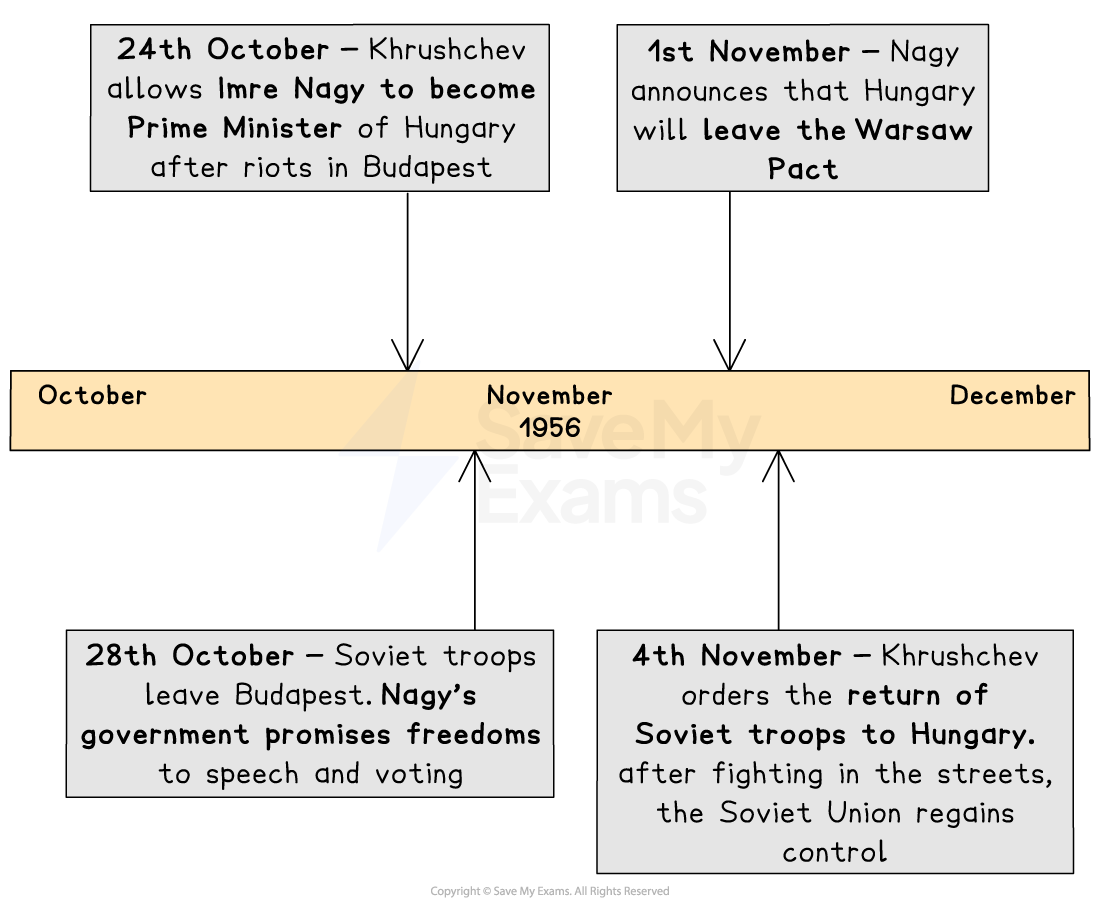
Nagy's proposals to leave the Warsaw Pact and share power with non-Communists went far beyond what Khrushchev was prepared to accept
On 4 November 1956, Soviet tanks invaded Hungary
They crushed the uprising
The Soviet Union installed a new pro-Soviet government under Janos Kadar
Many Hungarians had expected help from the West
The USA offered sympathy but no military support
The uprising:
strengthened Khrushchev's authority over the Warsaw Pact
confirmed the limits of what the USA was prepared to do to help a satellite state
Reasons for the Soviet invasion of Hungary
Khrushchev could not accept Nagy's attempt to withdraw Hungary from the Warsaw Pact
The Soviet Union needed Hungary to remain in the Warsaw Pact
Khrushchev may have needed Hungarian troops to suppress future uprisings in other satellite states
Hungary's withdrawal may have prompted other satellite states to do the same
The Soviet Union relied upon the 'collective security' of pro-Communist states as stated in the Warsaw Pact
Khrushchev did not want any more independent Communist states in Eastern Europe
Yugoslavia, under the leadership of Tito, broke away from the Soviet Union's influence in 1948
Yugoslavia became closer to the West by accepting military aid from the USA
Khrushchev did not want other satellite states to form alliances with Yugoslavia
How did Khrushchev stop the Hungarian Uprising?

The effects of the Soviet invasion of Hungary
Hungary after the invasion
A new pro-Soviet government was set up in Hungary under Janos Kadar
Nagy was arrested, and he was executed in 1958
Effects on the Warsaw Pact
The Hungarian Uprising made Khrushchev's authority within the Warsaw Pact much stronger
Members of the Warsaw Pact now understood that they had to do as they were told
If they rebelled, as Hungary had done, they could not expect military support from the USA
Rebellion carried too much risk and no realistic hope of outside help
Khrushchev also became more confident in dealing with the USA
He now knew that the Americans were very unlikely to risk direct military action to defend a satellite state
International reaction to the invasion of Hungary
When the Soviet invasion force entered Hungary, Nagy believed that the West would support his government
Radio Free Europe was a US-funded radio channel that transmitted across Eastern Europe
The station encouraged Eastern Europeans to rise up against the Soviet Union
Broadcasts led many Hungarians to expect Western help
Khrushchev's suppression of the Hungarian Uprising shocked many Western nations
Khrushchev's actions did not match his previous policies of de-Stalinisation
The United Nations (UN) condemned the invasion and set up an enquiry, but the Soviet Union ignored it
Spain, the Netherlands and Switzerland boycotted the 1956 Melbourne Olympics in protest
Thousands of Communists in Western Europe left their parties in protest
About 200,000 Hungarians fled abroad as refugees, many to Austria and then the USA
Should the USA intervene in the Hungarian Uprising?
Reasons for US intervention
Khrushchev's repression went against the UN stance on human rights
Nagy's government wanted to increase Hungary's individual freedoms
This matches the democratic values of the USA
If the USA could free Hungary from the Eastern Bloc, it could use Hungary's geographical position to intimidate the Soviet Union
It could make an alliance with Hungary or station weapons on its border with the Soviet Union
Reasons against US intervention
The USA had a foreign policy of Containment
This meant that the USA did not intervene in countries that were already communist
Any military intervention in the Eastern Bloc could cause a nuclear war between the USA and the Soviet Union
The US government and population still distrusted Communist countries
The USA's decision about the Hungarian Uprising
Ultimately, Eisenhower decided not to give military support to Nagy
He did not believe the cause was worth risking a nuclear war for
Hungary did receive some support from the West
European members of NATO accepted Hungarian refugees
Examiner Tips and Tricks
An exam question could ask you how far you agree that the Hungarian Uprising was the most important reason why Cold War tensions increased in the 1950s.
To achieve Levels 3 and 4 (9–16 marks) you must discuss the stated reason in the question. For this example, you would have to discuss the Hungarian Uprising.
How far did the Hungarian Uprising damage superpower relations?
Evidence of serious damage
The friendlier relations suggested by the Geneva Summit of 1955 proved to be short-lived
Even though the USA did not take military action, it strongly opposed the Soviet invasion
Khrushchev's tough response damaged relations between the two superpowers once again
The brutality of the invasion, and the execution of Nagy, gave the West clear propaganda evidence of the harshness of Soviet rule
Evidence that the damage was limited
In some ways, the failure of the uprising reflected just as badly on the West as on the Soviet Union
The USA and its allies were not prepared to back up their words with military support
The USA's underlying policy of Containment did not actually change
The crisis confirmed existing limits to the willingness of the USA to interfere in already-Communist countries
Neither superpower seriously considered direct war with the other over Hungary
Conclusions
The Hungarian Uprising damaged superpower relations
The uprising confirmed, for both sides, exactly what each already suspected:
that the Soviet Union would use force to keep its satellite states in line
that the USA would not risk a wider war to stop it
Relations worsened again in 1958, when Khrushchev demanded that Western troops leave West Berlin
Worked Example
Study Extract F.
Extract F: From a history of the Soviet Union, published in 2014
"There was a real danger of Hungary becoming a neutral state with a multi-party parliamentary democracy. On 4 November Soviet tanks rolled in again. In the week it took the Soviet military to crush the uprising 2,500 civilians were killed and 20,000 wounded. Denounced by Moscow as a 'counter-revolutionary', Nagy was arrested, and later executed 'as a lesson to all the other leaders in socialist countries'.
Distracted by the Suez Crisis, the West's reaction was subdued. But the Soviet action brought about a crisis in the movement internationally with many Communists resigning from the party in protest."
What impression does the author give about the Soviet Union's response to the Hungarian Uprising?
You must use Extract F to explain your answer.
(6)
Partial answer:
The author also creates this impression by choosing not to explain the "danger" the extract opens with. The first sentence states that there was "a real danger of Hungary becoming a neutral state with a multi-party parliamentary democracy." However, the author never explains why that would have been so threatening to the Soviet Union. The reader is told that a danger existed, but not what made it dangerous: for example, that Hungary leaving the Warsaw Pact would have weakened the Soviet Union's western border. By leaving out Nagy's justification for his reforms and the way this threatened the Soviet Union, the author makes the invasion seem inevitable. Therefore, the reader is left having to accept the invasion was justified rather than question Khrushchev's motives.
Examiner Tips and Tricks
Keep your answer focused on the extract, because this question is only about the interpretation in front of you.
You should avoid stating if you agree or disagree with the extract as this is not what the question requires. You simply need to show the author's opinion through the words that they use and the evidence they select. When you point out what the author leaves out, only use evidence relevant to the topic in the question.

Unlock more, it's free!
Join the 100,000+ Students that ❤️ Save My Exams
the (exam) results speak for themselves:

Was this revision note helpful?
