Stresemann & Economic Recovery, 1924–29 (Edexcel IGCSE History: Paper 1: Depth Studies): Revision Note
Exam code: 4HI1

Timeline & Summary
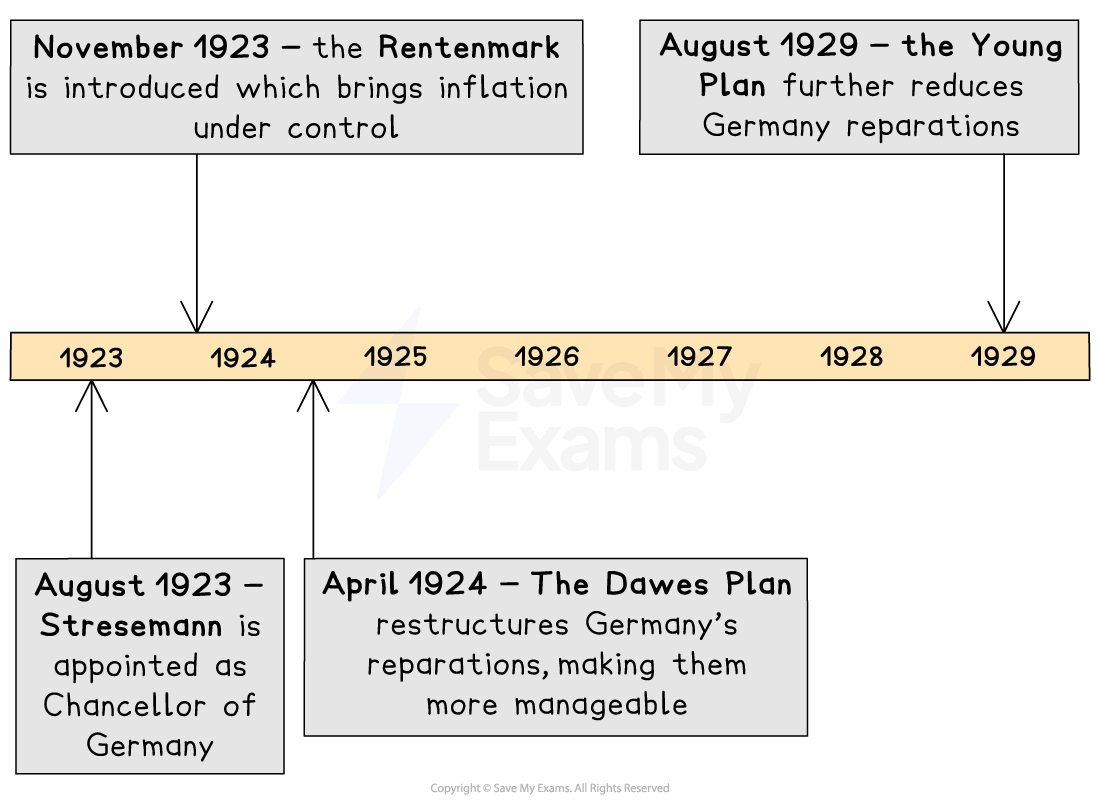
The years 1924 to 1929 are often called the "Stresemann Era" or the "Golden Age" of the Weimar Republic
This is because Germany recovered from the crisis of 1923 and enjoyed several years of stability and rising prosperity
Gustav Stresemann was Chancellor for about three months in 1923 and then Foreign Minister until his death in October 1929
He shaped Germany's recovery throughout that period
In November 1923, the government replaced the worthless mark with a temporary currency, the Rentenmark
In 1924, an independent Reichsbank took control of a new permanent currency, the Reichsmark
The Dawes Plan of 1924 reorganised reparations
It brought in a large American loan to Germany
It led to about 25,000 million marks of further US loans by 1930, which funded an industrial recovery
The Young Plan of 1929 cut the total reparations bill and stretched payments to 1988. However, the plan faced challenges:
Nationalists attacked the agreement
Recovery collapsed when American lending stopped after the Wall Street Crash of 1929
Who was Gustav Stresemann?
Gustav Stresemann became Chancellor in August 1923
Stresemann was a nationalist
Initially, he did not like the Weimar Republic
After the assassination of Rathenau, Germany’s foreign minister, Stresemann’s opinion of the government changed
He led the DVP (German People's Party), a moderate right-wing party he had founded in 1918
As chancellor, Stresemann had three aims for Germany:
Bring inflation under control
Regain Europe’s respect
Minimise the support for extremist parties
In September 1923, Stresemann called off passive resistance in the Ruhr and restarted reparations payments
This angered nationalists, but it was the first step towards ending hyperinflation and the French occupation of the Ruhr
Examiner Tips and Tricks
Keep Stresemann's aims in mind whenever a 16-mark question asks how "successful" he was, because success has to be judged against what he was trying to do.
The Rentenmark and the end of hyperinflation
Germany’s currency, the mark, was beyond saving:
The largest note was 100,000,000,000,000 (100 trillion) marks
By November 1923, there were about 400 million trillion marks in circulation
In November 1923, the government introduced a temporary new currency called the Rentenmark
Two features made it work:
The government issued only a strictly limited number of Rentenmarks, instead of printing money to cover its debts
Its value was tied to Germany's farmland and industry
The government promised that notes could be exchanged for a share in German land or industry if the currency failed
Because the supply was controlled and the currency was linked to real assets, Germans and foreign traders began to trust it
In August 1924, the Reichsbank took control of the Rentenmark
A new permanent currency, the Reichsmark, was introduced alongside the Rentenmark, at the same value
The new currency allowed German businesses to trade with foreign countries
The Dawes Plan, 1924 and the Young Plan, 1929
Why were the plans needed?
Stresemann argued that Germany's economy could not recover until the reparations problem was solved
He believed Germany should accept the Treaty of Versailles for now, in order to improve relations with Britain and France
He believed that this would allow Germany to renegotiate the payments
This position was very unpopular, because most Germans hated the treaty
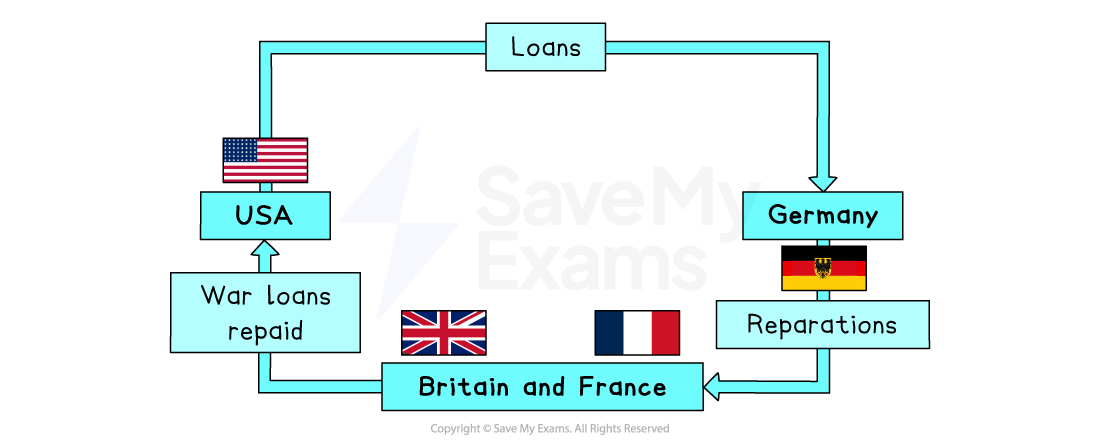
The Allies had reasons to help
If Germany's economy recovered, Germany could pay reparations to Britain and France
Britain and France could then repay their war debts to the USA
Examiner Tips and Tricks
An exam question could ask you to explain to what extent Stresemann's policies recovered Germany's economy. The flow diagram shows how risky this strategy was. Britain, France and Germany were gambling their economies on the USA’s prosperity.
Stresemann was aware of the dangers involved in accepting American loans. In 1929, he stated that Germany was “dancing on a volcano”. If the USA recalled the loans or experienced a depression, the "volcano" would erupt and destroy the stability of Weimar Germany. Stresemann believed it was a risk worth taking to rebuild Germany’s economy. Some historians argue that it placed Germany at risk of another, more catastrophic economic crash.
The Dawes Plan, 1924
In 1924, the American banker Charles Dawes led talks that produced the Dawes Plan, agreed between Germany and the Allies
Its main terms:
The USA lent Germany 800 million gold marks, giving industry an immediate boost
Annual reparations payments were reduced at first, starting at 1,000 million marks a year and rising to 2,500 million marks by 1929
The payment rate would be reviewed in future according to Germany's ability to pay
France agreed to withdraw its troops from the Ruhr, which it completed in 1925
The Allies took some control over the Reichsbank and the German railways as security
Over the next six years, American banks lent Germany more than 25,000 million marks, and this money rebuilt German industry
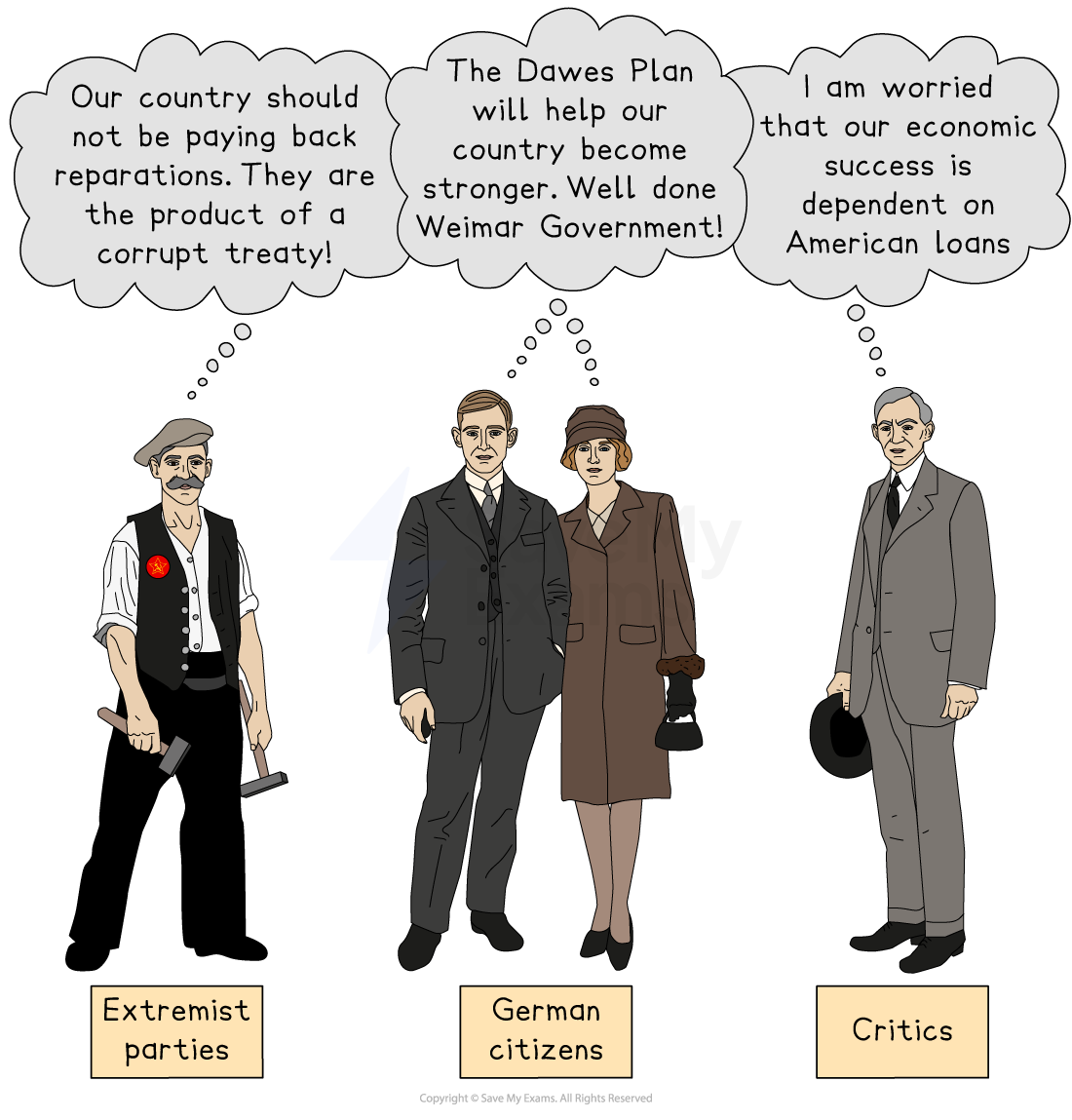
How did Germans react to the Dawes Plan?
The Young Plan, 1929
Even with the Dawes Plan, Germany still found the payments hard to manage
In 1929 a committee, led by the American Owen Young, produced the Young Plan:
The total reparations bill was cut to around $8 billion, roughly a quarter of the original figure
Payments were spread over 59 years, to 1988
Only about a third of each year's payment was compulsory, and the rest could be delayed
France agreed to leave the Rhineland by June 1930, five years earlier than the Treaty of Versailles required
The lower payments let the government cut taxes and put money into industry and jobs
Opposition to the Young Plan
Nationalist groups were furious that Germany would go on paying reparations until 1988
The media businessman Alfred Hugenberg, working with Adolf Hitler, organised a national petition against the plan
This forced a referendum in December 1929
Only about 14% of voters rejected the plan, so the campaign failed
However, it gave Hitler valuable national publicity and made the Nazis look more respectable
Examiner Tips and Tricks
Students very often mix up details from the two plans. One way to remember the order in your head is that "D" comes before "Y" in the alphabet, just as the Dawes Plan came before the Young Plan.
If you can state one distinctive term for each — the US loan and the Ruhr for Dawes, the 1988 end date for Young — you will not confuse them under pressure
How did the plans end?
The Young Plan came to little in practice
The Wall Street Crash of October 1929 meant the USA could no longer lend to Germany
The German economy crashed in 1931, and the Allies suspended reparations
When Hitler came to power in 1933, he stopped payments altogether
How successful was Stresemann in solving Germany's economic problems?
The economy recovered under Stresemann
The currency was stable from late 1923 onwards
This ended hyperinflation and restored confidence
Industrial production recovered strongly and had passed its pre-war (1913) level by 1928
Wages for industrial workers rose faster than prices, until they were among the highest in Europe
The government could afford to build new roads, schools and housing
Germany introduced unemployment insurance in 1927
Political extremism declined, because the Nazi and communist share of the vote fell during the recovery
The economy did not recover under Stresemann
The recovery depended on short-term American loans, which lenders could recall at short notice
This means Germany's recovery rested on foundations it did not control
The countryside did not share in the "Golden Age"
German farming was in difficulty for much of the 1920s because world food prices were low
Unemployment never fell below about 1.3 million, and it was rising again by 1928–29
Government spending and borrowing rose faster than tax income, so the state was living beyond its means
Some of the growth came from a general upturn in the world economy in the mid-1920s, not only from Stresemann's policies
Conclusions
Stresemann rescued Germany from the immediate crisis of 1923 and delivered several years of real prosperity
However, the recovery was shallow and borrowed
The Wall Street Crash proved this within weeks of his death
Worked Example
Study Extract C.
Extract C: From a history of Germany, published in 1998.
"While the economy of the Weimar Republic was undoubtedly growing in the mid-1920s, thanks largely to foreign capital, many sections of the German population felt strongly that they were not receiving their fair share of rewards. Indeed, considerable numbers of small businessmen and farmers believed that it was their increasing taxes and contributions to welfare schemes which were helping to increase the wages and living standards of workers in the cities while they were sliding further into poverty and facing rising debt."
What impression does the author give about the success of Gustav Stresemann's economic policies between 1924 and 1929?
You must use Extract C to explain your answer.
(6)
Partial answer:
The author builds the impression that Stresemann's policies were only partially successful by choosing to focus on the people who did badly from them. They write that "many sections of the German population" and "considerable numbers of small businessmen and farmers" were "sliding further into poverty and facing rising debt". The phrase "sliding further into poverty" makes their situation sound serious and getting worse. By putting the resentment of farmers and small businessmen at the centre of the passage, and saying nothing about the achievements of these years, such as the rise in industrial output or the introduction of unemployment insurance in 1927, the author makes Stresemann's economic policies look like a failure for a large part of the population.
Examiner Tips and Tricks
Keep your answer focused on the extract, because this question is only about the interpretation in front of you.
You should avoid stating if you agree or disagree with the extract as this is not what the question requires. You simply need to show the author's opinion through the words that they use and the evidence they select. When you point out what the author leaves out, only use evidence from the years in the question.

Unlock more, it's free!
Join the 100,000+ Students that ❤️ Save My Exams
the (exam) results speak for themselves:

Was this revision note helpful?
