Early Steps Towards the Thaw (Edexcel IGCSE History: Paper 1: Depth Studies): Revision Note
Exam code: 4HI1

Summary
After the Cuban Missile Crisis, both the USA and the Soviet Union wanted to reduce the danger of nuclear war
In 1963, they set up a 'hotline' so the two leaders could talk directly in a crisis
They also signed the Limited Test Ban Treaty
In 1967, the Outer Space Treaty stopped nuclear weapons being placed in space
In 1968, the Nuclear Non-Proliferation Treaty tried to stop nuclear weapons spreading to more countries
These agreements made nuclear war less likely
However, they did not limit the number of weapons or end the rivalry
Relations stayed poor, as shown when the USA cancelled a meeting after the Soviet invasion of Czechoslovakia in 1968
The 'hotline'
What motivated the USA and the Soviet Union to act?
The 'thaw' is the easing of tension between the USA and the Soviet Union from 1963, after the Cuban Missile Crisis
Historians usually use 'détente' for the more lasting improvement from 1969 to 1972
After the Second World War, the USA and the Soviet Union entered an arms race
Soon both could destroy the other several times over
Many people believed this would keep the peace
This idea is known as 'Mutually Assured Destruction' (MAD), because nobody would risk a war that was certain to destroy their own country too
However, the Cuban Missile Crisis showed that the leaders could lose control of events
A devastating war could break out almost by accident
After the crisis, both countries began to look for ways to reduce the threat from nuclear war
Some moves had started earlier
Khrushchev had called for a halt to nuclear testing in 1958
The West had proposed a test ban in 1961, which the Soviets rejected
The growing split between the Soviet Union and China also made the USA less afraid of a united Communist bloc
What was the 'hotline'?
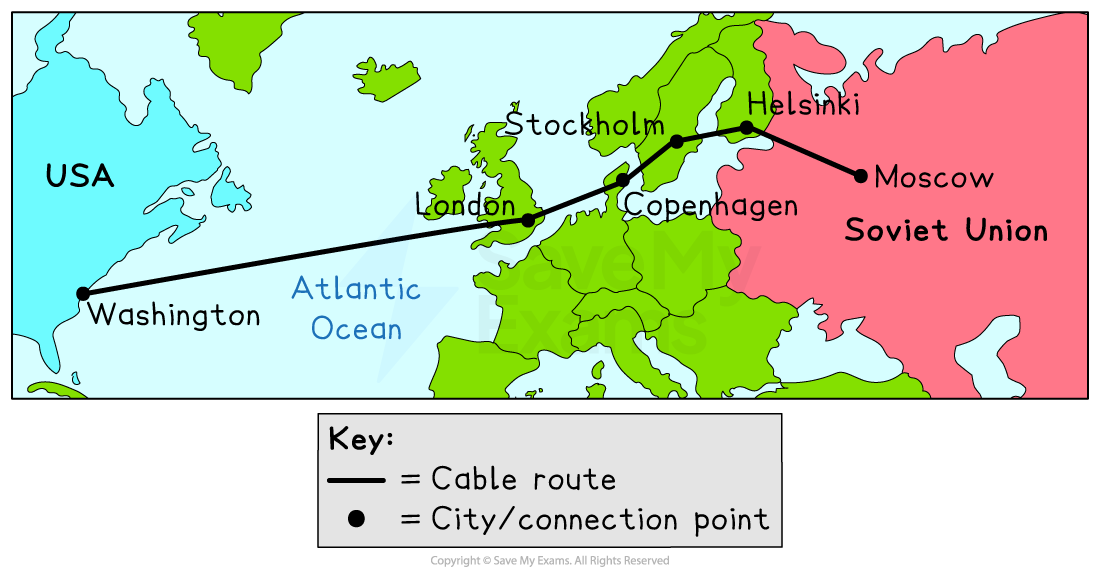
The USA and the Soviet Union agreed to set up a system of direct communication between the White House in Washington and the Kremlin in Moscow
The two countries agreed it at Geneva on 20 June 1963
Its purpose was to prevent misunderstandings between the two countries by allowing the leaders to talk quickly in times of crisis
It was not a red telephone on each leader's desk, as many people imagine
Written messages were used so that nothing was lost or misunderstood in spoken translation
Messages were sent by wire telegraph along a 16,000-kilometre cable from Washington to London, Copenhagen, Stockholm, Helsinki and finally Moscow
It was not used very often
However, Nixon and Brezhnev did use it in 1971, when there was a war between India and Pakistan
Why did the 'hotline' matter?
It was a practical step
It could not stop the arms race, but it made an accidental war less likely
By agreeing to talk directly, both sides showed they accepted that the danger of nuclear war was too great to leave to chance
The Test Ban Treaty and the Outer Space Treaty
The Limited Test Ban Treaty, 1963
Why was it signed?
Since developing atomic weapons, both the USA and the Soviet Union had tested them in the atmosphere
Scientists now understood the dangers of radioactive fallout
The two governments became worried about contaminating the environment
A warning came in 1954, when the USA exploded a hydrogen bomb at Bikini Atoll in the Pacific Ocean
Fallout spread outside the area the Americans had marked as unsafe and reached a Japanese fishing boat, the Lucky Dragon
The crew became ill, and one man died
What did it agree to?
In August 1963, the USA, the Soviet Union and Britain signed the Limited Test Ban Treaty (also called the Partial Test Ban Treaty)
They agreed not to carry out nuclear test explosions in the atmosphere, under water or in outer space
They also agreed not to carry out any explosion that would send radioactive debris outside their own borders
After 1963, a further 113 countries signed the treaty
It was called 'limited' because it did not ban every test
Tests deep underground, where the fallout stays inside the ground, were still allowed
The Outer Space Treaty, 1967
Why was it signed?
By the 1960s, both superpowers were launching satellites and planning to reach the Moon
Both feared the other might place nuclear weapons in orbit, which would spread the arms race into space
What did it agree to?
Its main terms were based on a 1963 United Nations resolution
Outer space should be explored and used for the benefit of all countries
Countries should not place nuclear weapons or other weapons of mass destruction in orbit or on other planets and moons
The Moon and other planets and moons should be used only for peaceful purposes
The USA, the Soviet Union and Britain drew up the treaty, and other countries signed it later
Why did these treaties matter?
Both treaties dealt with places where the superpowers did not yet have weapons or where testing harmed everyone
They were easier to agree than treaties that cut existing weapons
They showed that the superpowers could agree on some things even while they were rivals
Examiner Tips and Tricks
Keep what each treaty banned separate, because mixing them up is an easy way to limit your marks for own knowledge.
The Limited Test Ban Treaty (1963) banned nuclear tests in the atmosphere, under water and in space, but not underground. The Outer Space Treaty (1967) banned nuclear weapons in orbit and on the Moon and other planets.
The Nuclear Non-Proliferation Treaty
Why was it signed?
'Non-proliferation' means stopping the spread of something
The Nuclear Non-Proliferation Treaty (NPT) was signed in 1968
The USA, the Soviet Union, Britain and 59 other states signed it
It was a further step by the major powers to stop nuclear weapons spreading to more countries
One concern was China, which had exploded its first atomic bomb in 1964
What did it agree to?
The treaty split countries into two groups
Nuclear weapon states (NWS): the USA, the Soviet Union, China, France and Britain, which already had nuclear weapons
Non-nuclear weapon states (NNWS): all the other countries
The nuclear weapon states promised to work towards disarmament and not to help other countries develop nuclear weapons
The non-nuclear weapon states promised not to get involved in developing nuclear weapons
Why did countries accept it?
When it was signed, few non-nuclear countries had the technology, the money or the wish to build nuclear weapons
Many countries also felt safer if fewer of their neighbours could get nuclear weapons
Limits of the treaty
Some countries, including Israel, Pakistan and India, either never signed the treaty or developed nuclear weapons anyway
The treaty did not make the superpowers give up their own weapons
Examiner Tips and Tricks
In a question about the effects of a treaty, do not just list its terms. Say how it made things different. For example, it made it less likely that more countries would get nuclear weapons, which lowered the risk of war.
How significant were agreements after 1962 towards a thaw?
Evidence that the agreements were significant
The 'hotline' made an accidental war less likely by allowing the leaders to talk directly in a crisis
The Limited Test Ban Treaty reduced the radioactive fallout that was damaging the environment
Many other countries signed it
The Outer Space Treaty stopped the arms race spreading into space
The Non-Proliferation Treaty was a clear step towards stopping nuclear weapons spreading to more countries
Together, they showed that the superpowers could co-operate
They were important early steps towards the more ambitious agreements of the early 1970s
Evidence that their significance was limited
None of the agreements cut the number of nuclear weapons
Both countries still had enough weapons to destroy each other many times over
Underground nuclear testing was still allowed under the Test Ban Treaty
The 'hotline' was not used very often
It did little to improve everyday relations
The treaties dealt with the dangers that both sides most wanted to avoid
They did not solve the causes of the Cold War, such as the rivalry between communism and capitalism
Relations in the 1960s remained very poor
In 1968, the Soviet invasion of Czechoslovakia led the US president, Lyndon B. Johnson, to cancel a meeting with the Soviet Union
Conclusions
The agreements were significant in the short term, because they reduced the risk of an accidental war and showed that co-operation was possible
They were less significant for improving relations in the long term
They did not limit the weapons already built
The two sides were still rivals
Worked Example
Study Extract F.
Extract F: From a history website, published in 2026
"On July 25, 1963, after only 12 days of negotiations, the two nations agreed to ban testing in the atmosphere, in space, and underwater. The next day, in a television address announcing the agreement, Kennedy claimed that “a limited test ban is safer by far for the United States than an unlimited nuclear arms race.” Over the next two months, President Kennedy convinced a fearful public and a divided Senate to support the treaty."
What impression does the author give about the Limited Test Ban Treaty?
You must use Extract F to explain your answer.
(6)
Partial answer:
The author gives the impression that the treaty was a quick and sensible step that made the USA safer. Saying it was agreed "after only 12 days" suggests that both sides were keen and that agreement came easily, which makes it look like a sign of co-operation after the tension of the Cuban Missile Crisis. By quoting Kennedy saying the treaty was "safer by far" than an unlimited arms race, the author presents it as the safer choice for the USA, which shows it was about protecting America’s own security, not about friendship.
Examiner Tips and Tricks
Keep your answer focused on the extract, because this question is only about the interpretation in front of you.
You should avoid stating if you agree or disagree with the extract as this is not what the question requires. You simply need to show the author's opinion through the words that they use and the evidence they select.

Unlock more, it's free!
Join the 100,000+ Students that ❤️ Save My Exams
the (exam) results speak for themselves:

Was this revision note helpful?