The Wartime Conferences: Tehran, Yalta & Potsdam (Edexcel IGCSE History: Paper 1: Depth Studies): Revision Note
Exam code: 4HI1

Summary
The leaders of the Grand Alliance met three times during the war
They wanted to plan how to win the war and how to run Europe afterwards
The meetings were at:
Tehran (November 1943)
Yalta (February 1945)
Potsdam (July–August 1945)
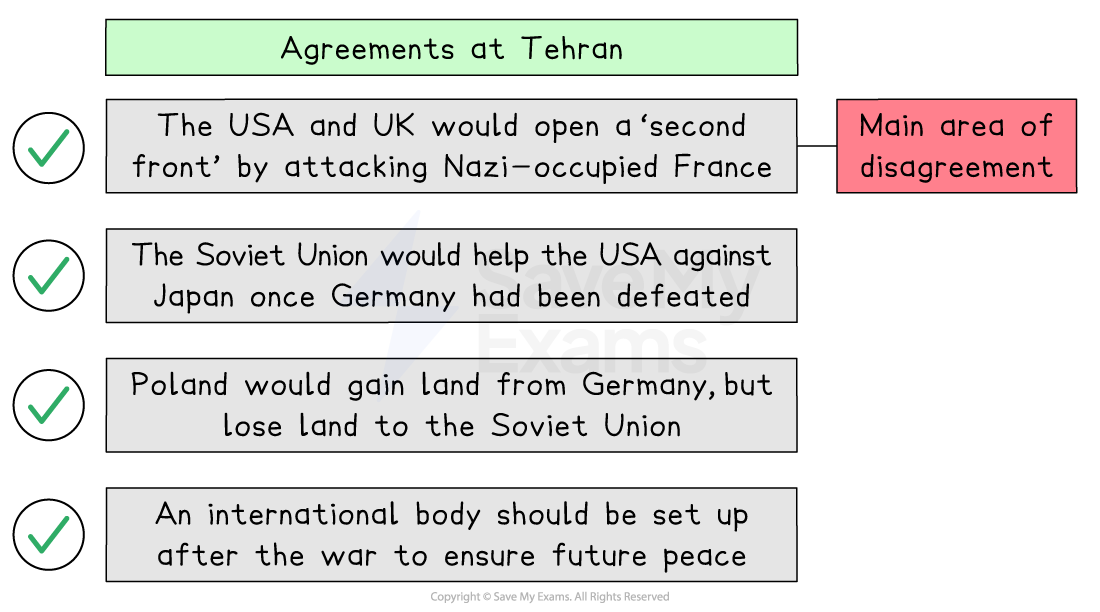
At Tehran, the 'Big Three' agreed that Britain and the USA would open a second front in Western Europe
Stalin agreed to fight Japan once Germany was beaten
At Yalta, they agreed to:
divide Germany into four zones
set up the United Nations
hold free elections in Eastern Europe
However, the wording of the Yalta agreements was vague, and Poland caused serious arguments
At Potsdam, two of the leaders were new - Truman for the USA and Attlee for Britain
The atomic bomb had been tested
The arguments over Eastern Europe, Poland and reparations were much more intense
The conferences did not start the Cold War, but they highlighted disagreements that were never fully settled
Key features of the Tehran Conference
The 'Big Three' met for the first time in Tehran, in Iran, in November 1943
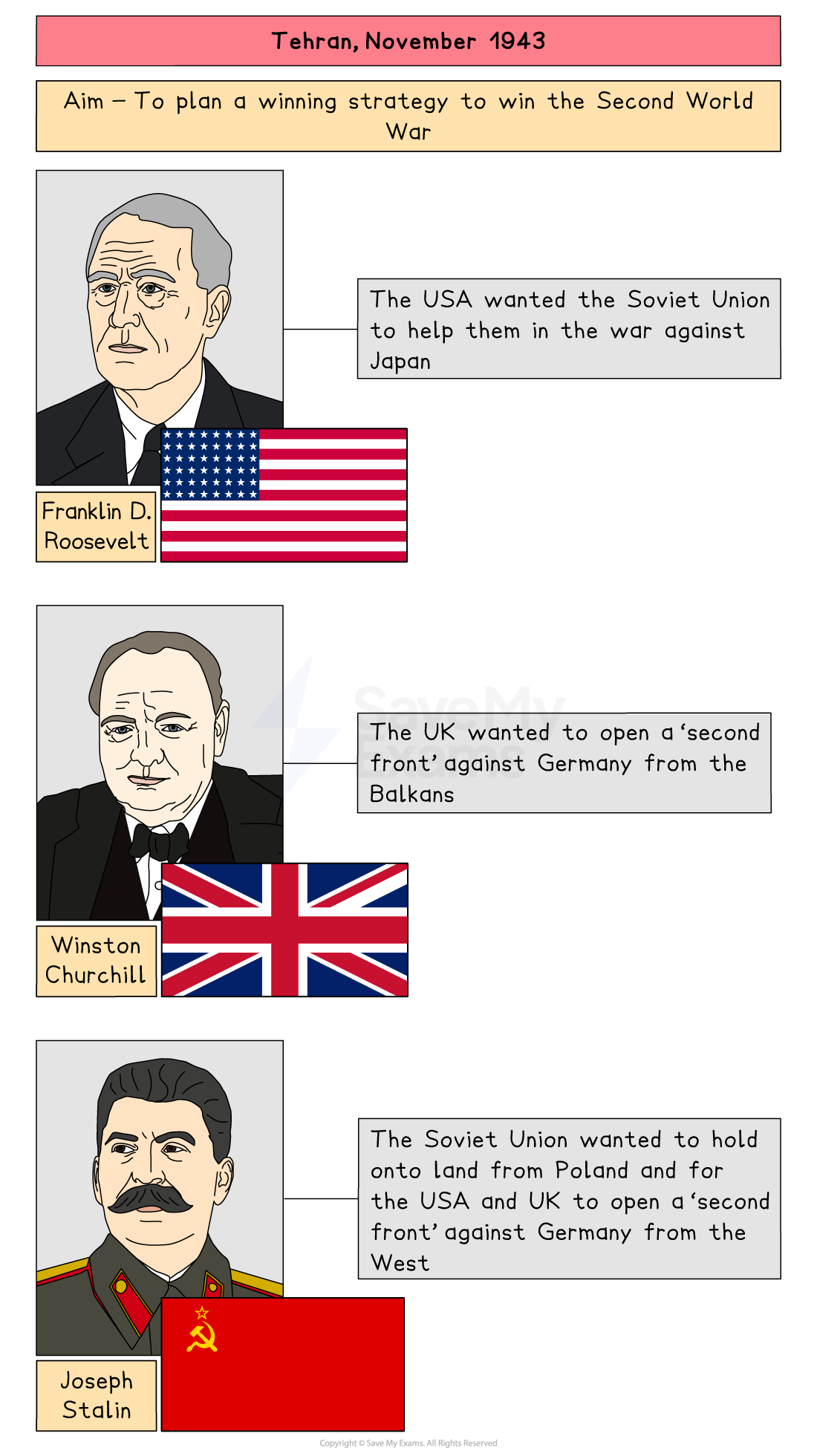
Aims for the Tehran Conference
Agreements made at the Tehran Conference
The impacts of the Tehran Conference
The conference at Tehran had a positive impact on the relationship between the USA and the Soviet Union:
Stalin was pleased that a second front beginning in northern France had been agreed
Roosevelt had supported Stalin in attacking Germany from the West and not from the Balkans as Churchill had wanted
Stalin had agreed to support the USA in its war against Japan
The conference at Tehran had a negative impact on the relationship between the USA and the UK:
Roosevelt sometimes saw British colonialism as a greater threat to world peace than the Soviet Union
Churchill was disappointed that Roosevelt had sided with Stalin in opening a ‘second front’ in northern France
Key features of the Yalta Conference
The Grand Alliance met 15 months later at Yalta - a city in the Soviet Union - during the final few months of the Second World War
Aims for the Yalta Conference

Agreements made at the Yalta Conference
After eight days the Grand Alliance reached five main agreements

The impacts of the Yalta Conference
The conference at Yalta had a positive impact on the relationship between the USA and the Soviet Union:
The Soviet Union declared war against Japan in August 1945
The Soviet Union would be awarded half of the $20 billion reparations
Roosevelt was pleased that Russia, Ukraine and Belarus had agreed to join the United Nations
Roosevelt was pleased that the Soviet Union agreed to join the United Nations, although he accepted Stalin's demand for extra seats for Ukraine and Byelorussia
The conference at Yalta had a negative impact on the relationship between the Soviet Union and the UK:
Stalin wanted a pro-Communist government to be elected in Poland whereas Churchill supported the non-Communist London Poles
Key features of the Potsdam Conference
The Grand Alliance met again a few months later at Potsdam, a city in Germany, during the end of the Second World War
Several events had happened between the conferences at Yalta and Potsdam:
Roosevelt had died and was replaced by Harry S. Truman
Truman adopted a tougher approach to Stalin
Churchill had been replaced by Clement Attlee following a general election
Germany had surrendered in May 1945
The USA had developed a new, devastating weapon: the atomic bomb
The United Nations Charter had been signed in June 1945; the UN began work in October 1945 with 51 members
Aims for the Potsdam Conference

Agreements made at the Potsdam Conference
Over two weeks of negotiation, the Grand Alliance reached four main agreements

The impacts of the Potsdam Conference
The conference at Potsdam had a negative impact on the relationship between the USA and the Soviet Union:
The USA had successfully tested the atomic bomb through the Trinity test
This increased tensions between both countries
Stalin wanted harsher reparations against Germany, while Truman wanted to protect the German economy
Truman was concerned with the Soviet Union’s control over Eastern Europe and the spread of Communism
Stalin wanted to keep his Red Army in Eastern Europe as protection against future threats
However, the leaders still reached important agreements
Germany and Berlin would be divided into four zones of occupation
The Nazi Party was banned and war criminals would be put on trial
This process was called denazification
How far did the wartime conferences increase Cold War tensions?
Evidence that the conferences increased tensions
When Stalin did not allow free elections, the West accused him of breaking his promises
The conferences confirmed that the Red Army controlled Eastern Europe, and Stalin refused to withdraw it
At Potsdam, Truman took a tougher stance with Stalin
The atomic bomb increased his confidence and Stalin's suspicion
The arguments over Poland were never settled
Germany was split into zones that were run separately in practice
This created a divided Germany, which later became a focus of Cold War tension
Evidence that the conferences did not increase tensions
At Tehran and Yalta, the 'Big Three' agreed on important matters, like the second front
This showed that cooperation was possible
Several agreements were carried out
Germany was split into occupation zones
The United Nations was set up in 1945
Many of the disagreements had causes that existed before the conferences
Therefore, the conference did not create the ideological differences between the USA and the Soviet Union
The conferences gave the leaders a chance to talk
The Cold War did not begin until 1946-47
The meetings did not lead straight to open hostility
Conclusions
The conferences did not cause the Cold War
Tehran reduced tension between the USA and the Soviet Union, because it dealt mainly with military plans, which were easier to agree on
Yalta and Potsdam increased tension because they dealt with the world after the war
The West and the Soviet Union wanted different things
The agreements were too vague to settle the disagreements
Worked Example
Explain two effects of the Potsdam Conference on US-Soviet relations.
(8)
Partial answer:
One effect of the Potsdam Conference was that it made Stalin more suspicious of the USA. Truman had delayed the conference until the atomic bomb was ready, and the USA successfully tested it the day before the conference began. He believed that the bomb would give him an advantage in the talks, so he took a "get tough" approach with Stalin, which was very different from Roosevelt's willingness to compromise. Stalin was already suspicious of the West, and he worried that the USA might one day use such bombs against the Soviet Union. As a result, he became even more determined to protect his country by keeping control of Eastern Europe as a buffer zone. This meant that the leaders left Potsdam trusting each other less than when they arrived, so relations between the USA and the Soviet Union got worse.
Examiner Tips and Tricks
An answer that only deals with one effect is capped at 4 marks, so make sure your answer includes two separate, developed points.
A reliable way to structure each effect is to name it, give one precise supporting fact, and then explain the outcome that it led to.

Unlock more, it's free!
Join the 100,000+ Students that ❤️ Save My Exams
the (exam) results speak for themselves:

Was this revision note helpful?
