Establishing the Nazi Dictatorship, 1933–34 (Edexcel IGCSE History: Paper 1: Depth Studies): Revision Note
Exam code: 4HI1

Timeline & Summary
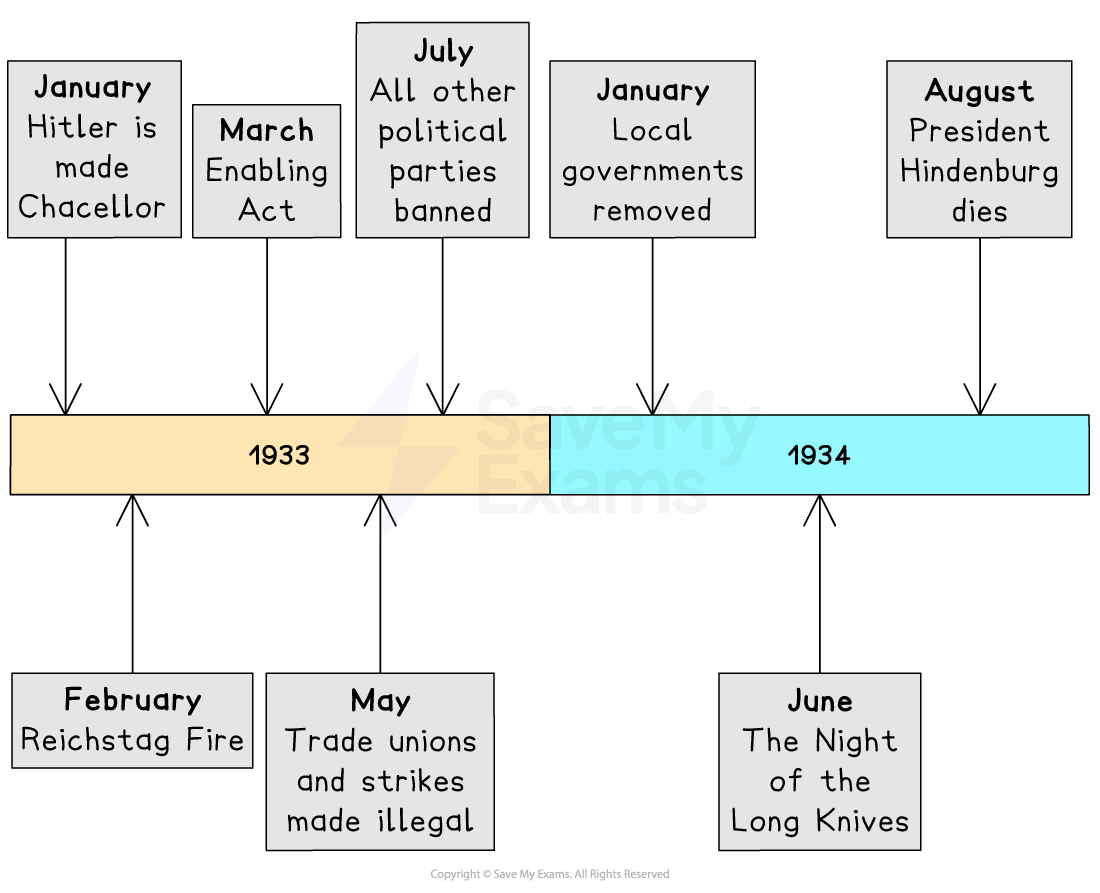
Within 18 months of becoming chancellor, Hitler turned Germany into a dictatorship with himself as its undisputed leader
The Reichstag Fire of February 1933 gave Hitler the excuse to suspend civil liberties and arrest his Communist opponents
The Enabling Act of March 1933 let Hitler make laws without the Reichstag's approval
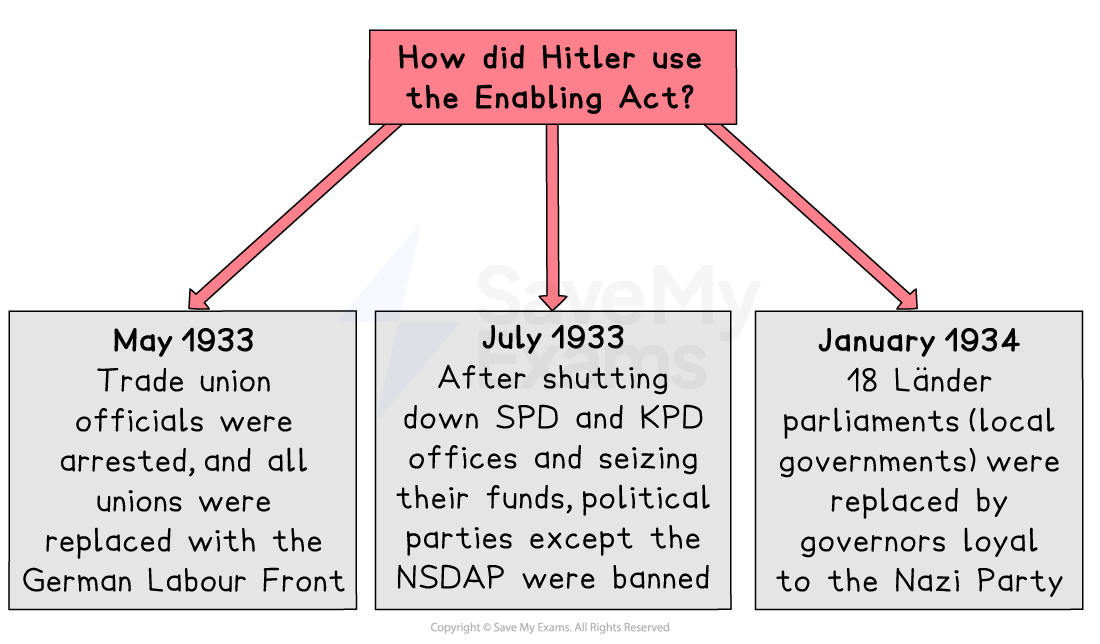
He used it to ban trade unions, rival parties and independent local government
In June 1934, Hitler used the Night of the Long Knives to destroy the leadership of the SA and settle old scores with other rivals
When President Hindenburg died that August, Hitler declared himself Führer and made the army swear personal loyalty to him
The Reichstag fire, 1933
Before the fire
Hitler became Chancellor of Germany on 30 January 1933, but still did not have complete control of Germany
The Nazi Party only controlled one-third of the Reichstag
Hindenburg was President of Germany
The Weimar Constitution limited the power of the chancellor
The fire
On 27 February 1933, a fire destroyed the Reichstag building
A Dutch communist, Marinus van der Lubbe, was found on site with matches and firelighters, confessed, and insisted he had acted alone
He was found guilty and executed by guillotine in January 1934
Historians still disagree about who was really responsible
Some believe that van der Lubbe started the fire
Others state that the Nazis started the fire themselves and blamed van der Lubbe
The one certain fact is that van der Lubbe was a communist, and the Nazis used this to their advantage

Bundesarchiv, Bild 183-R99859 / Unknown / CC-BY-SA 3.0. Firemen at the burning Reichstag, Berlin, 27 February 1933.
Examiner Tips and Tricks
As this area of history is debated among historians, the exam could contain an extract about who started the Reichstag Fire. Remember, we do not know for sure who started it. There is evidence to support whatever the author chooses to argue:
Van der Lubbe started the fire because he was found in the building with matches
The Nazis started the fire and blamed van der Lubbe because they wanted to eliminate their closest rivals – the Communists
Consequences of the fire
Hermann Goering, the new Nazi police chief, claimed the fire proved a communist plot
He urged the Nazis to seize the opportunity to destroy communist opposition
4,000 communist leaders were arrested on the night of the fire alone
On 28 February, Hitler persuaded Hindenburg to sign the Reichstag Fire Decree
This was an emergency decree that let police search homes and imprison people without trial, and ban meetings and close newspapers
Goering used it to take over the state radio
Examiner Tips and Tricks
Do not confuse the Reichstag Fire Decree (February 1933) with the Enabling Act (March 1933). The Reichstag Fire Decree paved the way to the Enabling Act but they are not the same act
The Enabling Act, 1933
The March 1933 election
The election Hitler had called for 5 March 1933 took place only six days after the fire
He claimed the fire proved a serious communist threat that only a Nazi vote could stop
Before the election, Goering replaced police officers with Nazi supporters and recruited 50,000 SA members as "police auxiliaries"
SA violence went largely unpunished
Thousands of Communists and Social Democrats were arrested and sent to concentration camps
Opposition newspapers were closed
Industrialists funded the Nazi campaign
On election day, Nazi supporters were posted at polling stations to threaten voters
The Nazis won 288 of 647 seats (43.9% of the vote)
They remained the largest party, but still did not have a majority
Passing the Act
The Enabling Act changed the constitution, so it needed a two-thirds majority in the Reichstag
Hitler won the Centre Party's votes by promising to protect the Catholic Church
The Act became law on 24 March 1933, by 444 votes to 94
All 81 members of the Communist Party were absent
Only the SPD opposed the Act
Other members of the Reichstag were intimidated by the SA before the vote took place
The Act gave Hitler's government several powers such as:
as chancellor, Hitler could propose new laws
Hitler’s cabinet could pass these laws
these laws could overrule the Weimar Constitution
Impacts of the Enabling Act
The Enabling Act was only valid for four years, but it was renewed in 1937
Parties in the Reichstag could no longer oppose new laws, marking an end to democratic rule in Germany
Hitler used the powers of the Enabling Act to remove forms of public opposition:
Examiner Tips and Tricks
Historians call this process of bringing every institution under Nazi control Gleichschaltung ("co-ordination"). Edexcel calls it "the Nazi Revolution". Either term is acceptable, but using this term, and explaining what it meant, adds depth to your answers.
The Night of the Long Knives, 1934
Why Hitler acted against the SA
The Enabling Act allowed Hitler to remove external opposition to the Nazi Party
Hitler was concerned about internal opposition, particularly from the SA
Ernst Röhm threatened the Party because he:
led around three million SA members, around 60% of whom were unemployed by 1933
wanted the SA to take over the German army
Army leaders opposed this plan, and Hitler needed their support to become President when Hindenburg died
wanted a greater focus on supporting the working class, which threatened Hitler's support from big business
clashed with the SS, led by Heinrich Himmler
The purge, 30 June 1934
SS members arrested around 200 SA officers
Many of them, including Röhm, were shot
Around 90 people are believed to have died, though the exact figure is uncertain
Hitler also took revenge on old enemies
Von Schleicher, Gregor Strasser and von Kahr were arrested and killed
Justification and reactions
On 13 July 1934, Hitler gave a speech to the Reichstag, which was broadcast on radio and defended acting outside the regular courts
The public was informed that Röhm had been planning to replace Hitler, and therefore, his death served the interests of the country
They were also told that Röhm was gay
The Nazis persecuted gay men, and Hitler used this to justify the killings
Hitler claimed that he had become "the supreme judge of the German people"
SA members felt weakened and betrayed
SS members felt rewarded with independence and Hitler's direct command
Opponents felt Hitler had shown himself a murderer
Hitler becomes Führer
On 2 August 1934, President Hindenburg died, aged 86
Hitler combined the offices of Chancellor and President and declared himself "Führer" of Germany, now known as the Third Reich
From then on, the army's loyalty oath was made directly and personally to Hitler, not to the constitution
This meant that soldiers swore to obey him personally
Hitler held a plebiscite to get public approval for these changes
After a huge propaganda campaign, he gained around 90% of the public vote
How did Hitler establish a dictatorship by 1934?
Four steps each removed a check on his power:
The Reichstag Fire let him crush the Communists.
The Enabling Act let him rule by decree.
The Night of the Long Knives removed his rivals from within the party and won the army's loyalty.
Hindenburg's death let him combine the offices of President and Chancellor to become Führer.
At every stage, Hitler combined force with legal or semi-legal methods
This made his dictatorship look constitutional even as it destroyed the constitution and democracy
By August 1934, Hitler had eliminated every rival source of power, such as:
the Reichstag
other political parties
the trade unions
the SA
the presidency
He also secured the loyalty of the one institution, the army, that could otherwise have stopped him
Examiner Tips and Tricks
For a 16-mark question about how far you agree that Hitler used the law to create a Nazi dictatorship, use the four steps above to structure your answer. Finish with a judgement about why combining legality and terror made Hitler so hard to resist
Worked Example
Explain two effects of the Reichstag Fire on Germany in 1933.
(8)
Partial answer:
One effect of the Reichstag Fire was that it allowed Hitler to crush the Communist Party almost overnight. Hermann Goering, the new Nazi police chief, claimed the fire proved the Communists were plotting against the government. On the night of the fire alone, 4,000 Communist leaders were arrested. The next day, Hitler persuaded President Hindenburg to sign the Reichstag Fire Decree, which banned political meetings and closed down newspapers. This meant that within 24 hours of the fire, the KPD (Communist Party) had lost most of its leaders and newspapers, and ordinary legal protections had disappeared. This cleared the way for the Nazis to dominate the election that followed only days later.
Examiner Tips and Tricks
Ensure that you carefully select your own knowledge. The example above shows how the fire caused 4,000 Communists to be arrested and the implementation of the Reichstag Fire Decree, which damaged the KPD.

Unlock more, it's free!
Join the 100,000+ Students that ❤️ Save My Exams
the (exam) results speak for themselves:

Was this revision note helpful?
