Soviet Expansion in Eastern Europe & the 'Iron Curtain' (Edexcel IGCSE History: Paper 1: Depth Studies): Revision Note
Exam code: 4HI1

Timeline & Summary
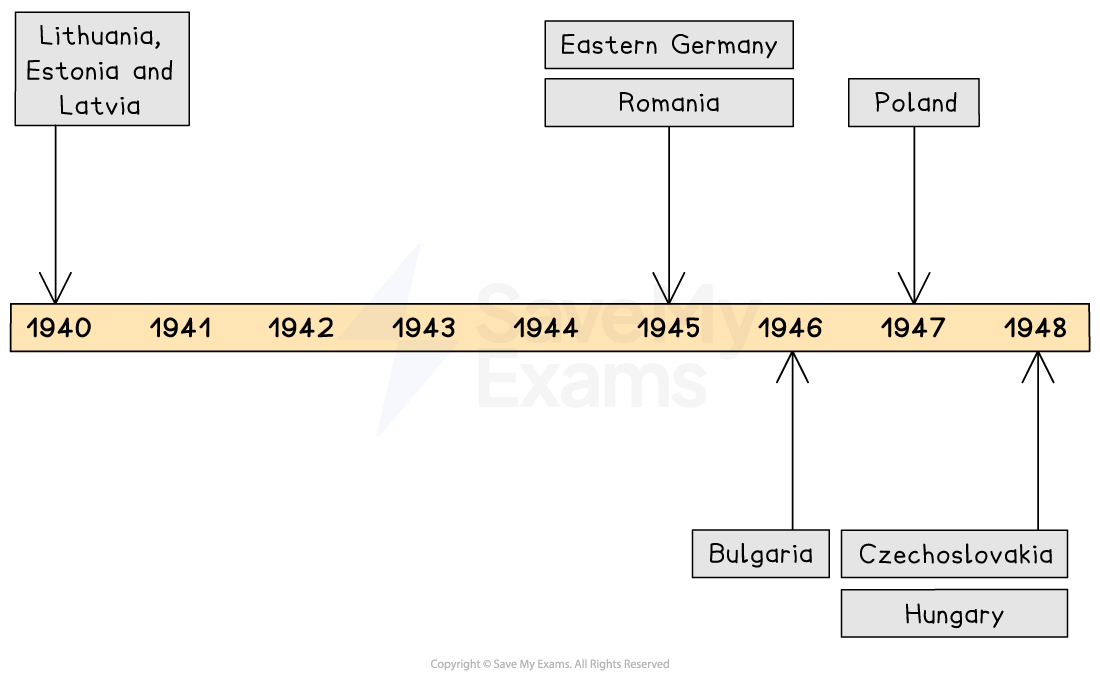
Between 1945 and 1949, the Soviet Union turned most of the countries of Eastern Europe into satellite states
These are countries that look independent but are really controlled by a stronger power
Stalin wanted a buffer zone of friendly countries between the Soviet Union and Germany
Stalin used a mixture of methods to take control, including:
rigged elections
force
the presence of the Red Army
In 1946, both superpowers tried to understand each other's intentions through secret telegrams
In March 1946, the former British Prime Minister Winston Churchill gave a public speech warning that an 'iron curtain' had come down across Europe
Soviet expansion and Churchill's speech both increased suspicion between East and West
The Soviet Union and Eastern Europe
Why Stalin wanted control of Eastern Europe
In 1944 and 1945, the Soviet Red Army freed many countries in Eastern Europe from Nazi occupation as it advanced west towards Germany
When the war ended, Stalin did not want to give up control of these countries
He wanted them as a buffer zone, which is a belt of friendly countries that protects a country from attack
Germany had invaded Russia twice in thirty years, in 1914 and in 1941
Truman’s concern about the spread of Communism was confirmed as each country fell under Soviet control
Examiner Tips and Tricks
Picture a satellite state as a moon orbiting a planet:
A moon looks like it moves on its own, but really its path is controlled by the planet's gravity
A satellite state looked like an independent country, with its own flag and government, but Moscow controlled its real decisions
How Stalin took control
The ‘Baltic States’, 1940
The ‘Baltic States’ were taken over by the Soviet Union during the Second World War
The Soviet Union saw them as legitimate Soviet states
The West and most Baltic people saw their incorporation into the Soviet Union as illegal
Poland
In 1944, the Soviet Red Army halted outside Warsaw while the Germans crushed the Warsaw Uprising (August-October, 1944), then took the city in January, 1945
At the Yalta conference, the Grand Alliance had agreed to allow free elections to be held in Poland
However, Stalin was concerned that free elections would lead to a non-Communist government being elected
During the 1947 elections, a campaign of violence and intimidation led to the creation of a fully Communist government
Romania, Bulgaria and eastern Germany, 1944-45
At Yalta, the Allies agreed that the Soviet Union would occupy eastern Germany
Romania (1947) and Bulgaria (1946) both lost their monarchies, which were replaced by Communist governments
Hungary, 1945-49
Non-Communists won the 1945 election in Hungary
However, a Communist politician called Rakosi took control of the secret police and imprisoned political opponents
After the Prime Minister of Hungary resigned, the Communists won the 1947 election
All other political parties were banned in 1949
Czechoslovakia, 1948
Czechoslovakia had been a democracy from 1918 until Nazi Germany took over the country in 1938–39
After the war, a coalition government ruled
The non-Communist Edvard Beneš was president
The Communist Klement Gottwald was prime minister
Stalin saw this as a threat to his ‘buffer zone’ and wanted a Communist government in power
In 1948, a coup led by Gottwald took full control of the government with support from the Soviet Union
Map of the Eastern Bloc

Churchill and the 'iron curtain' speech
The importance of telegrams
Both Truman and Stalin were worried by the break-up of the wartime alliance
In 1946, both leaders asked their embassies to report on attitudes in each other's countries
These reports came in the form of telegrams, which are written messages sent along a telegraph line
Kennan’s Long Telegram
George Kennan was a senior US diplomat in Moscow
His opinion on the Soviet Union was highly respected because he had lived and worked there for many years
In February 1946, Kennan sent a telegram from Moscow back to the USA
It was nicknamed the ‘Long Telegram’ because it contained around 8,000 words, far more than a typical telegram message
The telegram contained Kennan’s assessment of Soviet attitudes towards the USA
Stalin saw capitalism as a threat to communism that needed to be destroyed
The Soviet Union and the spread of communism could be ‘contained’
Peace would not be possible between the Soviet Union and the USA

Examiner Tips and Tricks
Containment is easiest to picture as a fence around a fire.
The USA was not trying to put the fire out where it already burned, in the Soviet Union itself
However, it was determined to stop the fire from spreading to any new country
Every policy you will meet later, from the Truman Doctrine to the Marshall Plan, is really a different method of fencing off communism
Novikov's Telegram
Nikolai Novikov was the Soviet ambassador in Washington
In September 1946, Novikov sent a telegram from Washington back to Stalin
The Soviet Union was aware of the Long Telegram and wanted to make a similar report on the USA
The telegram contained Novikov’s assessment of American attitudes towards the Soviet Union
The USA wanted to build up its military strength to achieve world domination
Following Roosevelt’s death, the USA no longer wanted to cooperate with the Soviet Union
The American people would support a war against the Soviet Union

Churchill's 'iron curtain' speech, March 1946
Winston Churchill was no longer the British Prime Minister, but he was still a very influential figure
Churchill was concerned that Poland, Hungary, Romania and Bulgaria had fallen under Soviet control
In March 1946, Churchill delivered a speech about the Soviet Union being a threat to freedom and peace:
from Stettin in the Baltic to Trieste in the Adriatic, an iron curtain has descended across the continent
The 'iron curtain' in post-war Europe

The 'iron curtain' was Churchill's phrase for the sharp divide between capitalism in the West and communism in the East
It was not a physical divide
The 'iron curtain' represents a divide in ideas about how countries should be run
As Churchill gave the speech in the USA, Stalin believed that it also reflected the beliefs of Truman and the US government
The speech helped turn American public opinion against Stalin
They had been friendly towards the Soviet Union during the war
Stalin responded by calling Churchill a 'warmonger' and compared him to Hitler, which took relations to a new low
How did Soviet expansion increase tension between East and West?
Evidence that Soviet expansion increased tension
Truman saw the creation of satellite states as proof that Stalin wanted to spread communism across the whole world
The methods Stalin used convinced the West that Stalin could not be trusted to keep his promises
At Yalta, Stalin had promised free elections in Eastern Europe
The 'free' elections in Poland, Hungary, Bulgaria and Romania were not genuinely free
The Long Telegram and the Novikov Telegram show that both sides were already assuming the worst about each other by 1946
Churchill's speech made the division of Europe public and gave it a memorable name, the 'iron curtain'
This increased Western fear of Soviet expansion
It encouraged Stalin to strengthen his forces and his propaganda
Evidence that other factors mattered too
Some of Stalin's actions were defensive rather than purely aggressive
Countries such as Poland had been used as an invasion route into Russia before
A buffer zone had a genuine security purpose for the Soviet Union
Yugoslavia and Albania show that Soviet-style communism did not automatically mean full Soviet control
These countries stayed Communist without being occupied by the Red Army
Both sides used the telegrams to confirm suspicions they already held
Kennan and Novikov were not the cause of the mistrust, only evidence that it already existed
Conclusions
Soviet expansion in Eastern Europe was a major reason why tension increased between 1945 and 1949
It turned the West's fear of communism from a general worry into a specific list of countries that had already been lost
However, the expansion built on suspicion that already existed from the war
It intensified an existing problem rather than creating a completely new one
Worked Example
'The main reason why Cold War tension increased between 1945 and 1949 was Soviet expansion in Eastern Europe.'
How far do you agree? Explain your answer.
You may use the following in your answer:
the 'iron curtain'
the dropping of the atomic bomb.
You must also use information of your own
(16)
Partial answer:
I only partly agree with the statement. Soviet expansion in Eastern Europe gave the West clear, specific evidence of Stalin's ambitions. However, it only caused so much tension because the two sides already distrusted each other over their different ideologies. I will judge each factor by asking how far it turned general suspicion into a real increase in hostility between 1945 and 1949.
Examiner Tips and Tricks
The statement names only one side. Your task is to weigh the threat of the Soviet expansion in Eastern Europe against other Cold War tensions and reach a judgement.
Once you state a view, carry that line of judgement through your answer and explain your criterion, for example how far each factor turned existing suspicion into open hostility. Explain how Soviet expansion caused tension, then weigh it against the ideological differences that already existed between the two sides.

Unlock more, it's free!
Join the 100,000+ Students that ❤️ Save My Exams
the (exam) results speak for themselves:

Was this revision note helpful?
