The Prague Spring & the Soviet Invasion of Czechoslovakia, 1968 (Edexcel IGCSE History: Paper 1: Depth Studies): Revision Note
Exam code: 4HI1

Summary
Czechoslovakia had been under Soviet-backed Communist rule since 1948
The government was very unpopular
In 1968, the new Czechoslovak leader, Alexander Dubcek, introduced reforms known as the Prague Spring
This offered "Socialism with a human face"
The Soviet Union's leader, Brezhnev, feared the reforms would spread
On 20 August 1968, Warsaw Pact troops invaded Czechoslovakia
The invasion ended the Prague Spring
Dubcek was removed from power in April 1969
Czechoslovakia then stayed under Soviet-approved Communist rule for around 20 years
Brezhnev then set out the "Brezhnev Doctrine"
This said the Soviet Union and its allies had the right to intervene in any Communist country where communism was under threat
The invasion had a limited effect on relations between the USA and the Soviet Union
Causes of the Soviet invasion of Czechoslovakia
Opposition to Soviet control
In 1948, Stalin supported a coup in Czechoslovakia
This removed non-Communists from power
The coup set up a pro-Soviet Communist government under Klement Gottwald
Life under Communist rule was difficult for Czech people
In effect, the country was ruled by the Soviet Union, which used the secret police to maintain control
The economy was run for the benefit of the Soviet Union
There were few consumer goods for the Czech people
There was no freedom of speech
The radio, newspapers and television were censored
Between 1949 and 1954, the Czechoslovak government carried out purges
The victims included democratic politicians, military leaders, Catholics, Jews, people with wartime links to the West, and even high-ranking Communists
Protests against the low standard of living and lack of freedom grew
Student demonstrations in 1967 showed how unpopular the government was
Dubček and the Prague Spring
In January 1968, Alexander Dubček became First Secretary of the Czechoslovak Communist Party
This in effect made him head of the Czechoslovak government
He replaced the hard-line leader Antonín Novotný, whom Brezhnev no longer supported
The Soviet leadership approved of him
They trusted him to:
make the government more effective and less unpopular
keep the country completely loyal to the Soviet Union
Dubček was committed to the Warsaw Pact and a devoted Communist
Dubček popularised the term 'Socialism with a human face'
Dubček wanted the Czech public to enjoy living in a Communist state by being able to:
express their opinion about Communism
raise concerns about their government without facing punishment
gain access to a better quality of life
Dubček's reforms

Reaction to Dubček's reforms
The Czech public reacted positively to the Prague Spring reforms
The Soviet Union did not like Dubcek's reforms
Brezhnev replaced Khrushchev as the leader of the Soviet Union in 1964
He was not as open to reform as Khrushchev had claimed to be
The Soviet Union became concerned about Dubček's commitment to the Warsaw Pact
Dubček confirmed that Czechoslovakia would remain a loyal ally to the Soviet Union
Brezhnev did not want Dubček's actions to encourage other satellite states to reform
In the 1960s, the Soviet Union's control over Eastern Europe was not as strong as it had been in the 1940s
Yugoslavia had broken away from Soviet control in 1948
Romania had refused to attend Warsaw Pact meetings
Brezhnev needed to keep control over Czechoslovakia
Examiner Tips and Tricks
Look for patterns when you explain causes.
Hungary in 1956 and Czechoslovakia in 1968 both involved satellite states wanting reform, and both were crushed by Soviet troops under different leaders (Khrushchev and Brezhnev).
This shows that Moscow's refusal to accept reform in its satellite states was a long-term underlying cause, while Dubček's reforms were the trigger that made it act.
Comparing the two events like this lets you argue about continuity, which strengthens your judgement.
Events of the Soviet invasion of Czechoslovakia
Brezhnev believed that he needed to take urgent action against Dubček and the Prague Spring reforms
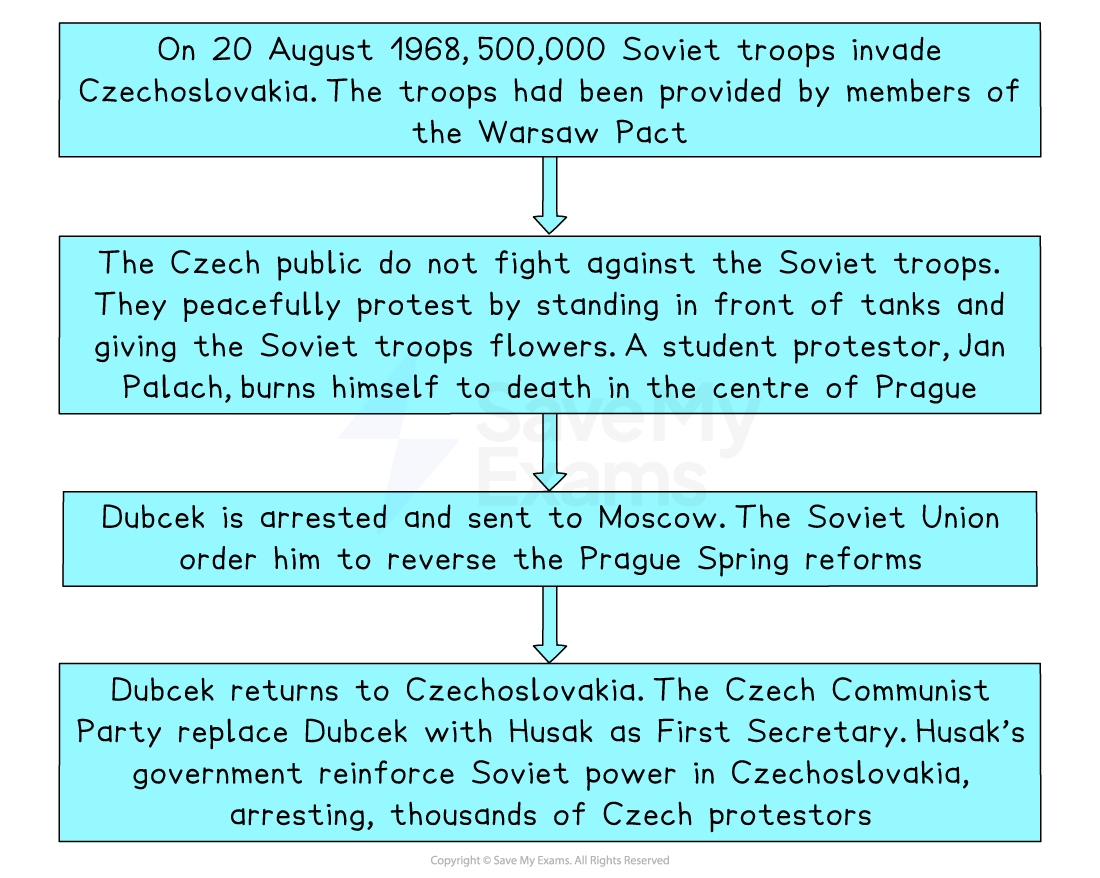
Brezhnev's actions ensured that Czechoslovakia remained under Soviet control for the next 20 years
Husák remained loyal to the Soviet Union
The Czechoslovak government punished any signs of dissent
Examiner Tips and Tricks
An exam question could ask you how far you agree that the Soviet invasion of Czechoslovakia was the main reason why superpower relations changed after 1968.
To achieve Levels 3 and 4 (9–16 marks) you must discuss the stated reason in the question: here, the Soviet invasion of Czechoslovakia
The Brezhnev Doctrine
Brezhnev published his doctrine in the Communist newspaper Pravda on 26 September 1968
The Brezhnev Doctrine aimed to bring the satellite states under more direct Soviet control

What was the impact of the Soviet invasion of Czechoslovakia on superpower relations?
Impact inside Czechoslovakia
The invasion ended the Prague Spring
The authorities soon put things back to 'normal' under Soviet-approved control
Impact on relations between Communist countries
Yugoslavia and Romania condemned the invasion
This strained their relations with Moscow
The Communist parties of Italy and France publicly criticised the invasion
East Germany and Poland welcomed the invasion
They could feel more secure that they would not be challenged by reformers in their own countries
The defeat of the Prague Spring led to greater Soviet control of the Warsaw Pact, which the Brezhnev Doctrine emphasised
Evidence that relations between the USA and the Soviet Union worsened
The USA and other Western governments were angered by the invasion
Many of them made strong protests to the Soviet Union
There was an attempt to pass a formal resolution criticising the invasion in the United Nations
This was vetoed by the Soviet Union
It made the West more suspicious of Soviet aims in Eastern Europe
President Johnson cancelled a planned summit with the Soviet Union, delaying the start of the SALT talks until 1969
Evidence that relations changed little
The USA did not take direct action
The Soviet Union saw that, while the USA might make protests, it would not take direct action to oppose the Soviet Union in Europe
At this time, the USA was involved in a costly war in Vietnam
It was beginning to adopt a less confrontational approach towards the Soviet Union
The USA regarded Eastern Europe as within the Soviet sphere
It was not worth risking a nuclear war over it, as in Hungary in 1956
The US government became more determined to pursue friendly relations with the Soviet Union
The process is often referred to as détente
Conclusions
The invasion had a much bigger impact on the Communist world than on superpower relations
It split the Communist countries and tightened Soviet control for around 20 years
Its effect on the USA and the Soviet Union was short-term anger and protest, but no crisis
In the long term, it showed both sides accepted the limits of each other's sphere of influence
Worked Example
Explain two effects of the Soviet invasion of Czechoslovakia.
(8)
Partial answer:
One effect was that the Prague Spring was ended and Czechoslovakia was brought back under strict Soviet control. Dubček was arrested, taken to Moscow and ordered to reverse his reforms. In 1969, he was replaced by Gustav Husák, who was very loyal to Moscow. Husák arrested over 1,000 Czechoslovak people, so for the next 20 years the country stayed under Soviet-approved Communist rule and any hope of reform was lost. This meant that the Prague Spring had failed and Czechoslovakia continued to struggle under Communist rule.
Examiner Tips and Tricks
Try to create a chain of consequences when explaining the effects of a person or an event.
In the worked example, Dubček's arrest led to Husák's appointment, which in turn kept Czechoslovakia under Soviet-approved Communist rule for 20 years.

Unlock more, it's free!
Join the 100,000+ Students that ❤️ Save My Exams
the (exam) results speak for themselves:

Was this revision note helpful?
