The Berlin Wall, 1961 (Edexcel IGCSE History: Paper 1: Depth Studies): Revision Note
Exam code: 4HI1

Summary
By 1961, millions of East Germans had left for the West through Berlin
This took skills East Germany badly needed
It embarrassed the Communist government
Khrushchev's pressure on the West over Berlin failed
The talks at Vienna in June 1961 ended with no agreement
On the night of 12 August 1961, East German troops began to close the border
Barbed wire soon became a concrete wall
The Wall:
split families
led to the deaths of people who tried to cross it
angered West Germany
It became a powerful symbol of the divide between East and West
However, the positive impacts of the Berlin Wall included:
stopping the refugee crisis
reducing the risk of war over Berlin
Why was the Berlin Wall built?
Long-term reasons
Berlin had been a longstanding issue between the superpowers
In the peace conferences of 1945, the governing of Berlin became the responsibility of the USA, France, Britain and the Soviet Union
When the Western powers combined their zones of Germany into Trizonia, the Soviet Union blockaded Berlin in June 1948
The Soviet blockade of Berlin lasted almost a year
East and West formally divided their zones of Germany into the GDR and the FRG in 1949
Examiner Tips and Tricks
Don't mix up the two Berlin crises. The Berlin Blockade was in 1948–49; the crisis that led to the Wall was in 1958–61.
The refugee problem
The difference between East and West Germany
West Germany grew wealthy
It received Marshall Aid
Most people enjoyed a high standard of living
East Germany was poor
It was blocked by the Soviet Union from receiving Marshall Aid
Comecon gave little support in rebuilding East Germany
People had a low standard of living
The secret police watched them closely
There were many limits on what they could say or do
In 1953, there were riots against the government
The Soviet Union sent armed force to restore order
Movement between East and West Germany
It was easy to move between East and West Germany through Berlin
Berlin was shared between East and West
A person could travel from East Berlin to West Berlin, and from there on to West Germany
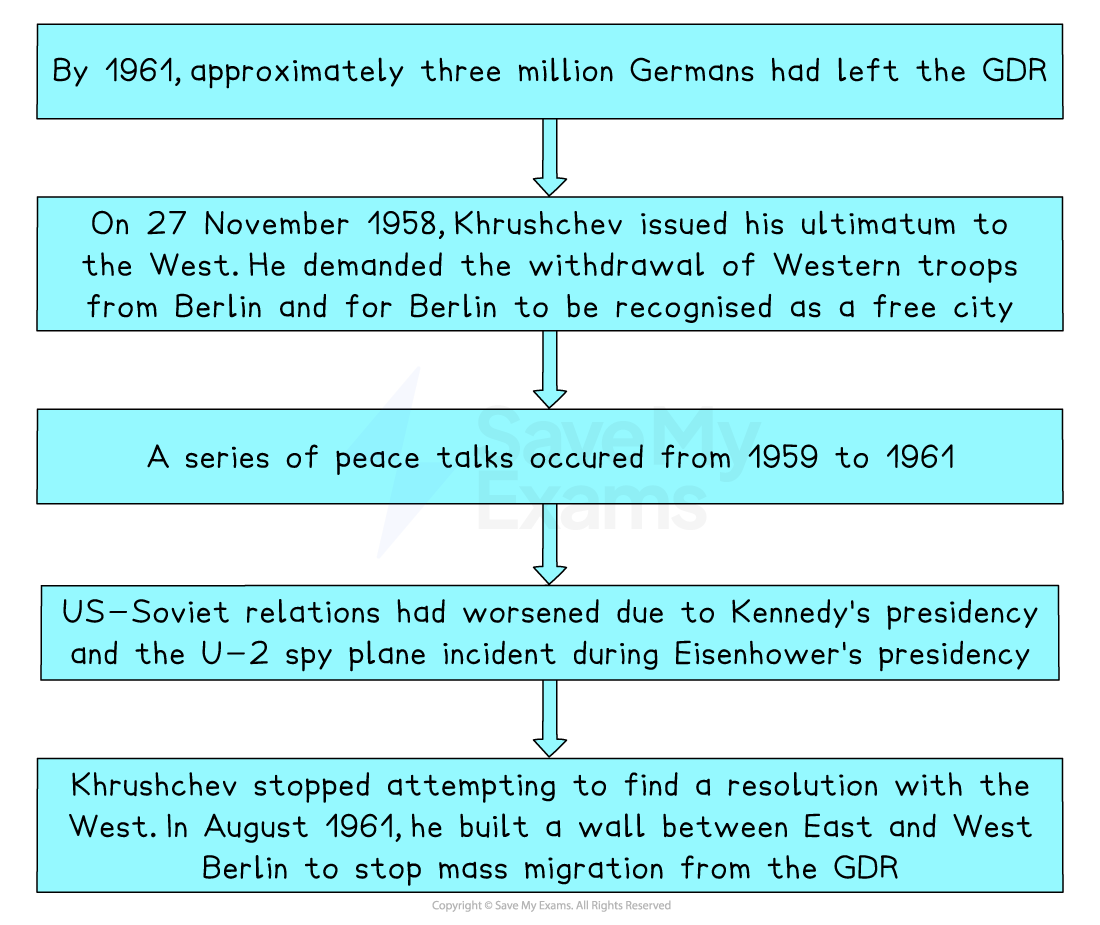
By 1958, about 3 million East Germans had crossed to the West
This was over a sixth of the country's population
Many were skilled workers, such as engineers, technicians and teachers, who could earn much higher salaries in West Germany
The impact of the refugee problem
This was a double problem for Khrushchev
It damaged the East German economy
It created a skill gap in the East German economy
It was a propaganda disaster for communism
People were showing that they preferred the Capitalist West
Short-term reasons
The situation in Berlin required Khrushchev to act quickly
By August 1961, up to 2,000 East Germans a day were escaping through Berlin, and about 2,400 left on 12 August alone
Walter Ulbricht, the leader of the GDR, urged Khrushchev to act quickly to prevent more East Germans from leaving
In November 1958, Khrushchev demanded that Western troops leave Berlin within six months
Talks from 1959 to 1961, including the Paris Summit and Vienna, failed to settle the Berlin issue
Building the Berlin Wall
Overnight on 12–13 August 1961, the East German government put up barbed wire
The Berlin Wall developed from barbed wire to a concrete structure during the 1960s

Examiner Tips and Tricks
A common misconception that students have is that the East German government constructed a concrete wall overnight. The Berlin Wall was under constant development from its creation. The GDR replaced the temporary divide of barbed wire and cinder blocks. From 1965, concrete slabs replaced the earlier walls, and by the late 1970s the Wall was a 3.6-metre concrete barrier
The effects of the Berlin Wall on relations between East and West Germany
East and West Germany
As there had been free movement between East and West Berlin, many people travelled between the two sectors to visit family and friends or for work
As a result, many people became stuck in East Berlin
The wall separated German families and friends for years
Many East Germans continued to attempt escape plans to West Berlin
The GDR killed over 130 people attempting to go over, around or under the Berlin Wall between 1961 and 1989
Escape plans included:
climbing and jumping from windows next to the wall
flying over the wall in hot air balloons
using open-top cars to duck underneath the barriers at the Berlin Wall's checkpoints
using the sewer systems to travel to West Berlin
In 1962, the failed escape attempt by Peter Fechter caused international outrage
The GDR border guards shot Fechter when he attempted to escape
Fechter fell into no-man's-land at the foot of the Wall
The West Berlin police and American soldiers could not reach Fechter
The GDR border guards did not attempt to treat Fechter's injuries
Fechter died of his injuries 45 minutes after he was shot
The nature of Fechter's death damaged the GDR's reputation
Relations between the two German governments
The Wall confirmed that Germany was split into two separate states
West Germany refused to recognise the GDR as a country and had no official relations with it
The GDR became more firmly tied to the Soviet bloc
Relations stayed frozen until West Germany's Ostpolitik and the Basic Treaty of 1972
The effects of the Berlin Wall on superpower relations
The Berlin Wall created a mixture of positive and negative impacts on US–Soviet relations
Negative outcomes of the Berlin Wall
The Soviet Union authorised the construction of the Berlin Wall without consulting the US government
It demonstrated that the Soviet Union did not value the West's opinion
The possibility of uniting Germany into one country seemed further away than ever after the building of the Berlin Wall
East Germans found it much more difficult to escape the GDR
The Soviet Union gained a reputation for repressing its own people
In the short term, tension rose: Kennedy sent extra troops and aircraft to Europe and called up about 150,000 reservists
In October 1961, US and Soviet tanks faced each other at Checkpoint Charlie after East German guards demanded to check the papers of US officials
Positive outcomes of the Berlin Wall
West Berlin remained independent of communist influence
It became a symbol of freedom across Europe
The Berlin Wall created a stalemate
Khrushchev had failed to force the Western powers out of West Berlin
Kennedy had shown that Khrushchev could not bully the USA out of Berlin
The migration of millions of East Germans was no longer an issue between the two countries
Kennedy's 'Ich bin ein Berliner' speech
Kennedy visited West Berlin in June 1963
Thousands of West Berliners gathered to see Kennedy
They placed flowers on his route through West Berlin and chanted his name
Kennedy was a symbol of freedom for the West Berliners
On 26 June 1963, Kennedy addressed the West Berliners in what is now known as the 'Ich bin ein Berliner' ('I am a Berliner') speech

Kennedy's speech praised the strength of West Berlin and maintained the USA's image as the protector of freedom
How far did the Berlin Wall ease or worsen Cold War tensions?
Reasons why the Berlin Wall eased tensions
The Berlin Wall meant there was less chance of a nuclear war developing over Berlin
Kennedy stated: "a wall is a hell of a lot better than a war"
The Berlin Wall ended the day-to-day comparison between Communist East Berlin and Capitalist West Berlin
This allowed both states to develop and function independently from each other
Reasons why the Berlin Wall escalated tensions
It was a diplomatic failure for the USA and the Soviet Union
It showed that the attempts to talk about the issue of Berlin had failed
The Berlin Wall created a physical divide to match the ideological divide between East and West
It became a symbol of the Cold War until 1989
Conclusions
If tension means the risk of war, the Wall eased tensions
It settled the Berlin dispute without a fight
If tension means hostility and propaganda, the Wall worsened tensions
It showed the world what communism had to do to keep people in
Worked Example
'The main reason why the Berlin Wall was built in 1961 was the refugee problem.'
How far do you agree? Explain your answer.
You may use the following in your answer:
the skills gap
the failure of talks over Berlin.
You must also use information of your own.
(16)
Partial answer:
The failure of talks over Berlin also mattered. In 1958, Khrushchev's ultimatum tried to force the Western powers out of Berlin, which would have closed the escape route, but the West refused. The talks of 1959 to 1960 achieved nothing, and the Paris Summit collapsed over the U-2 incident. This left Khrushchev with no peaceful way to solve the problem. As a result, he built the Berlin Wall as a physical barrier to stop people from leaving East Germany through Berlin. However, this was less important than the refugee problem. This is because the talks were only an attempt to solve the refugee problem so it was a consequence of this factor.
Examiner Tips and Tricks
Keep one line of argument running through the whole answer. This paragraph explains why the failed talks mattered, but its last two sentences say they mattered less because the talks were only an attempt to solve the refugee problem.
Think of the answer as a necklace. Each paragraph is a bead, and your judgement is the string that holds them together.

Unlock more, it's free!
Join the 100,000+ Students that ❤️ Save My Exams
the (exam) results speak for themselves:

Was this revision note helpful?
