Reorganising the Nazi Party, 1924–28 (Edexcel IGCSE History: Paper 1: Depth Studies): Revision Note
Exam code: 4HI1

Summary
The failed Munich Putsch convinced Hitler that the Nazis could not seize power by force
After his release from prison in December 1924, he set out to win power "legally" through elections
Between 1924 and 1928, Hitler:
rebuilt the party's national organisation
relaunched its propaganda machine
set up new bodies such as the SS and the Hitler Youth
Despite this reorganisation, the Nazi Party had very limited electoral support in these years
It won only 12 seats in the 1928 Reichstag election
This was largely because of Stresemann's economic recovery and diplomatic successes
Stability and prosperity gave most Germans little reason to vote for an extreme party promising to overthrow the Republic
Reorganisation of the Party, 1924–28
A change of strategy
While in prison, Hitler decided that the Nazis had been wrong to try to seize power through violent revolution
The party should instead try to win support by legal means
This would let the Nazis take power using the very constitution they despised
Rebuilding the organisation
The ban on the Nazi Party was lifted in February 1925
Hitler relaunched it in the same Munich beer hall that had been the location of the putsch, in front of 4,000 supporters
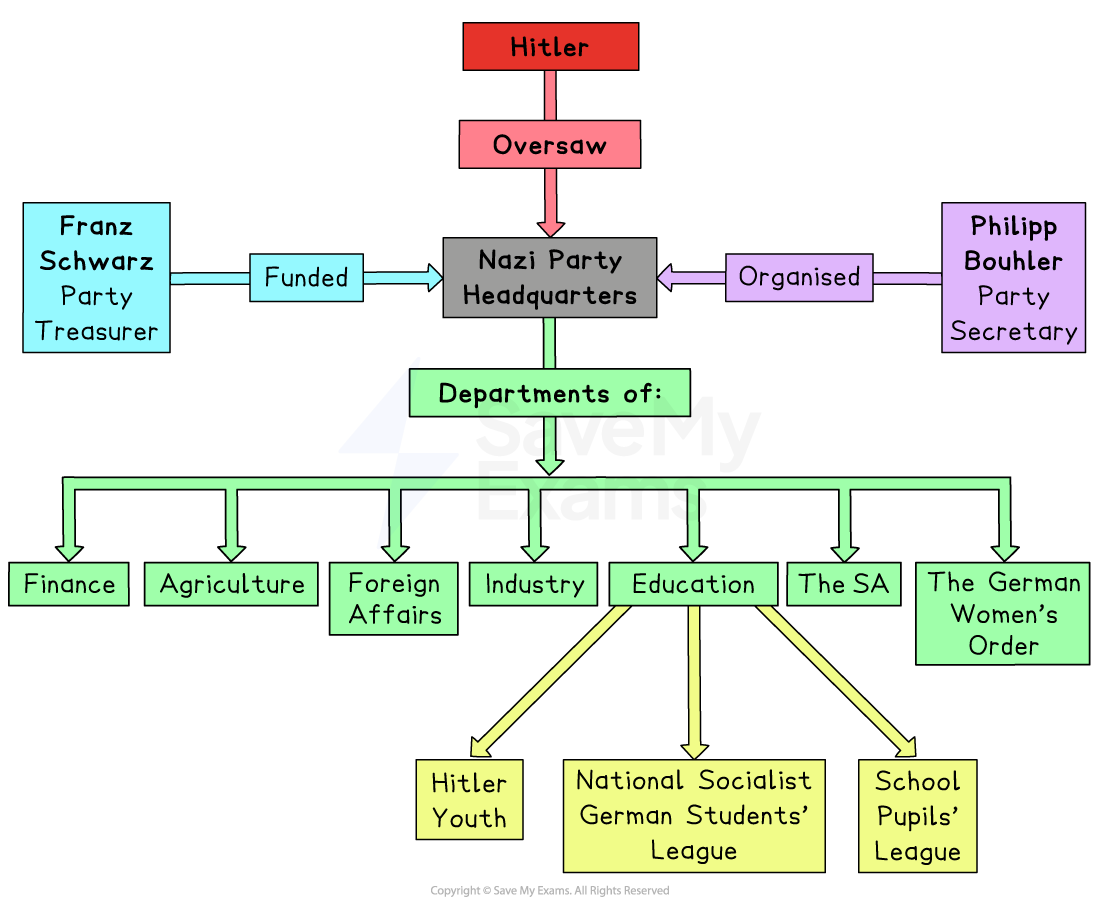
Hitler created a national headquarters for the party in Munich
He divided Germany into 34 districts, appointing a leading Nazi to build support in each one
At the Nuremberg rally of 1927, weak Gauleiters (district leaders) were replaced
Philipp Bouhler and Franz Schwarz ran the party's administration and finances
New ideas
Mein Kampf
Hitler's book, Mein Kampf, was published in 1925
Mein Kampf means "My Struggle"
It sold slowly at first but became a bestseller after 1930
The book set out his key beliefs, including:
antisemitism: blaming Jewish people for Germany's problems and wanting them removed from German life
the need for more living space (Lebensraum) for Germans
the Führerprinzip (leader principle): the belief that one leader, Hitler, should hold total power
the dominance of the Aryan race
The Bamberg Conference
In 1926, Hitler called a party conference at Bamberg
Bamberg established the Führerprinzip: party members had to obey Hitler absolutely
He attacked the socialist side of the party, suggesting they were communists and enemies of the Nazis
Gregor Strasser, leader of the party's socialist wing, accepted Hitler's leadership, which united the party behind him
He strengthened the nationalist side of the party by persuading industrialists to join the Nazis and attacking Jewish people
He was confirmed as leader
Propaganda
Joseph Goebbels became the Nazi leader in Berlin in 1926 and later took charge of the party's propaganda
He used simple slogans, posters and rallies to spread the Nazi message
The Nazis held public meetings across Germany
They trained members to be effective public speakers
The party paid particular attention to winning the support of farmers
This is because German agriculture was suffering badly in the late 1920s
New organisations
Hitler encouraged more young people to join the SA
He set up the Hitler Youth (1926) to win over young Germans before they were old enough to vote
The party took over the German Women's Order to gain support from women
Hitler created a new, more elite private bodyguard called the Schutzstaffel, or SS
Examiner Tips and Tricks
Notice how many of the institutions that later ran Nazi Germany after 1933, including the SS, the Hitler Youth and Goebbels's propaganda machine, actually began life in this "wilderness" period, 1924 to 1928, when the party had almost no electoral success.
In a question on 1924–28, explain how the reorganisation helped the party survive. Only use evidence from the years in the question.
Why did the Nazi Party have limited support before 1929?
By 1929, the NSDAP had 100,000 members
Despite this success, historians call this period "The Lean Years"
In the May 1928 election, the Nazi Party only won 12 seats (roughly 3% of the overall votes)
They were the ninth largest party in the Reichstag

Conclusions
The reorganisation gave the party a strong internal structure and a clear identity
However, its message of crisis and revolution had little appeal while Germany appeared calm and increasingly prosperous
In these years, the Nazis remained a small, mainly rural, extremist party
Worked Example
Study Extract C.
Extract C: From an account of life in Weimar Germany, published in 1959.
"Support for the Nazi Party had grown due to the country's problems of hyperinflation and the French invasion of the Ruhr. By 1928 Nazism appeared to be a dying cause. Now that Germany's outlook was suddenly bright, the Nazi Party was rapidly withering away. One scarcely heard of Hitler or the Nazis except as a joke."
What impression does the author give about the Nazi Party in 1928?
You must use Extract C to explain your answer.
(6)
Partial answer:
The author gives the impression that by 1928 the Nazi Party was no longer a serious threat and had almost disappeared from view. The author says plainly that "Nazism appeared to be a dying cause" and that the party "was rapidly withering away". The word "withering" makes the party sound like a dying plant, which gives the idea of a slow, natural decline rather than one sudden defeat. The author also shows that the party's earlier growth had depended completely on crisis conditions, by linking its support directly to "hyperinflation and the French invasion of the Ruhr". This was the Nazi Party's 'food'. This means that once "Germany's outlook was suddenly bright" again, that support had nothing left to feed on, and the Nazi Party was dying.
Examiner Tips and Tricks
The strength of this answer is how it explores the author's choice of words. Remember, the author is intentionally selecting the words they use to explain their viewpoint.
Ensure you spend at least 5 minutes reading the extract, highlighting key words from it and annotating your own knowledge around it before writing your answer.

Unlock more, it's free!
Join the 100,000+ Students that ❤️ Save My Exams
the (exam) results speak for themselves:

Was this revision note helpful?
