Nazi Racial Policy & the Persecution of Jewish People, 1933–39 (Edexcel IGCSE History: Paper 1: Depth Studies): Revision Note
Exam code: 4HI1

Timeline & Summary
Nazi ideology divided people into superior and inferior races
They saw the Aryan race as the ideal
Groups such as Jewish people, Roma and Sinti people, and people with disabilities were condemned as Untermenschen, or "sub-humans"
The Nazis used forced sterilisation and, from 1939, murder (which they called "euthanasia") against Germans they judged to be a "burden"
They persecuted Roma and Sinti people and Black Germans as supposedly inferior races
Persecution of Jewish people intensified in stages
Legal punishment from 1933
Formal segregation under the 1935 Nuremberg Laws
Economic punishment and violent terror from 1938, resulting in 'Kristallnacht'
Many Jewish people tried to emigrate
However, most countries, including Britain and the USA, severely limited refugee numbers
By 1939, around 214,000 Jewish people remained trapped in Greater Germany
Nazi racial policies
Hitler outlined his belief in a racial hierarchy in his book, Mein Kampf. Hitler stated that:
Aryans were the superior race — blonde, blue-eyed and athletic
other white Western races were respected, but lower than Aryans
races of Eastern Europe like Slavs were seen as Untermenschen (sub-humans)
the Nazis believed that gay men lowered moral standards as they could not procreate or be part of a traditional family unit
the Nazis believed that people with disabilities were a burden on society
Jewish people and Roma were seen as the lowest races and a threat to Aryan "racial purity"
How were minorities treated in Nazi Germany before the Second World War?
In 1935, marriage between Black people and Aryans was banned
From 1936, young people in trouble with the law, homeless people, homosexuals and Jewish people were sent to concentration camps
After 1938, Roma and Sinti communities were too

Examiner Tips and Tricks
Keep this alongside the persecution of Germans with disabilities, Roma and Sinti people and Black Germans.
Exam questions on Nazi racial policy can draw on any of these groups, so have at least one fact ready about each.
The increasing persecution of Jewish people, 1933–39
Jewish people were less than 1% of the German population (about 500,000 people)
After the First World War, many Germans looked for a scapegoat
Hitler claimed Jewish people were responsible for defeat and economic hardship
1933–1934
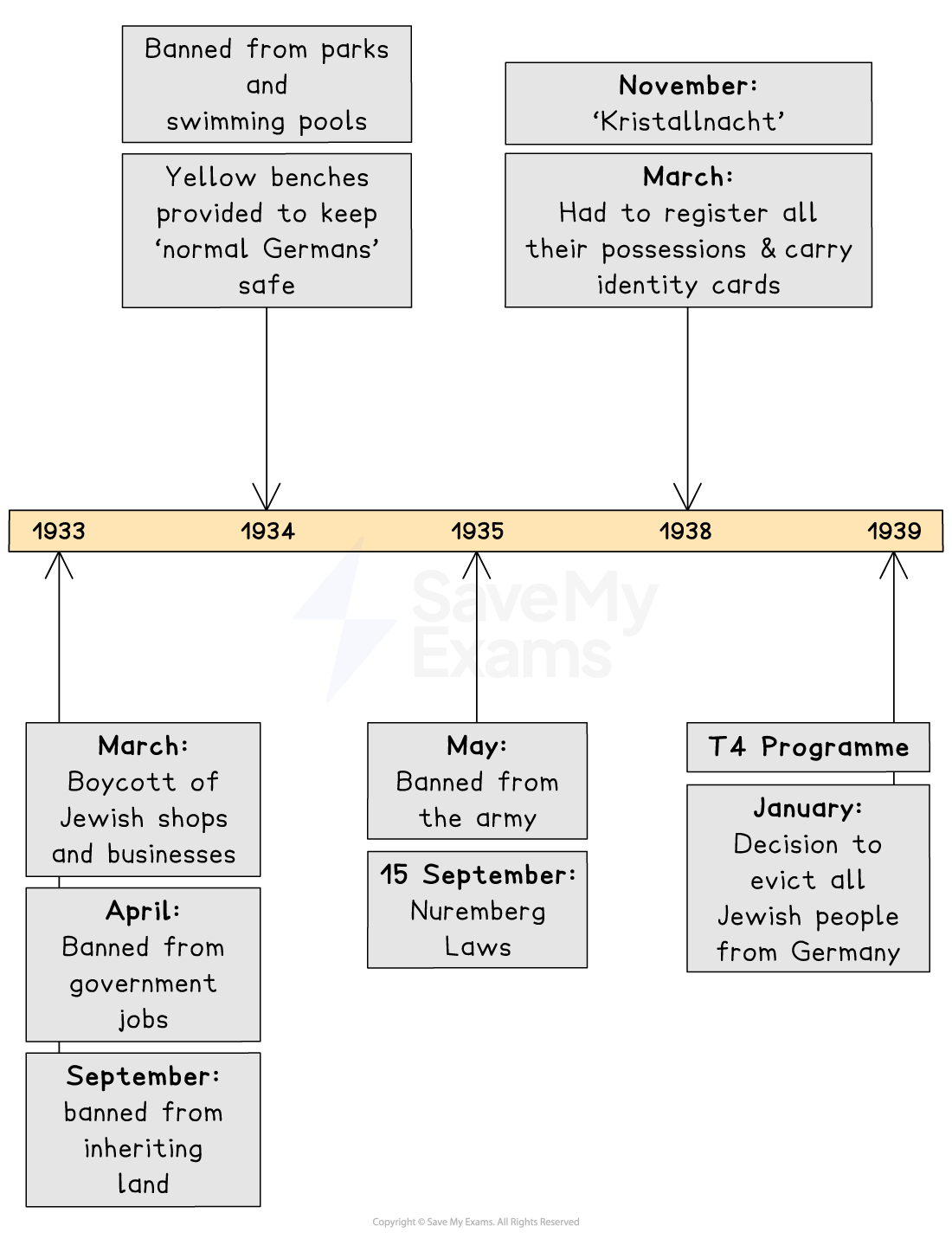
In March 1933, a nationwide boycott of Jewish shops began
SA members blocking entry to Jewish shops
Jewish people were banned from government jobs and teaching, and later in 1933 from journalism
Jewish doctors lost state health-insurance work, and their licences were taken away in 1938
From 1934, Jewish people were banned from public places such as parks, cinemas and swimming pools
From May 1935, they could not join the army
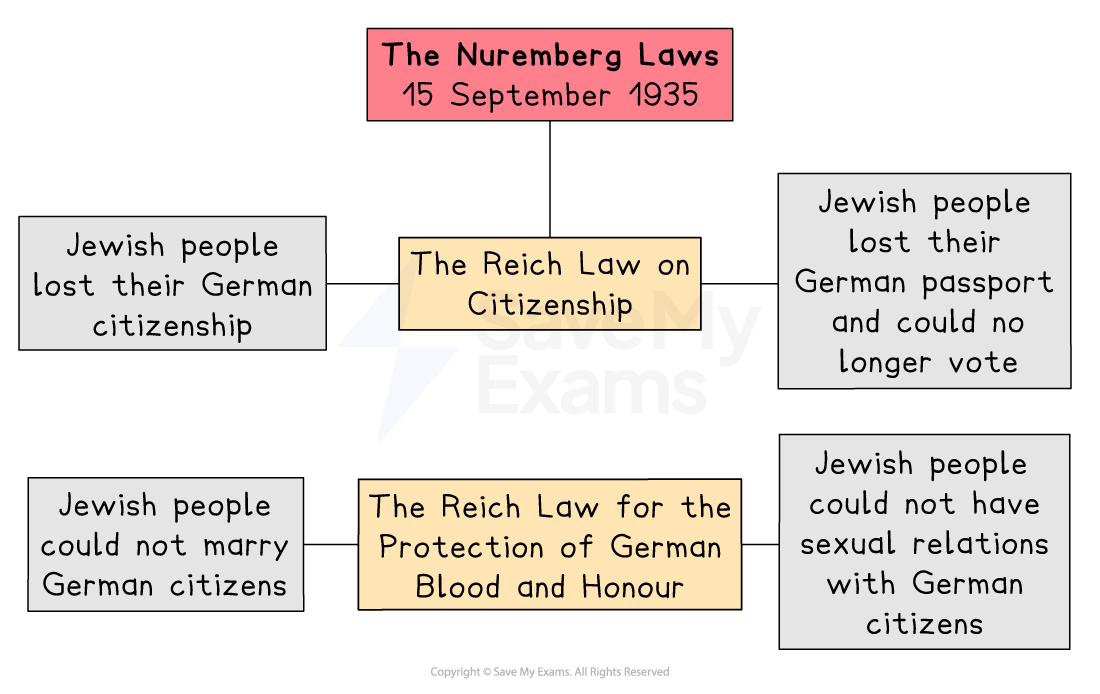
September 1935, the Nuremberg Laws
The Reich Law for the Protection of German Blood and Honour banned marriage between Jewish people and Aryans
The Reich Law on Citizenship said only people of German blood were citizens, so Jewish people lost the vote and the right to hold a German passport
Anyone with three or four Jewish grandparents was considered Jewish, regardless of whether they practised Judaism
Many people who had converted to Christianity still faced persecution
From 1938, Jewish people had to register their possessions and also had to carry identity cards
'Kristallnacht'
Persecution of Jewish people became much worse in November 1938 following an event known as ‘Kristallnacht’ (Night of Broken Glass)

The Nazis blamed Jewish people for "Kristallnacht" and punished them
They were fined 1 billion marks as an "atonement payment"
They also had to pay for the repairs themselves because the government seized their insurance payouts
By 12 November, around 20,000 Jewish people were sent to concentration camps like Dachau
How did persecution of Jewish people intensify between 1933 and 1939?
Four escalating stages
Stage 1 – Legal exclusion
In 1933, Jewish people were banned from certain jobs and their businesses were boycotted, although they remained technically citizens
Stage 2 – Segregation
In 1935, the Nuremberg Laws removed Jewish citizenship and banned intermarriage with Aryans
Stage 3 – Economic punishment
In 1938, Jewish possessions had to be registered, and Jewish professionals were barred from taking on non-Jewish clients
Stage 4 – Violent terror
In November 1938, 'Kristallnacht' unleashed organised, state-sanctioned violence and mass arrest on a nationwide scale for the first time
Examiner Tips and Tricks
Picture these four stages as a staircase going downwards, not a single jump. Each step removed something different: jobs, then citizenship, then property, then physical safety.
Each stage made the next step easier, since there was less public reaction each time.
Conclusions
Persecution intensified steadily and deliberately across the period, moving from economic and legal discrimination towards organised violence
By 1939, the foundations were already in place for the far greater horrors that followed once the Second World War began
Worked Example
Explain two effects of 'Kristallnacht' on Jewish people in Germany in November 1938.
(8)
Partial answer:
One effect of 'Kristallnacht' was widespread, immediate destruction of Jewish property and businesses. On the night of 9 to 10 November 1938, over 800 shops owned by Jewish people were destroyed and 191 synagogues were vandalised or set on fire across Germany. Many Jewish homes were attacked and looted. This caused significant damage to Jewish businesses and homes, and limited the ability for Jewish communities to rebuild after 'Kristallnacht'. This situation was worsened when the Nazis then fined the Jewish community 1 billion Reichsmarks and seized their insurance payouts, so Jewish owners also had to pay for the repairs. This left many Jewish families not only frightened but also financially ruined.
Examiner Tips and Tricks
A great way to approach this question would be to consider long-term and short-term effects of "Kristallnacht".
The paragraph above considers the immediate aftermath. The second paragraph could then explore the longer-term impacts of the event on Jewish safety in Germany and attempts to emigrate

Unlock more, it's free!
Join the 100,000+ Students that ❤️ Save My Exams
the (exam) results speak for themselves:

Was this revision note helpful?
