The Cuban Missile Crisis, 1962 (Edexcel IGCSE History: Paper 1: Depth Studies): Revision Note
Exam code: 4HI1

Timeline & summary

After the Bay of Pigs invasion, Khrushchev sent weapons to Cuba
In 1962, the USA discovered that the Soviet Union was building nuclear missile sites on Cuba
For 13 days in October 1962, Kennedy and his advisers decided how to respond
They chose a naval blockade rather than an attack
Khrushchev ordered his ships to turn back
The two leaders agreed a deal: the missiles would leave Cuba, and the USA promised not to invade
The USA also secretly agreed to remove its own missiles from Türkiye (Turkey)
The crisis was the closest the world came to nuclear war
However, it led to Cold War tensions reducing in the future
The causes of the Cuban Missile Crisis
Short-term causes
On 14 October 1962, a U2 spy-plane took photographs of missile launch pads in Cuba
Intelligence informed Kennedy that approaching Soviet ships could be carrying ballistic missiles to Cuba
Medium-term causes
The Bay of Pigs incident in 1961 heightened Cold War tensions between the USA and the Soviet Union
Castro publicly announced that he was a Communist
Kennedy warned Khrushchev not to place nuclear weapons on Cuba
Long-term causes
Since 1945, US-Soviet relations had been tense
Both countries competed against each other to become the biggest superpower
The USA and the Soviet Union developed powerful nuclear weapons that could destroy the world
Why did Khrushchev put missiles in Cuba?
To balance US missiles in Türkiye
NATO had missiles based in Türkiye, just a short distance from the Soviet Union
Khrushchev believed it was time for the USA to feel what it was like to be under threat
It is also possible that his real aim was to have the missiles in Türkiye removed
To restore his reputation
Many Soviet critics presented the building of the Berlin Wall as a failure for Khrushchev
If he could outwit Kennedy over Cuba, it would win back his reputation
To protect Cuba
He feared another American attack after the Bay of Pigs invasion
If the Americans overthrew Castro, this would be seen as another defeat for Communism
Why did the USA see it as such a threat?
Missiles in Cuba worried the USA
Soviet missiles on Cuba had significant political consequences for the USA
Missiles on Cuba could reach most major US cities within minutes, giving almost no warning of an attack
The US Defence Secretary, Robert McNamara, told Kennedy that the Soviet missiles would become operational two weeks after their arrival
This meant Kennedy had to decide quickly on the US action
The options about Cuba
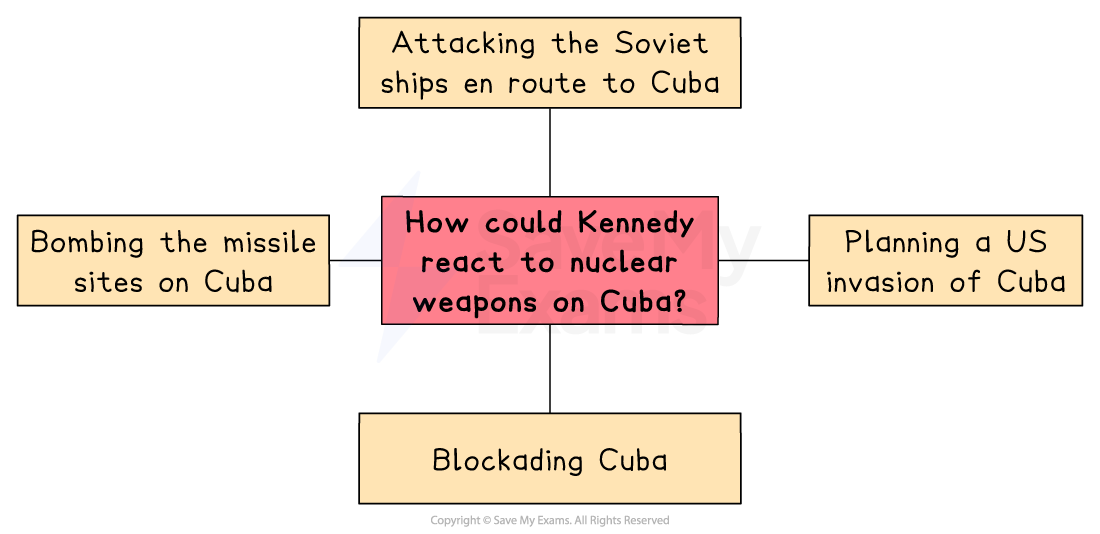
What did Kennedy have to consider before making a decision about Cuba?
How the American public would react to missiles on Cuba
Little to no reaction by the US government could cause widespread panic in the USA
The impact of his decision on other Cold War issues
Kennedy worried that a strong reaction to Cuba would encourage Khrushchev to become more aggressive over the issue of Berlin
The Cold War was a war of propaganda
Kennedy had to make the best decision that would not damage the USA's reputation internationally
Bombing Cuba would make the USA look aggressive
The Bay of Pigs incident in 1961
Kennedy knew most Cubans had backed Castro during the Bay of Pigs, so another invasion could lead to a long war in Cuba
Key events of the Cuban Missile Crisis
The 'Thirteen Days' refers to the period of 16 October to 28 October 1962
During these 13 days, the world became the closest it had ever been to nuclear war
Kennedy made a series of decisions about how to deal with the missile sites in Cuba
What happened in the Thirteen Days?

The Soviet ships' reluctance to break the naval blockade of Cuba was a key moment in the Cuban Missile Crisis
Kennedy had prepared the US military to sink the Soviet ships. This would have triggered a war between the USA and the Soviet Union
The actions of the Soviet ships proved that the Soviet Union was unwilling to cause direct armed conflict with the USA
Examiner Tips and Tricks
Students are often overwhelmed by the amount of events that happened in a short space of time in the Cuban Missile Crisis. This revision note displays these events in a flow diagram and in a timeline. This should help you visualise how one event triggered the next event to happen. Knowing the order of the Thirteen Days helps you give precise supporting detail in your Question (b) and (c) answers.
Reasons for the outcome of the Cuban Missile Crisis
Why did the crisis end peacefully?
Kennedy chose a naval blockade rather than an air strike, which gave Khrushchev time to back down
The leaders kept talking through letters and Robert Kennedy's secret meetings with the Soviet ambassador
Kennedy secretly agreed to remove US missiles from Türkiye (Turkey), so Khrushchev could claim a gain
Both leaders feared that nuclear war would destroy their countries
The outcome
By 28 October, Kennedy and Khrushchev had resolved the Cuban Missile Crisis
Kennedy agreed not to invade Cuba in return for the removal of the missile launch pads in the country
Kennedy's brother, Robert, and the Soviet ambassador in Washington verbally agreed to the removal of the US missiles in Türkiye
The US public had no knowledge of the removal of the US missiles in Türkiye
Who won?
Kennedy's popularity increased significantly, particularly because the Türkiye deal had not been made public
He had shown himself to be a strong leader, not only against Khrushchev but also against the Hawks in his own government
Khrushchev claimed in his memoirs that he had been the winner, because Cuba's security was guaranteed without firing a shot
However, many people in Moscow, including the military, felt that Khrushchev had been forced into a humiliating withdrawal
His unpopularity was a significant factor in his dismissal in 1964
How close did the Cuban Missile Crisis bring the world to nuclear war?
Evidence that it was extremely close
The missiles were close to being ready to fire
McNamara said they would be ready within two weeks
Kennedy prepared 54 bombers with four nuclear warheads each
Soviet ships were heading towards the blockade
If US ships had been forced to fire on Soviet ships, war would probably have followed
On 27 October, a U-2 plane was shot down over Cuba
The Hawks demanded military action
If Kennedy had listened to the Hawks, this would have triggered a nuclear war
Evidence that war was less likely than it seemed
Neither leader wanted a nuclear war
Kennedy and Khrushchev were looking for a way out
Khrushchev turned his ships back on 24 October, before the blockade was tested
The two leaders stayed in contact through telegrams and a back-channel meeting between Robert Kennedy and the Soviet ambassador
Kennedy rejected the military option even when under great pressure
The crisis was settled in 13 days, with compromises from both sides
The aftermath
The crisis showed what could happen if the superpowers continued with brinkmanship
This is the policy of pushing disagreements to the point where there is a risk of war (the 'brink'), hoping the other side will back down first
Both countries wanted to make sure future misunderstandings would not cause war, so important steps were taken after the Cuban Missile Crisis
Conclusions
The crisis was the closest the world came to a nuclear war
Both sides had weapons ready
At several points, a mistake or a refusal to compromise could have started a war
However, war was avoided largely because of the decisions of two leaders who both feared nuclear war
In the long term, the crisis made the world safer
Worked Example
'The Cuban Missile Crisis ended as a success for the USA.'
How far do you agree? Explain your answer.
You may use the following in your answer:
the removal of US missiles from Türkiye
Kennedy's reputation as a leader.
You must also use information of your own.
(16)
Partial answer:
Some historians argue that the removal of US missiles from Türkiye shows that the success was limited. Khrushchev's second letter demanded that the USA remove its missiles in Türkiye. Kennedy ignored this request publicly, but his brother, Robert, secretly agreed to it. This meant the USA had to give something important to its safety up in order to end the crisis. Therefore, it could be argued that the USA had to compromise to 'win' the Cuban Missile Crisis, rather than it being a clear victory. However, the deal was kept secret, so the American public saw no sign of weakness. This means the compromise did little damage to the USA's position at the time.
Examiner Tips and Tricks
Great 16-mark answers try to have balance in their argument. Whilst you may agree that the Cuban Missile Crisis ended as a success for the USA, you must also examine how the USA had to make compromises. You could include the secret removal of its missiles from Türkiye and promising not to invade Cuba, which meant Castro stayed in power.

Unlock more, it's free!
Join the 100,000+ Students that ❤️ Save My Exams
the (exam) results speak for themselves:

Was this revision note helpful?
