Hitler's Appointment as Chancellor, 1932–33 (Edexcel IGCSE History: Paper 1: Depth Studies): Revision Note
Exam code: 4HI1

Timeline & Summary
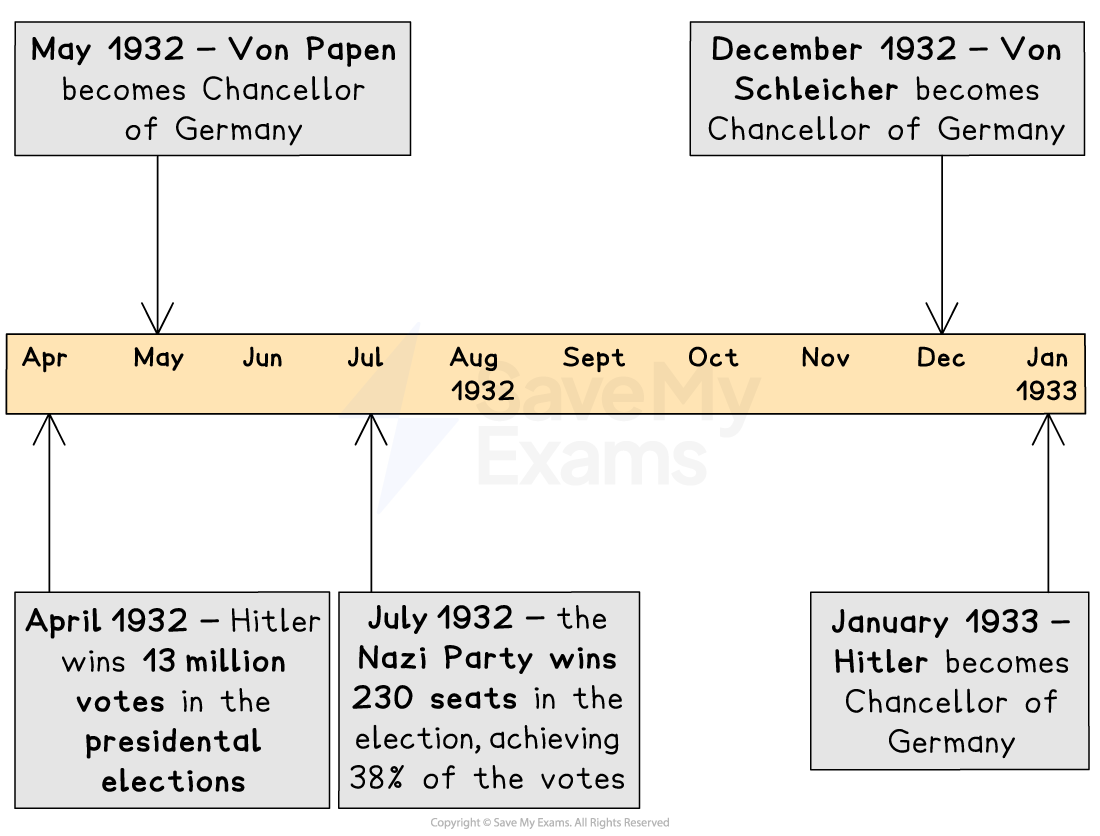
Even after becoming the largest party in the Reichstag in July 1932, the Nazis could not win power through elections alone
Hitler could never gain an outright majority
President Hindenburg refused to make him Chancellor
Between 1932 and January 1933, Germany was governed by a small group of politicians around Hindenburg
The key figures competing for power were Franz von Papen and Kurt von Schleicher, not Hitler himself
Von Papen, desperate to regain power after being forced to resign, persuaded Hindenburg to appoint Hitler as Chancellor with himself as Vice-Chancellor
He believed that he and his conservative allies could control Hitler from behind the scenes
Hitler was appointed Chancellor on 30 January 1933
Examiner Tips and Tricks
Students often find this section of the course very challenging to understand. For your exam, it is important you have specific, correct information on Hitler's path to power.
It may help you to make a Who's Who list with the information from this revision note, summarising each key person and their role in allowing Hitler to become Chancellor
The roles of von Papen and von Schleicher
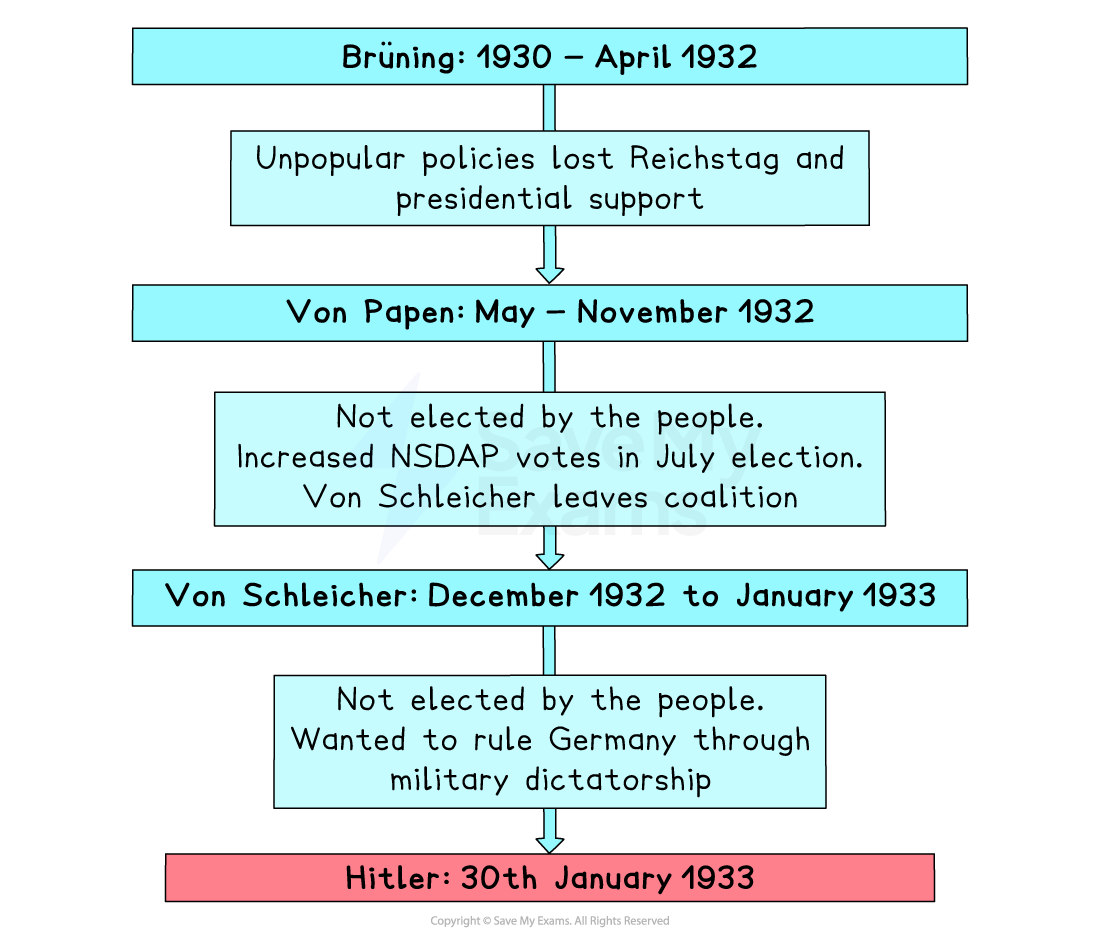
The fall of Brüning
In the presidential election that April, Hitler received around 13 million votes
Hindenburg received more votes
It showed that Hitler was a popular figure in Weimar Germany
That same month, Chancellor Brüning used a presidential decree to ban the SA and the SS due to the political unrest they were causing
An ambitious army general, Kurt von Schleicher, then organised a right-wing coalition to persuade Hindenburg to sack Brüning as Chancellor
The coalition included army officers, landowners and industrialists
In July 1932, the Nazis became the biggest party in the Reichstag, with 230 seats
This was 37.4% of the vote
Von Papen's coalition
Von Schleicher selected Franz von Papen, a wealthy politician, to head the new government
He offered Hitler a place in the coalition
Hitler refused the position
Von Papen's coalition was weak
Hitler argued that he should be Chancellor, since the Nazis had the most Reichstag seats
Hindenburg refused, because he disliked Hitler and thought him too ambitious
Von Papen called another election in November 1932
Nazi support fell, but the party remained the largest in the Reichstag
Von Schleicher left the coalition
Von Papen was forced to resign
Von Schleicher as Chancellor
Powerful businessmen wrote to Hindenburg asking him to appoint Hitler as Chancellor
Hindenburg refused and chose von Schleicher instead
As Chancellor, von Schleicher asked Hindenburg to suspend the constitution and make him head of a military dictatorship
He claimed that Hitler and von Papen were conspiring against him
Hindenburg refused, and von Schleicher resigned on 28 January 1933
The role of von Hindenburg
An elderly, reluctant president
Hindenburg, a former army commander in the First World War, had been President since 1925
He was popular among conservative and nationalist Germans
He personally disliked and distrusted Hitler
He saw him as low-born and dangerously ambitious
He repeatedly refused to make him Chancellor despite the Nazis' Reichstag strength and pressure from businessmen
Examiner Tips and Tricks
Hindenburg's dislike of Hitler is an important piece of own knowledge for a 16-mark essay on whether Hitler's appointment was inevitable.
It shows that Hitler's rise to power depended on persuading a president who did not want to give him power, rather than on some unstoppable momentum.
The final decision
Von Papen, determined to return to power, believed he could control Hitler from the background as Vice-Chancellor
He persuaded Hindenburg to make Hitler Chancellor on those terms
Hindenburg eventually, and reluctantly, agreed
Hindenburg's own decisions were crucial
He dismissed Brüning (May 1932)
Replaced von Papen with von Schleicher (December 1932)
Then he accepted von Schleicher's resignation and appointed Hitler (January 1933)
Hitler's appointment as Chancellor, January 1933
President Hindenburg appointed Hitler Chancellor of Germany on 30 January 1933
Hitler's cabinet contained few Nazis at first
Most ministers were conservative allies of von Papen, which is one reason von Papen believed he was still in control
Was Hitler's appointment as Chancellor inevitable?
Arguments that it was inevitable
The Nazis had consistently been the largest party in the Reichstag from July 1932 onwards
This made it increasingly hard to continue to exclude Hitler from government
The Depression had discredited moderate coalition government
Ruling by Article 48 had already made Germany less democratic before Hitler arrived
Nazi propaganda and SA activity had built genuine mass support
Hitler was a popular public figure
Arguments that it was not inevitable
Hitler was appointed through a political deal among a small circle of people around Hindenburg, not by winning an outright electoral majority
The Nazis never won more than 37.4% of the vote before 1933
Hindenburg personally disliked Hitler
He had refused to appoint him Chancellor on several occasions
Nazi support had actually fallen between July and November 1932, from 230 seats to around 196
This suggested that the party's momentum may have already passed its peak
It was the specific miscalculation of von Papen, who believed he could control Hitler, that finally brought him to power
A different decision by von Papen or Hindenburg could have kept Hitler out of government
Conclusions
The Depression and the weaknesses of the Weimar constitution made some kind of crisis of democracy likely by the early 1930s
Hitler's specific appointment as Chancellor depended on the choices of a small number of individuals, including:
von Papen's miscalculation
Hindenburg's reluctant consent
It is more accurate to call Hitler's rise to power probable rather than inevitable in its exact form and timing
Worked Example
Study Extract C.
Extract C: A history on Hitler, published in 1996.
"In January 1933, Hitler did not seize power; it was handed to him by the men who controlled Germany. The Nazi Party had suffered huge losses in the Reichstag elections of November 1932 and it was starting to fall apart by January 1933. Hindenburg began to mistrust Chancellor von Schleicher. Meanwhile, von Papen managed to overcome the elderly President Hindenburg's doubts about Hitler and persuaded him to appoint Hitler as Chancellor. Hitler was supported by less than half the German population when he was appointed Chancellor by President Hindenburg."
What impression does the author give about how Hitler became Chancellor in January 1933?
You must use Extract C to explain your answer.
(6)
Partial answer:
The author creates the impression that Hitler was appointed at a moment of Nazi weakness rather than strength. They stress that the party had "suffered huge losses" in the November 1932 elections and was "starting to fall apart", and add that Hitler "was supported by less than half the German population" when he became Chancellor. The author builds the extract entirely around political manoeuvring inside Hindenburg's inner circle, and says nothing about the years of Nazi mass campaigning, propaganda and SA activity that had already made the party impossible to ignore. By leaving out the popular side of Hitler's rise, the author makes his appointment look like a political accident rather than something the Nazis had built towards for years.
Examiner Tips and Tricks
Stating the impression and quoting from the extract will reach the middle level. To reach the top level, you must also analyse the author's choices — the contrast between "seize" and "handed", and the emphasis on Nazi weakness and elite manoeuvring rather than mass support. Use your own knowledge to name what has been left out.

Unlock more, it's free!
Join the 100,000+ Students that ❤️ Save My Exams
the (exam) results speak for themselves:

Was this revision note helpful?
