The Korean War & the Warsaw Pact (Edexcel IGCSE History: Paper 1: Depth Studies): Revision Note
Exam code: 4HI1

Summary
In June 1950, Communist North Korea invaded non-Communist South Korea
The Cold War moved beyond Europe for the first time
A United Nations force, mostly American, defended South Korea
Communist China sent troops to help North Korea
The war ended in 1953 with the border close to where it had been in 1950, at the 38th parallel
The Korean War convinced the superpowers to build up their armed forces and alliances on a much larger scale
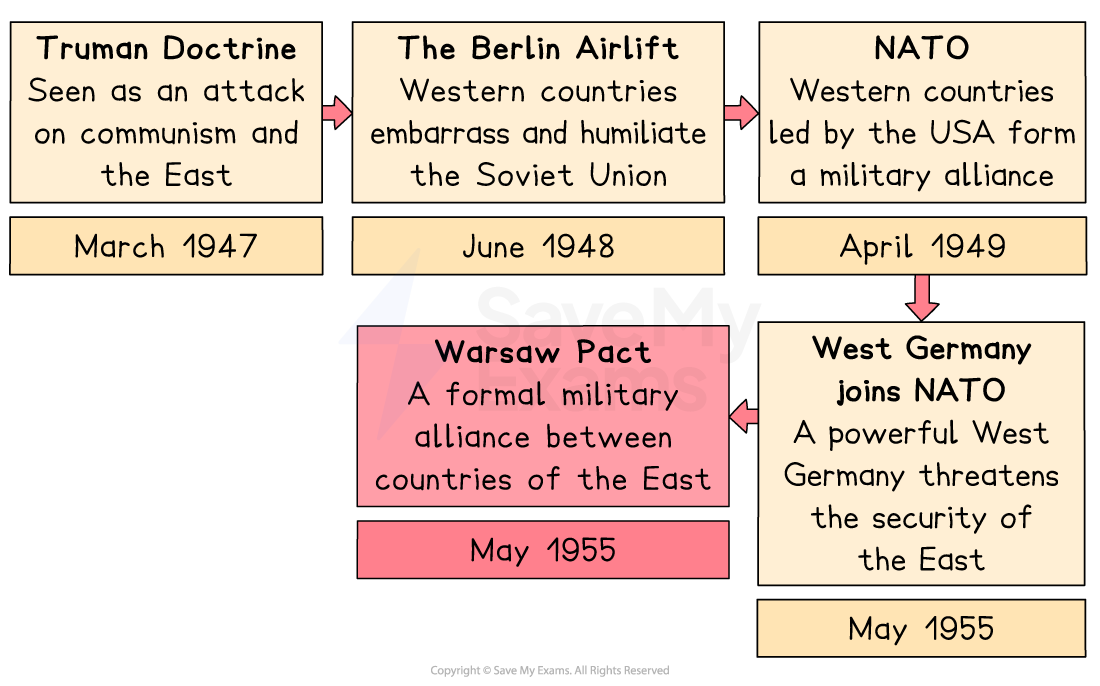
In 1955, West Germany joined NATO
The Soviet Union responded by forming its own military alliance of Communist states, the Warsaw Pact
By the mid-1950s, Europe was clearly divided into two armed camps, one led by the USA and one led by the Soviet Union
The causes and events of the Korean War
Korea divided
Korea had been under Japanese control until 1945
When Japan was defeated:
Soviet forces entered the north of the country
American forces entered the south
The two sides agreed a temporary border along the 38th parallel
This was an imaginary line 38 degrees north of the Equator

The country was effectively split into two states:
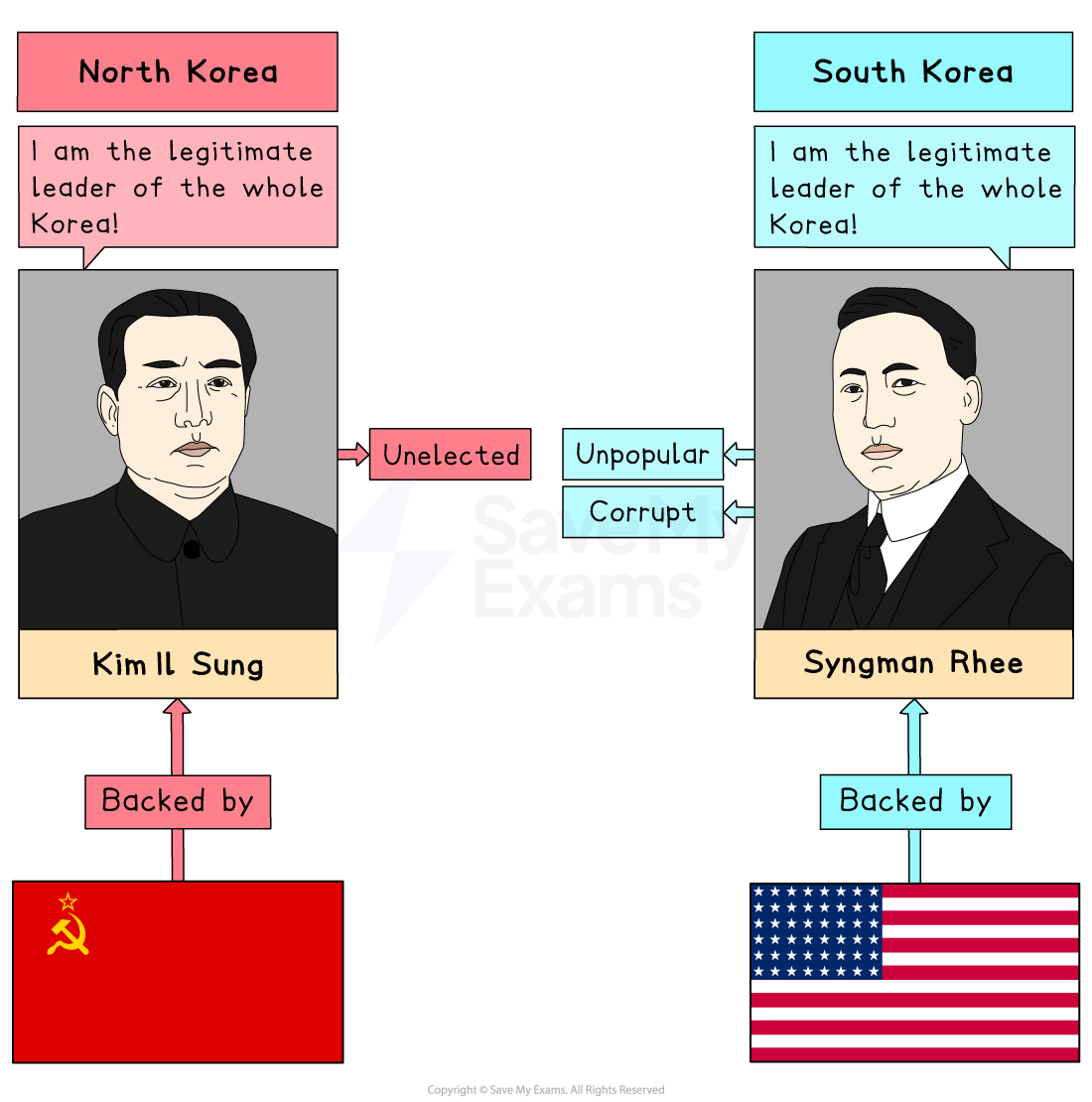
The Communist Soviet-backed Democratic People's Republic of Korea (North Korea) led by Kim Il Sung
The American-backed Republic of Korea (South Korea) led by Syngman Rhee
North Korea received aid and military equipment from China and the Soviet Union
South Korea received similar support from the USA
Both governments claimed to be the rightful rulers of the whole of Korea
Why the USA got involved
President Truman was determined that South Korea should not become Communist
The USA was already trying to contain Communism in Europe, through the Truman Doctrine and the Marshall Plan
Truman feared a domino effect
This is the idea that if one country becomes Communist, its neighbours will follow, like a row of dominoes falling over
Therefore, if South Korea fell to Communism, Truman feared that other countries in Asia would follow

War breaks out
On 25 June 1950, North Korean forces invaded South Korea
At the request of the USA, the Security Council of the United Nations met to decide what to do
The Soviet Union was not attending the United Nations at this time
It could not use its veto to stop the UN from intervening
North Korea was told to withdraw but refused
A UN force from 16 countries was put together to help South Korea
This was the first time the UN had taken military action, and it showed the UN could be used against communism
Most of the troops were American
The commander was the US General Douglas MacArthur
The war lasted for three years with heavy casualties for both sides
The final peace left the border between the two countries close to where it had started, at the 38th parallel

The formation of the Warsaw Pact
The Warsaw Pact was created in May 1955 in response to the German Federal Republic (West Germany) joining NATO
The Soviet Union was worried about a strong West Germany being part of a military alliance with the USA
The Warsaw Pact was a military alliance based on 'Collective Security'
If one member was attacked, all members would defend it
The Warsaw Pact was under the command of the Soviet Union
Reasons for the Warsaw Pact
Examiner Tips and Tricks
Some students confuse the Warsaw Pact with NATO. They are both military alliances. However, NATO combined the military force of the West whereas the Warsaw Pact was a military agreement within Eastern Europe.
Aims and membership of the Warsaw Pact

The impact of the Warsaw Pact
The Warsaw Pact confirmed the separation of Europe into two groups:
Western, Capitalist countries that were members of NATO
Eastern, Communist countries that were members of the Warsaw Pact
The Soviet Union set up and commanded the Warsaw Pact, so it tightened Soviet military control over Eastern Europe
The Warsaw Pact gave the Soviet Union a legal reason to keep troops in Eastern Europe, which it used to control its satellite states
In August 1949, the Soviet Union tested its first atomic bomb, ending the USA's nuclear monopoly
The presence of two military alliances in Europe increased the likelihood of war and led to both groups increasing their military power
How far did the Korean War worsen the Cold War?
Evidence that it worsened the Cold War
The war turned a mainly European rivalry into a global conflict
It was the first time Cold War tension led to large-scale fighting, even though Soviet and American troops did not fight each other directly
It convinced the USA that Communism had to be resisted with military force as well as economic aid
This led to a permanently larger US defence budget and new alliances such as Southeast Asia Treaty Organisation (SEATO)
It convinced the Soviet Union that it needed to match American military strength
This caused the rapid increase in the size of the Red Army
It brought Communist China into direct conflict with the USA for the first time
This widened the Cold War beyond Europe and the Soviet Union
Evidence that other factors mattered too
The war did not change the spread of Communism
Korea ended the war divided along almost the same border as before
Unlike the division of Germany, it did not create a new, lasting flashpoint of its own
Some of the build-up in weapons and alliances, such as NATO, was already under way before the war began
Ideological rivalry and the disagreements over Germany had begun before the war
The sharpest new division in Europe itself came later, with the formation of the Warsaw Pact in 1955, two years after the Korean War had ended
Examiner Tips and Tricks
A strong "How far do you agree" answer on the Korean War distinguishes between its effect on Korea itself, which was limited, and its effect on the wider Cold War, which was lasting.
Making that distinction clearly shows the examiner that you understand the difference between an event's immediate results and its longer-term significance.
Conclusions
The Korean War was a major turning point
It was the moment the Cold War became a worldwide struggle, fought with real armies and real casualties
The Korean War tripled the US defence budget and nearly doubled the size of the Red Army
However, the war's lasting effect was on attitudes and spending rather than on the map of Korea itself
Its significance lies in what it taught both superpowers to expect from each other, rather than in anything it physically changed
Worked Example
'The main reason why Cold War tension increased during the 1950s was the Korean War.'
How far do you agree? Explain your answer.
You may use the following in your answer:
the Korean War
the formation of Warsaw Pact.
You must also use information of your own.
(16)
Partial answer:
In conclusion, I believe that this statement is largely true. The Korean War did significantly increase Cold War tension in the 1950s. This is because its significance was long-term and global, reshaping how both superpowers behaved for years afterwards. In comparison, events like the Warsaw Pact mainly reorganised a Europe that was already dividing. However, I do not fully agree, because ideology was not itself a trigger for tension; it was the underlying cause that allowed the Korean War to have the effect it did. The statement is therefore true to a large extent, but not completely.
Examiner Tips and Tricks
Start your conclusion with a direct statement of how far you agree — "In conclusion, I believe that this statement is largely/mostly/only partly true". This shows the examiner you are directly answering the question.
When justifying your position, consider significance (long-term versus short) and causation (an underlying cause versus a trigger), instead of repeating the facts from your paragraphs. A conclusion that just lists the evidence again, without this kind of language to weigh it, will not reach the top level.

Unlock more, it's free!
Join the 100,000+ Students that ❤️ Save My Exams
the (exam) results speak for themselves:

Was this revision note helpful?
