Unit 6 Overview (College Board AP® Calculus AB): Exam Questions

2 hours11 questions
1a
Sme Calculator
3 marks
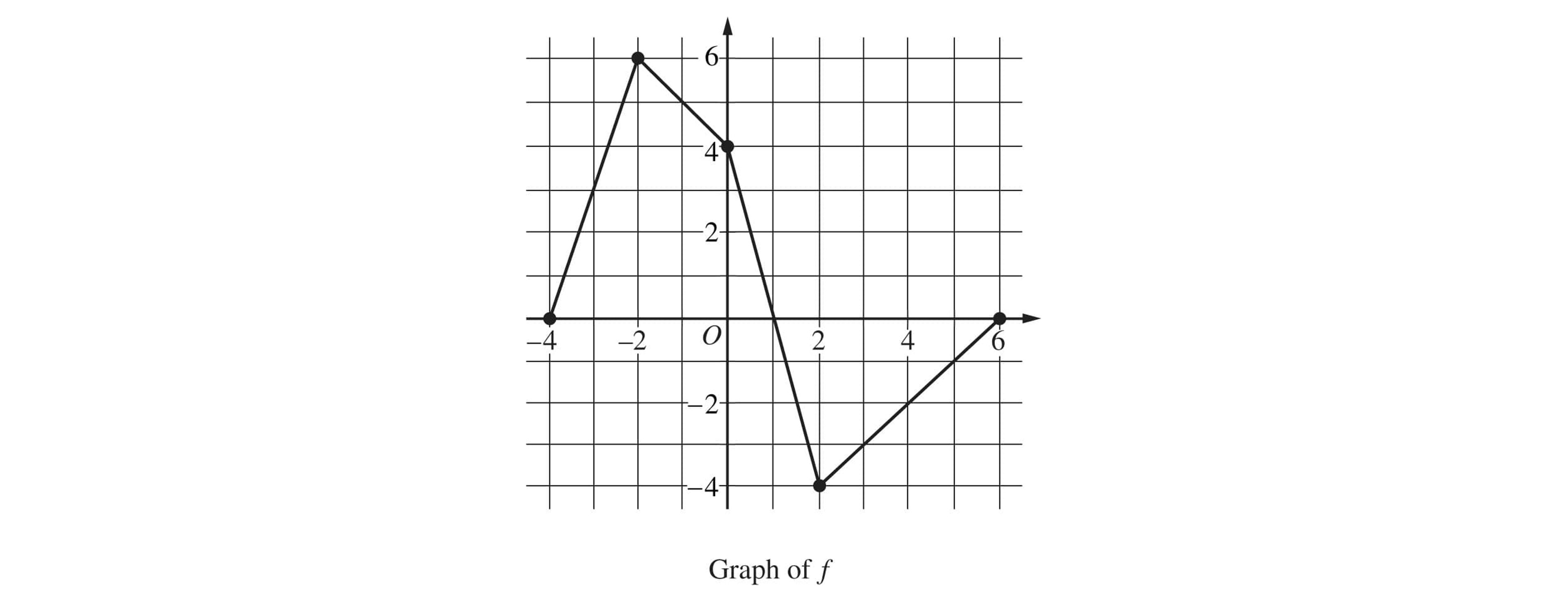
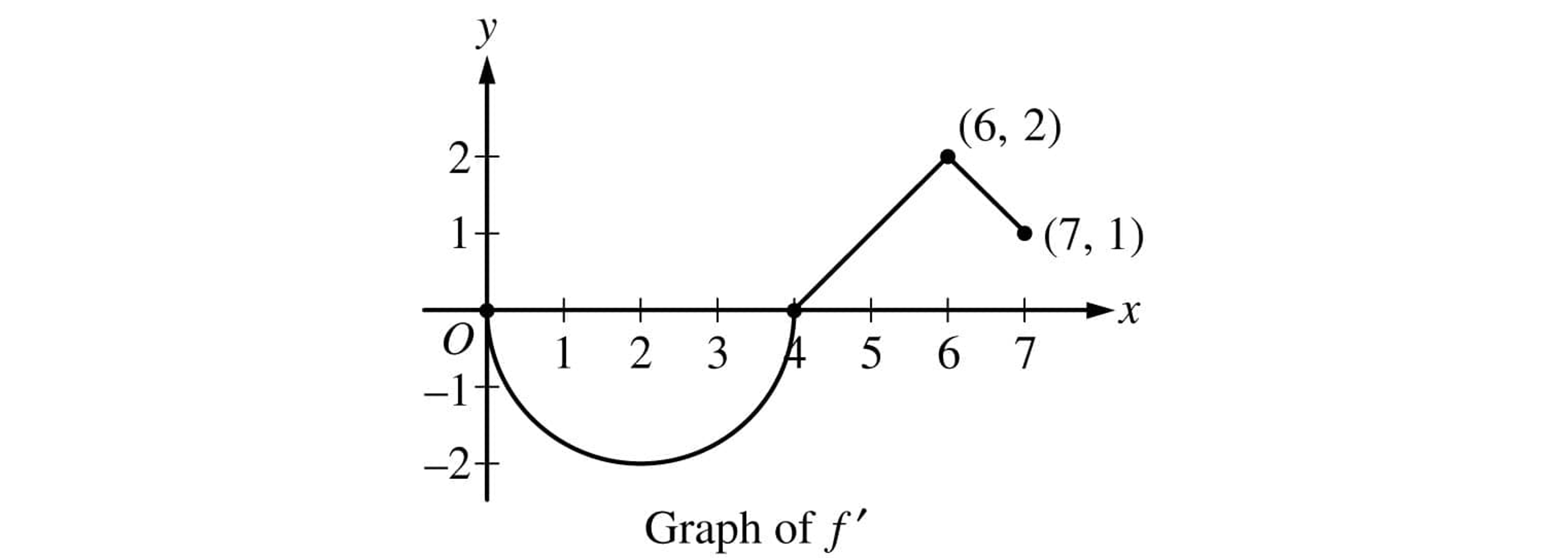
Graph of f′: semicircle from (0,0) to (4,0) dipping to y = −2, then line up to (6,2) and line down to (7,1) on x–y axes.

Let f be a differentiable function with f(4) = 3. On the interval 0 \leq x \leq 7, the graph of f', the derivative of f, consists of a semicircle and two line segments, as shown in the figure above.

Find f(0) and f(5).

1b
Sme Calculator
2 marks

Find the x-coordinates of all points of inflection of the graph of f for 0 < x < 7. Justify your answer.

1c
Sme Calculator
2 marks

Let g be the function defined by g(x) = f(x) - x. On what intervals, if any, is g decreasing for 0 \leq x \leq 7? Show the analysis that leads to your answer.

1d
Sme Calculator
2 marks

For the function g defined in part (c), find the absolute minimum value on the interval 0 \leq x \leq 7. Justify your answer.

2a
Sme Calculator
3 marks

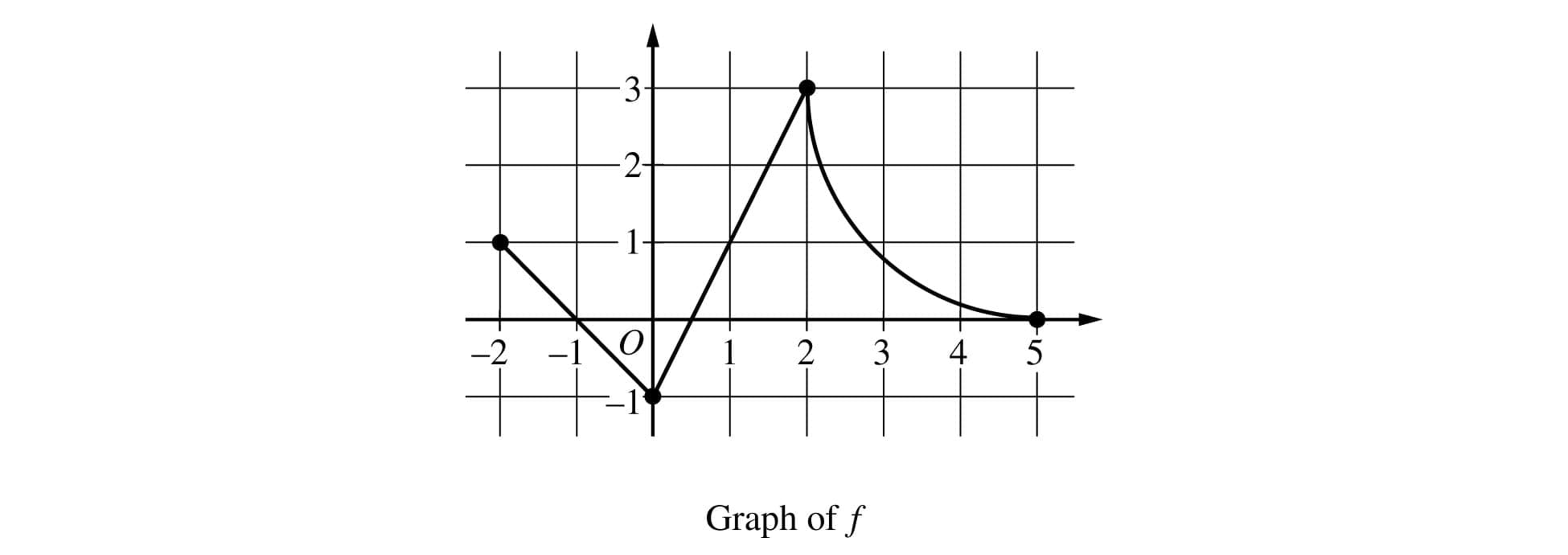
The continuous function f is defined on the closed interval -6 \leq x \leq 5. The figure below shows a portion of the graph of f, consisting of two line segments and a quarter of a circle centered at the point (5, 3). It is known that the point \left(3, 3 - \sqrt{5}\right) is on the graph of f.

Graph of function f: piecewise curve from (−2,1) down to (0,−1), up to (2,3), then decaying smoothly to (5,0) on Cartesian axes.

If \int_{-6}^{5} f\left(x\right) dx = 7, find the value of \int_{-6}^{-2} f\left(x\right) dx. Show the work that leads to your answer.

2b
Sme Calculator
2 marks

Evaluate \int_{3}^{5} \left(2f'\left(x\right) + 4\right) dx.

2c
Sme Calculator
3 marks

The function g is given by g\left(x\right) = \int_{-2}^{x} f\left(t\right) dt. Find the absolute maximum value of g on the interval -2 \leq x \leq 5. Justify your answer.

2d
Sme Calculator
1 mark

Find \underset{x \rightarrow 1}{lim} \frac{10^{x} - 3 f ' \left(x\right)}{f \left(x\right) - arctan x}.

3a
Sme Calculator
2 marks

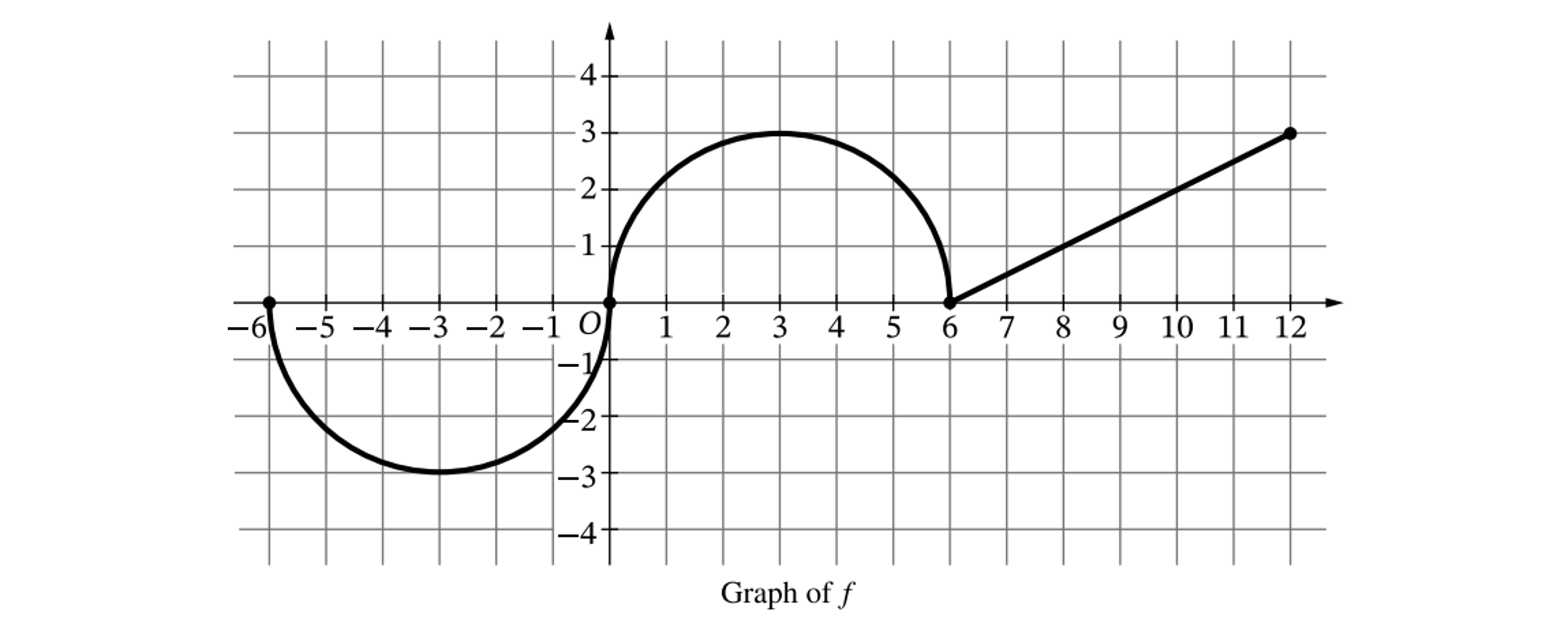
The continuous function f is defined on the closed interval - 6 \leq x \leq 12. The graph of f, consisting of two semicircles and one line segment, is shown in the figure.

Graph of function f: a U-shaped curve from (-6,0) to (0,0), rising to (3,3), dropping to (6,0), then a straight line to (12,3).

Let g be the function defined by g \left(x\right) = \int_{6}^{x} f \left(t\right) \, \text{d}t.

Find g ' \left(8\right). Give a reason for your answer.

3b
Sme Calculator
2 marks

Find all values of x in the open interval - 6 < x < 12 at which the graph of g has a point of inflection. Give a reason for your answer.

3c
Sme Calculator
2 marks

Find g \left(12\right) and g \left(0\right). Label your answers.

3d
Sme Calculator
3 marks

Find the value of x at which g attains an absolute minimum on the closed interval - 6 \leq x \leq 12. Justify your answer.

4a
Sme Calculator
2 marks

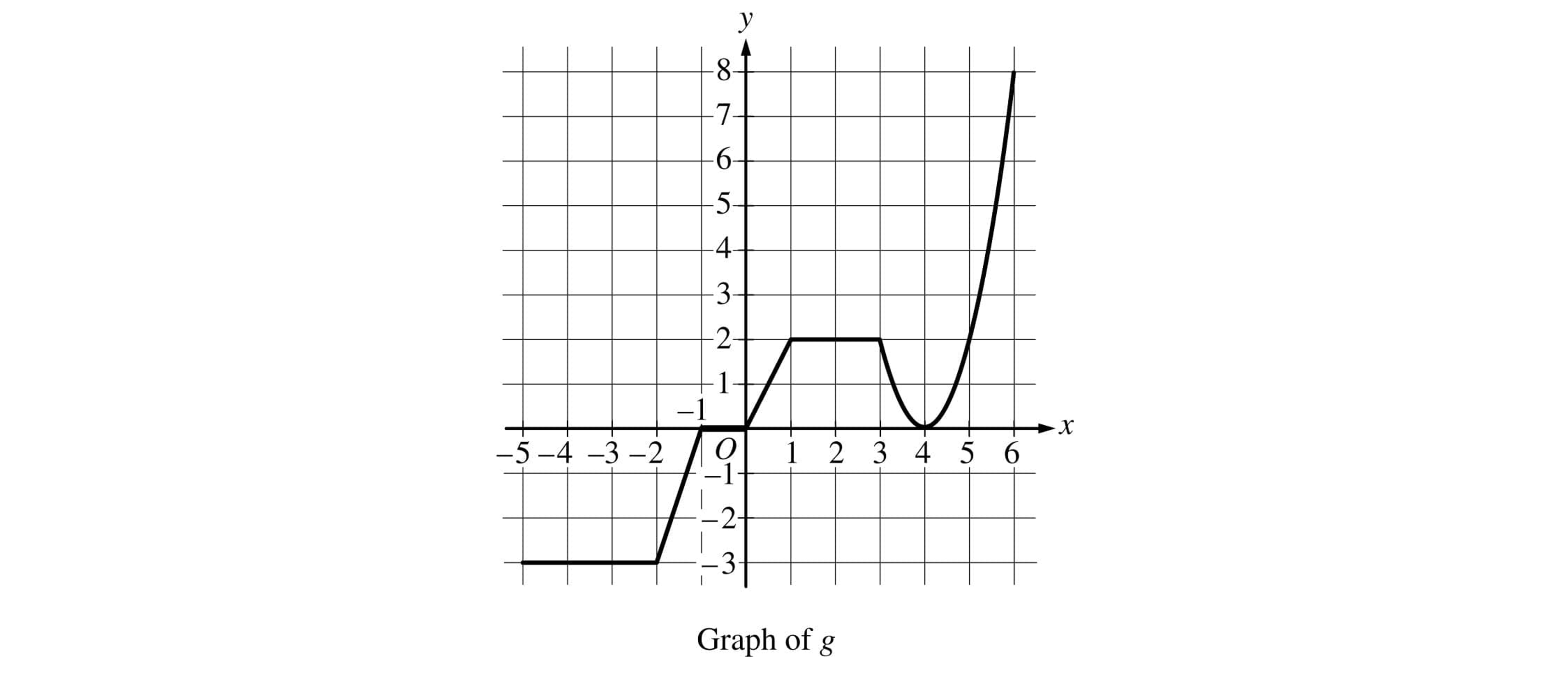
The graph of the continuous function g, the derivative of the function f, is shown below. The function g is piecewise linear for -5 \leq x < 3, and g(x) = 2(x-4)^2 for 3 \leq x \leq 6.

Graph of function g: piecewise line, flat at y = −3 for x ≤ −2, rising to (0,0), then to (1,2), flat to x = 3, dip to (4,0), curve up past y = 8 by x = 6.

If f(1) = 3, what is the value of f(-5)?

4b
Sme Calculator
3 marks

Evaluate \displaystyle\int_1^6 g(x)\,dx.

4c
Sme Calculator
2 marks

For -5 < x < 6, on what open intervals, if any, is the graph of f both increasing and concave up? Give a reason for your answer.

4d
Sme Calculator
2 marks

Find the x-coordinate of each point of inflection of the graph of f. Give a reason for your answer.

5a
Sme Calculator
2 marks

An ice sculpture melts in such a way that it can be modelled as a cone that maintains a conical shape as it decreases in size. The radius of the base of the cone is given by a twice-differentiable function r, where r(t) is measured in centimeters and t is measured in days. The table below gives selected values of r'(t), the rate of change of the radius, over the time interval 0 \leq t \leq 12.

t (days)

0

3

7

10

12

r'(t) (cm per day)

-6.1

-5.0

-4.4

-3.8

-3.5

Approximate r''(8.5) using the average rate of change of r' over the interval 7 \leq t \leq 10. Show the computations that lead to your answer, and indicate units of measure.

5b
Sme Calculator
2 marks

Is there a time t, 0 \leq t \leq 3, for which r'(t) = -6? Justify your answer.

5c
Sme Calculator
2 marks

Use a right Riemann sum with the four subintervals indicated in the table to approximate the value of \displaystyle\int_0^{12} r'(t)\,\text{d}t.

5d
Sme Calculator
3 marks

The height of the cone decreases at a rate of 2 centimetres per day. At time t = 3 days, the radius is 100 centimetres and the height is 50 centimetres. Find the rate of change of the volume of the cone with respect to time, in cubic centimeters per day, at time t = 3 days. (The volume V of a cone with radius r and height h is V = \dfrac{1}{3}\pi r^2 h.)

6a
Sme Calculator
3 marks

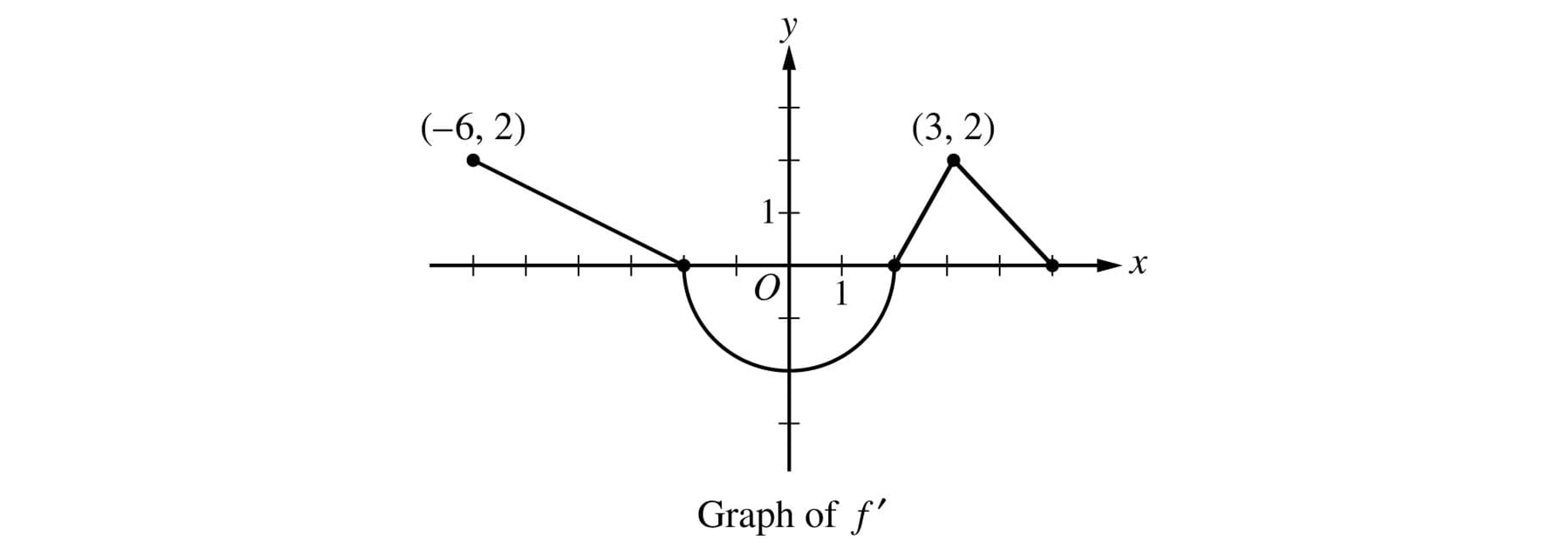
The function f is differentiable on the closed interval [-6, 5] and satisfies f(-2) = 7. The graph of f', the derivative of f, consists of a semicircle and three line segments, as shown below.

Graph of f′: piecewise curve from point (−6,2) sloping to (−2,0), semicircle below x-axis to (1,0), then triangle peaking at (3,2) and ending at (5,0).

Find the values of f(-6) and f(5).

6b
Sme Calculator
2 marks

On what intervals is f increasing? Justify your answer.

6c
Sme Calculator
2 marks

Find the absolute minimum value of f on the closed interval [-6, 5]. Justify your answer.

6d
Sme Calculator
2 marks

For each of f''(-5) and f''(3), find the value or explain why it does not exist.

7a
Sme Calculator
2 marks
Piecewise linear graph of f through points (−4,0), (−2,6), (0,4), (2,−4) and (6,0) on an x‑y grid from −4 to 6 and −4 to 6.

Let f be a continuous function defined on the closed interval - 4 \leq x \leq 6. The graph of f, consisting of four line segments, is shown above. Let G be the function defined by G(x) = \int_{0}^{x} f(t) \text{d} t.

On what open intervals is the graph of G concave up? Give a reason for your answer.

7b
Sme Calculator
3 marks

Let P be the function defined by P(x) = G(x) \cdot f(x). Find P'(3).

7c
Sme Calculator
2 marks

Find \displaystyle\lim_{x \to 2} \frac{G(x)}{x^2 - 2x}.

7d
Sme Calculator
2 marks

Find the average rate of change of G on the interval [-4, 2]. Does the Mean Value Theorem guarantee a value c, -4 < c < 2, for which G'(c) is equal to this average rate of change? Justify your answer.

8a
Sme Calculator
2 marks
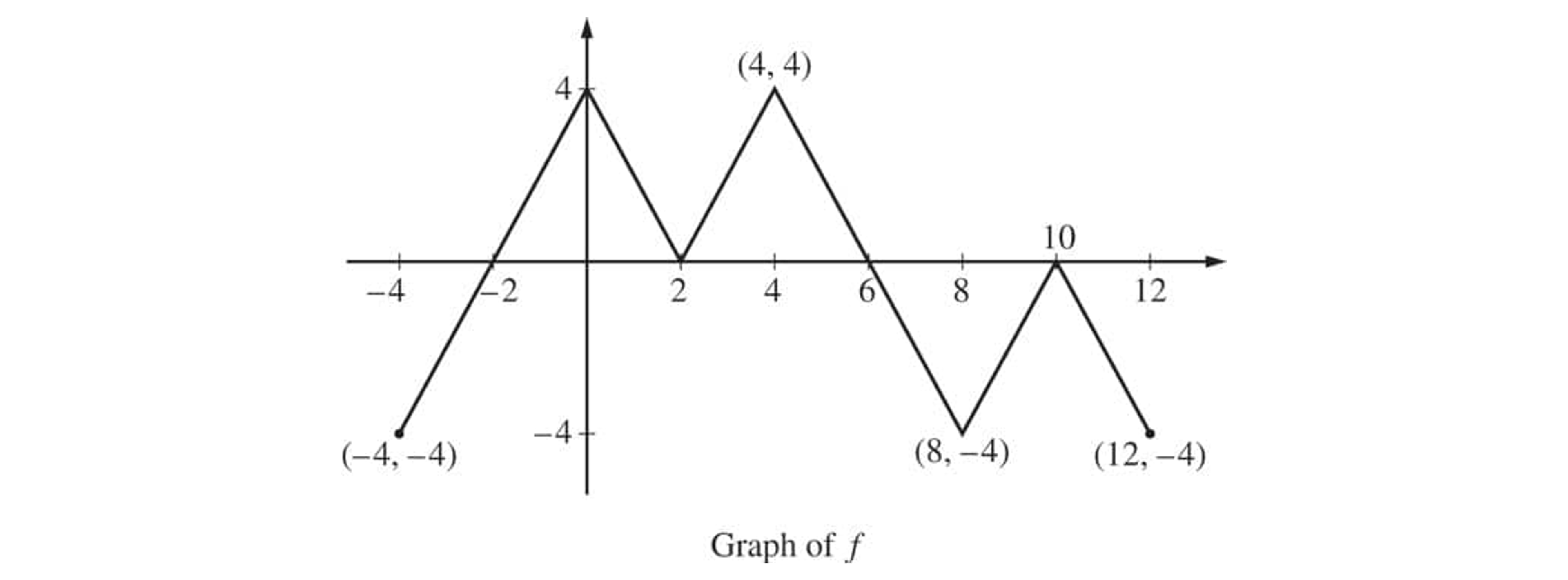
Piecewise linear graph of f joining points (−4,−4), (−1,4), (2,0), (4,4), (6,0), (8,−4), (10,0) and (12,−4) on x–y axes.

The figure above shows the graph of the piecewise-linear function f. For -4 \leq x \leq 12, the function g is defined by

g(x) = \int_{2}^{x} f(t)\,dt

Does g have a relative minimum, a relative maximum, or neither at x = 10? Justify your answer.

8b
Sme Calculator
1 mark

Does the graph of g have a point of inflection at x = 4? Justify your answer.

8c
Sme Calculator
4 marks

Find the absolute minimum value and the absolute maximum value of g on the interval -4 \leq x \leq 12. Justify your answers.

8d
Sme Calculator
2 marks

For -4 \leq x \leq 12, find all intervals for which g(x) \leq 0.

9a
Sme Calculator
3 marks

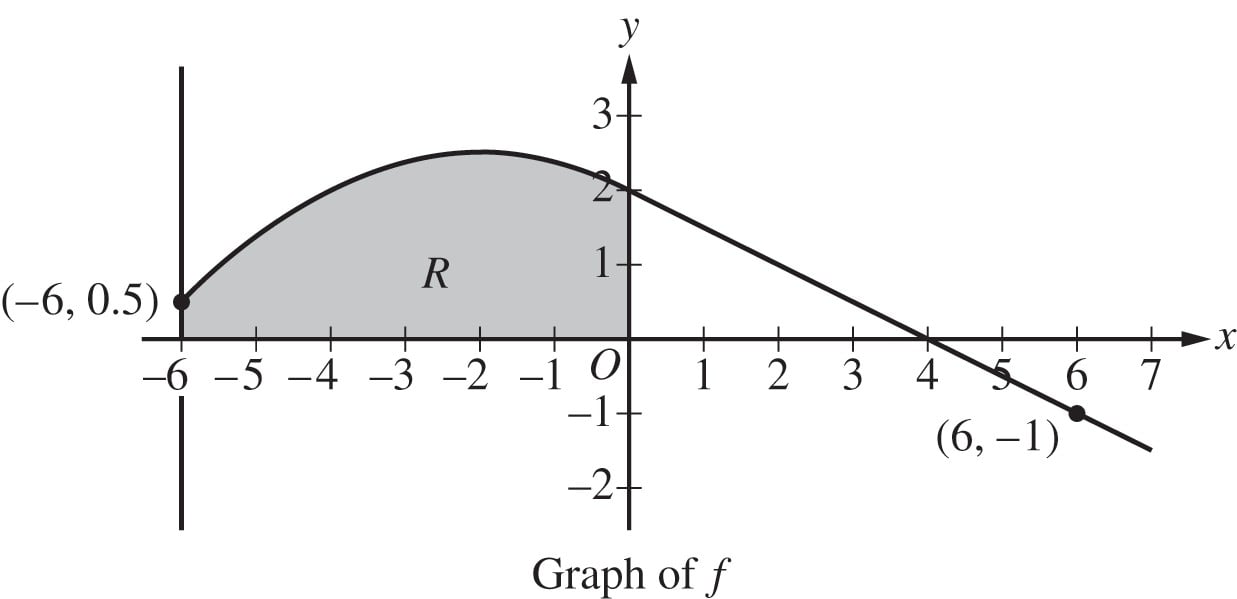
The graph of the differentiable function f, shown below for -6 \leq x \leq 7, has a horizontal tangent at x = -2 and is linear for 0 \leq x \leq 7. Let R be the region in the second quadrant bounded by the graph of f, the vertical line x = -6, and the x- and y-axes. Region R has area 12.

Graph of function f showing a shaded region R under a curved arc from x = −6 to 0 and a straight decreasing line from (0, 2) through (6, −1).

The function g is defined by g(x) = \displaystyle\int_0^x f(t) \, \text{d}t. Find the values of g(-6), g(4), and g(6).

9b
Sme Calculator
2 marks

For the function g defined in part (a), find all values of x in the interval 0 \leq x \leq 6 at which the graph of g has a critical point. Give a reason for your answer.

9c
Sme Calculator
4 marks

The function h is defined by h(x) = \displaystyle\int_{-6}^x f'(t) \, \text{d}t. Find the values of h(6), h'(6), and h''(6). Show the work that leads to your answers.

10a
Sme Calculator
2 marks

The functions f and g are twice differentiable. The table gives values of the functions and their first derivatives at selected values of x.

x

0

2

4

7

f(x)

10

7

4

5

f'(x)

\frac{3}{2}

-8

3

6

g(x)

1

2

-3

0

g'(x)

5

4

2

8

Let h be the function defined by h(x) = f(g(x)). Find h'(7). Show the work that leads to your answer.

10b
Sme Calculator
3 marks

Let k be a differentiable function such that k'(x) = (f(x))^2 \cdot g(x). Is the graph of k concave up or concave down at the point where x = 4? Give a reason for your answer.

10c
Sme Calculator
1 mark

Let m be the function defined by \displaystyle m(x) = 5 x^3 + \int_0^x f'(t) \text{d} t. Find m(2). Show the work that leads to your answer.

10d
Sme Calculator
3 marks

Is the function m defined in part (c) increasing, decreasing, or neither at x = 2? Justify your answer.

11a
Sme Calculator
3 marks

The functions f and g have continuous second derivatives. The table below gives values of the functions and their derivatives at selected values of x.

x

f \left( x \right)

f ' \left( x \right)

g \left( x \right)

g ' \left( x \right)

1

-6

3

2

8

2

2

-2

-3

0

3

8

7

6

2

6

4

5

3

-1

Let k \left( x \right) = f \left( g \left( x \right) \right). Write an equation for the line tangent to the graph of k at x = 3.

11b
Sme Calculator
3 marks

Let h(x) = \dfrac{g(x)}{f(x)}. Find h'(1).

11c
Sme Calculator
3 marks

Evaluate \int_{1}^{3} f ' ' \left( 2 x \right) d x.