Social effects (DP IB History: SL): Revision Note

Summary
Mao's rule transformed Chinese society through campaigns aimed at improving education, healthcare, women's rights and social equality
Many traditional inequalities were reduced and access to basic services expanded
However, Mao's social policies involved extensive state control, political campaigns and social upheaval, particularly during the Cultural Revolution
Improvements in healthcare
Before 1949, healthcare was limited, especially in rural areas, with many peasants having little or no access to medical treatment
Mao expanded healthcare services across China as part of his goal of creating a stronger socialist society
The Barefoot Doctors Programme was introduced during the 1960s, training ordinary peasants to provide basic healthcare, vaccinations and health education in rural communities
By the mid-1970s, there were approximately 1 million barefoot doctors serving villages across China
Government campaigns improved sanitation, vaccination rates and disease prevention
Major diseases such as cholera, smallpox and plague were brought under greater control
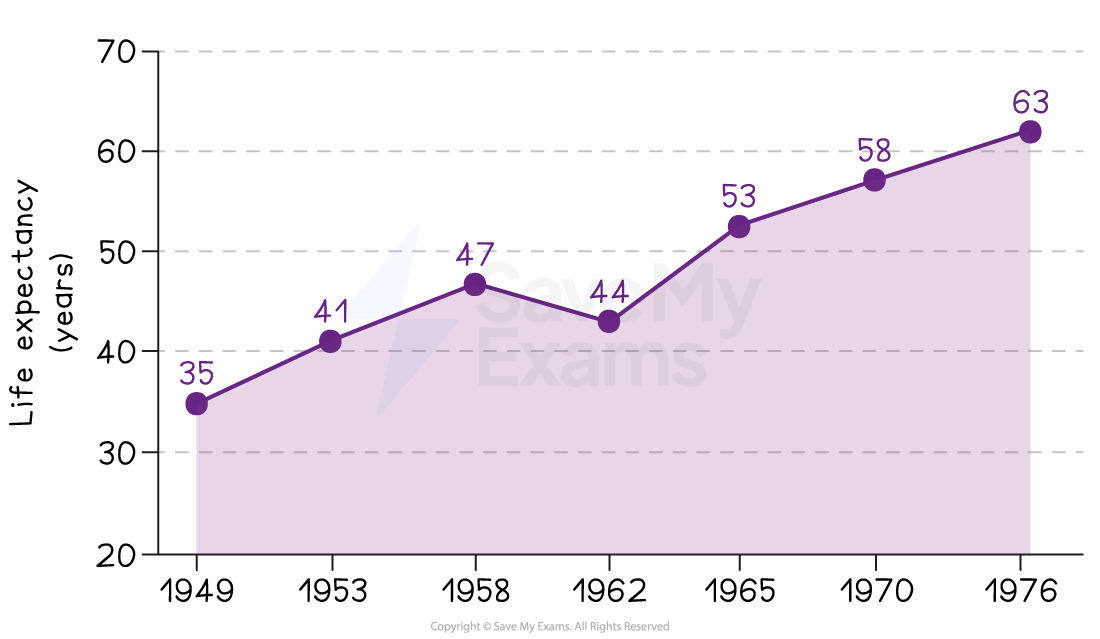
As a result, life expectancy increased from around 35 years in 1949 to over 60 years by the mid-1970s, demonstrating a significant improvement in public health
Improvements in education
Mao regarded education as essential for building a communist society and increasing support for the CCP
Large-scale literacy campaigns targeted China's largely illiterate rural population
Primary education expanded significantly during the 1950s and 1960s
Schools taught both academic subjects and communist ideology, helping to spread support for Mao's policies
Literacy rates rose substantially during Mao's rule, with estimates suggesting literacy increased from around 20% in 1949 to over 65% by the mid-1970s
Educational opportunities became more widely available to peasants and workers than under previous governments
Limitations
Education often prioritised political loyalty over academic achievement
During the Cultural Revolution (1966–1976), schools and universities were closed for long periods
Millions of young people experienced major disruptions to their education
Many teachers and academics were persecuted as supposedly "bourgeois" intellectuals
Increased social equality
Mao aimed to create a classless socialist society by eliminating traditional social hierarchies
Landlords and wealthy elites lost their economic and social privileges following the Land Reform
Wealth differences were reduced through collectivisation and state control of the economy
Workers and peasants were celebrated as the most important groups in society
Access to education and healthcare became more equal than under previous governments
Limitations
New inequalities emerged based on political loyalty rather than wealth
Individuals from "bad class backgrounds", such as landlord or capitalist families, often faced discrimination
Social status increasingly depended on a person's relationship with the CCP
Cultural changes and social control
Mao sought to transform Chinese society by replacing traditional beliefs and customs with communist values and revolutionary ideals
Citizens were encouraged to prioritise loyalty to Mao, the Communist Party and socialism above traditional family, religious or cultural loyalties
Political campaigns promoted ideological conformity and discouraged criticism of the government, creating pressure to demonstrate support for Mao's policies
During the Anti-Rightist Campaign (1957–1959), approximately 550,000 intellectuals and critics were persecuted after expressing opposition to government policies, contributing to a climate of fear and self-censorship
The Cultural Revolution (1966–1976) represented Mao's most ambitious attempt to reshape Chinese society and eliminate perceived capitalist influences
Millions of young people joined the Red Guards, who were encouraged to attack the Four Olds
Old customs
Old culture
Old habits
Old ideas
Temples, historical sites, books and cultural artefacts were destroyed across China as revolutionary groups attempted to eradicate traditional influences
Teachers, intellectuals and officials were publicly humiliated, attacked and denounced as enemies of the revolution
Many were imprisoned or sent to labour camps
Family relationships were often damaged
Children were encouraged to criticise parents and relatives who were accused of insufficient revolutionary commitment
Education was severely disrupted
Schools and universities closed for extended periods
This limited opportunities for an entire generation of young people
From 1968, approximately 17 million urban youths were sent to rural areas through the 'Up to the Mountains and Down to the Countryside Movement', where many faced harsh living conditions and lost educational and career opportunities
Historians estimate that between 1 and 2 million people died as a result of violence and persecution during the Cultural Revolution
Millions more people experienced imprisonment, public humiliation or forced relocation
Mao's efforts to transform Chinese culture weakened many traditional beliefs and strengthened communist ideology
However, the Cultural Revolution caused widespread social disruption and created a climate of fear that affected millions of Chinese citizens
Examiner Tips and Tricks
In Paper 2 essay questions, the effects on society section is where many students lose marks because they describe policies instead of analysing their impact. The examiner wants to know how Mao's policies changed people's lives and whether those changes strengthened or weakened his authoritarian rule
Overall impact of social policies
Mao's rule transformed Chinese society through major improvements in healthcare and education, ultimately increasing life expectancy in China
Traditional social hierarchies were weakened as landlords lost their privileged position and workers and peasants gained greater status within society
However, social progress often came alongside increasing political control, ideological conformity and restrictions on individual freedoms
Historiography
Traditional (Orthodox) historians argue that Mao's social policies caused significant suffering and repression, outweighing many of the benefits of healthcare and education reforms
Frank Dikötter, Jung Chang and Jon Halliday emphasise the human cost of Mao's campaigns and social control
Revisionist historians focus on Mao's achievements in improving literacy, healthcare and women's rights
Maurice Meisner and Mark Selden argue that Mao transformed the lives of millions through improved access to education, healthcare and greater social equality
Post-revisionist historians take a balanced view, recognising both the social progress and the suffering caused by Mao's rule
Jonathan Spence argues that Mao achieved important social improvements but undermined many of these gains through political campaigns such as the Cultural Revolution
Worked Example
How to use historiography? The key is to use historians briefly to reinforce your argument, rather than devoting a whole paragraph to historiography.
For example: While Maurice Meisner argues that Mao's reforms improved the lives of millions through greater literacy and healthcare, Frank Dikötter contends that the immense suffering caused by the Great Leap Forward outweighed these achievements. Overall, Mao’s social policies reveal a clear tension between progress and repression, with limited gains in welfare being undermined by widespread human suffering.

Unlock more, it's free!
Join the 100,000+ Students that ❤️ Save My Exams
the (exam) results speak for themselves:

Was this revision note helpful?
