Role of conflict (DP IB History: SL): Revision Note

Summary
Conflict played a decisive role in Mao’s emergence as a leader because prolonged warfare weakened the Guomindang (GMD)
The conflict with the GMD allowed the Chinese Communist Party (CCP) to expand its military strength, political influence, and popular support
The Chinese Civil War, the Long March, and the Sino-Japanese War enabled Mao to strengthen his leadership within the CCP
Military conflict created instability, social disruption, and nationalist resentment, all of which increased support for the CCP
Mao’s successful use of military organisation allowed the CCP to eventually defeat the GMD by 1949
Chinese Civil War
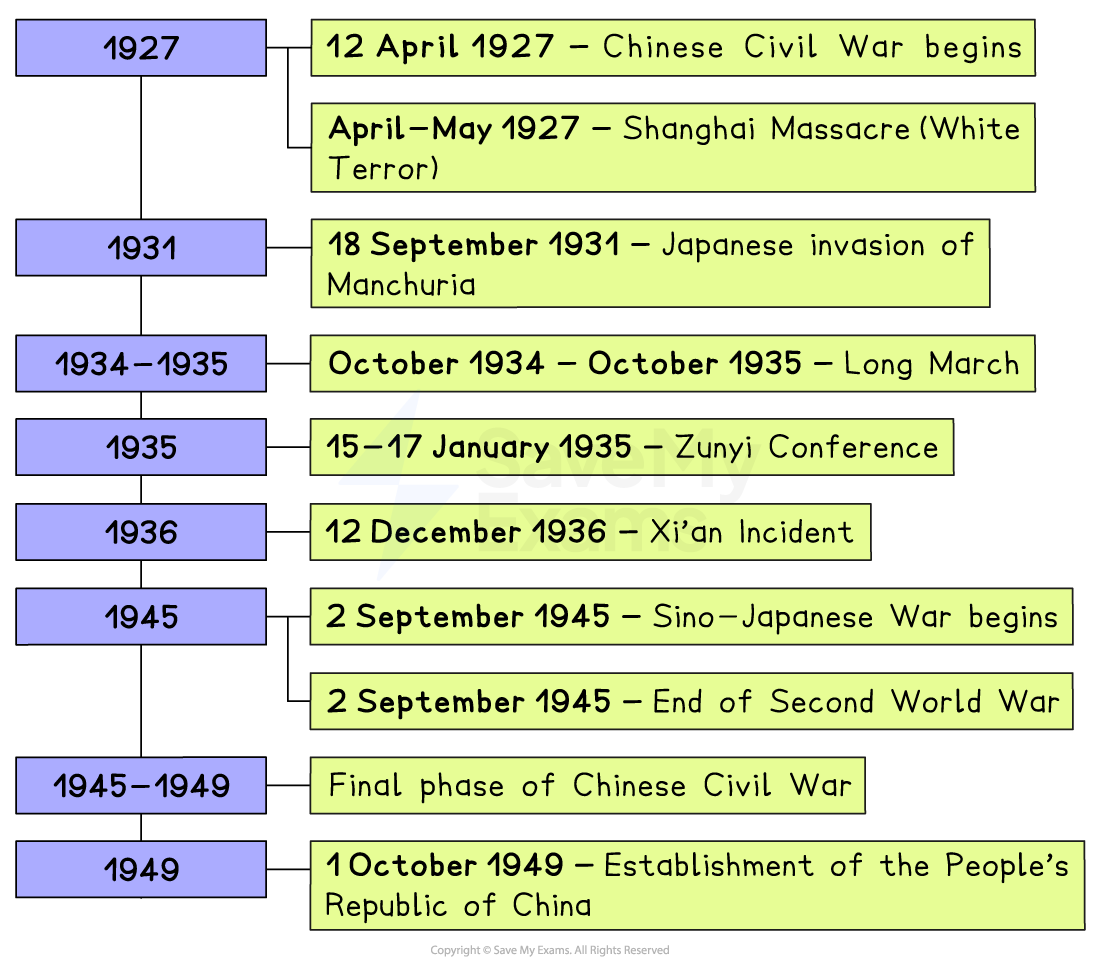
The Chinese Civil War began in 1927 after Chiang Kai-shek launched the Shanghai Massacre against the communists
This conflict ended cooperation between the GMD and the CCP
The Shanghai Massacre was part of the wider 'White Terror'
This was a campaign carried out by the GMD against communists and suspected left-wing supporters across China
Thousands of communists were arrested or killed during the White Terror, forcing the CCP to retreat into rural areas
The violence of the Civil War radicalised the CCP
It also strengthened Mao’s belief that revolution in China would require armed struggle and peasant support
Conflict with the GMD allowed Mao to present the CCP as victims of repression and defenders of ordinary Chinese people against a brutal nationalist government
The Civil War also forced the CCP to develop effective military organisation, discipline, and guerrilla warfare tactics
Examiner Tips and Tricks
In your exam, try not to narrate (tell a story!) of the Chinese Civil War. Examiners want reasons and evaluation of importance
Top tips:
Always compare factors: GMD weakness vs CCP strength vs wartime conditions
Make sure you explain why peasants supported Mao, not just that they did
Strong answers show that victory was not inevitable
Mao’s military leadership
Mao increased his influence within the CCP because many communist leaders recognised the effectiveness of his military strategies during periods of conflict
Mao argued that guerrilla warfare and peasant mobilisation were more suitable for Chinese conditions than traditional urban revolution
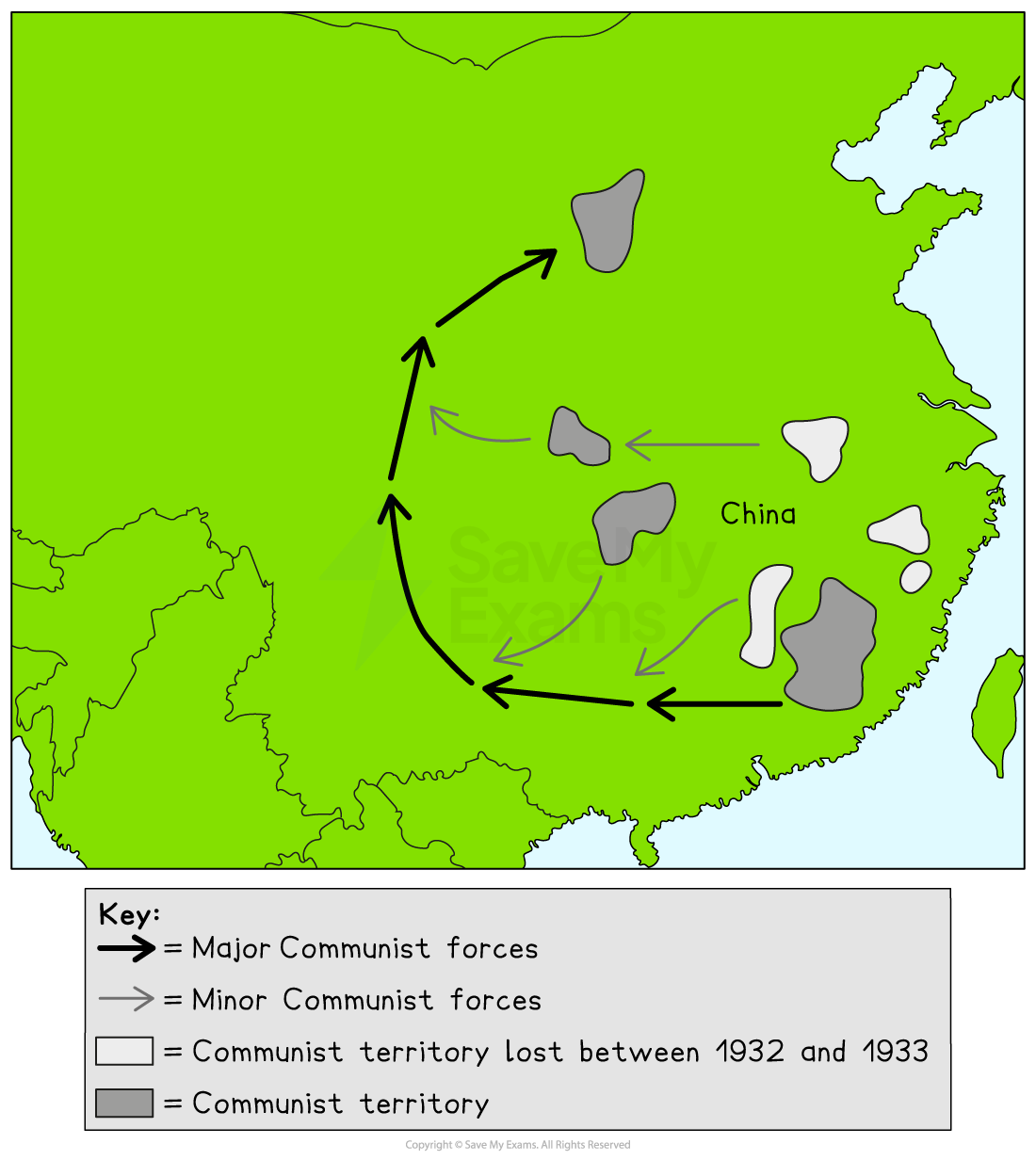
The CCP established rural communist bases
These were where Mao developed the communist military and political organisation
Many were located in Jiangxi during the early 1930s,
Mao’s leadership became increasingly important because the survival of the CCP depended upon military adaptability and support from rural populations
Japanese invasion of China
The Japanese invasion of Manchuria in 1931 and the outbreak of full-scale war in 1937 transformed the political situation within China
Japanese aggression weakened the authority of the GMD
Many Chinese people believed Chiang Kai-shek focused too heavily on defeating the communists rather than resisting Japan
The CCP benefited from growing nationalist anger because the communists portrayed themselves as patriotic defenders of China against foreign imperialism
Communist guerrilla forces gained support in northern China by resisting Japanese occupation and organising local resistance movements
The war created conditions that allowed the CCP to expand its membership, military strength, and territorial control
The Long March (1934–1935)
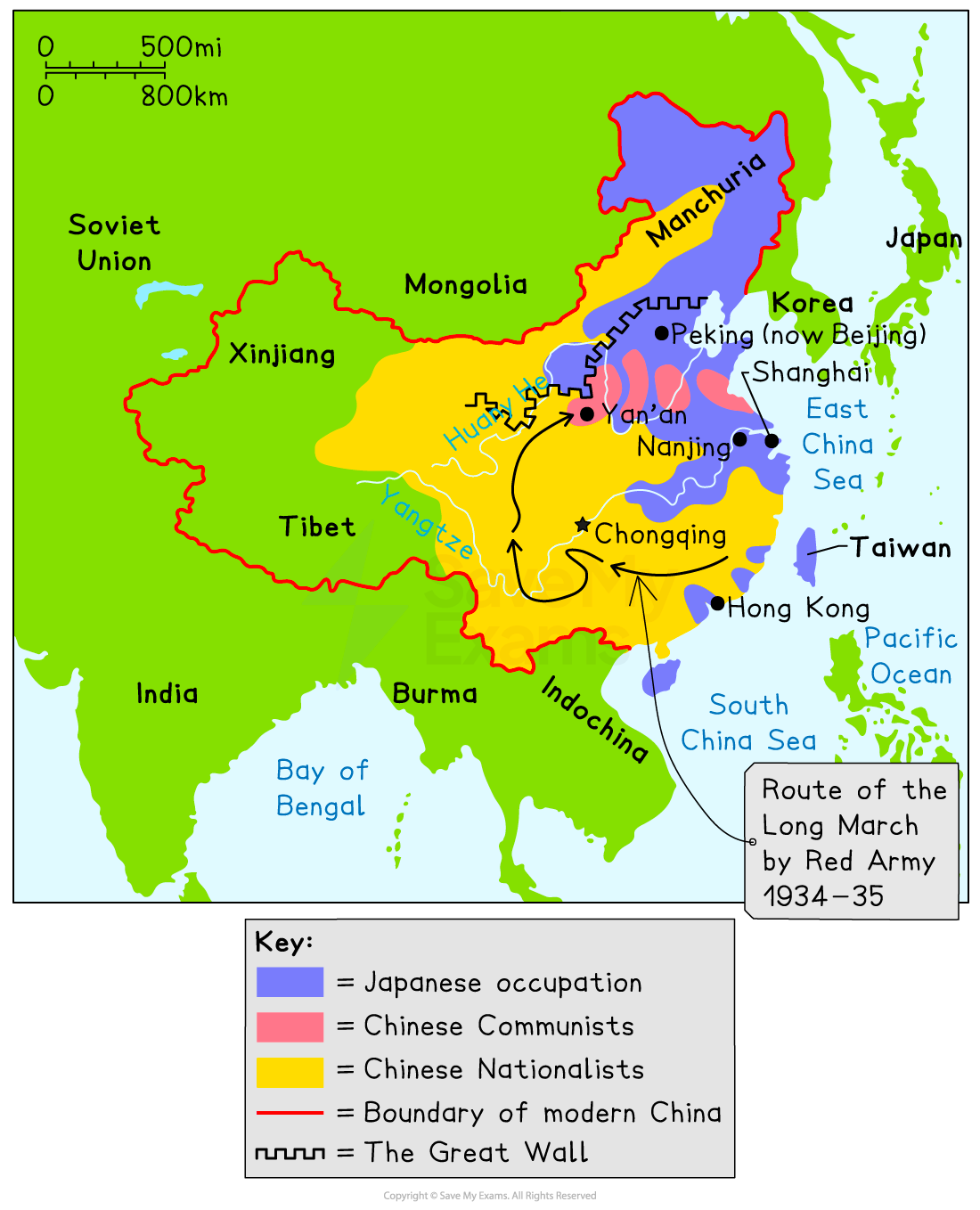
The Long March began in October 1934 after the GMD's encirclement campaigns forced the CCP to retreat from Jiangxi province
Approximately 80,000–100,000 communist soldiers and supporters began the retreat
The march covered roughly 9,000 kilometres across some of China’s most difficult terrain
Only around 8,000–10,000 survived the march
Despite severe losses, the Long March became one of the most important symbols in CCP history
It demonstrated communist determination, sacrifice, and discipline
During the Zunyi Conference in January 1935, Mao emerged as the dominant leader of the CCP
The Long March strengthened Mao’s authority because surviving communists increasingly viewed him as the leader most capable of ensuring the CCP's survival
Communist propaganda later presented the Long March as a heroic revolutionary struggle, helping strengthen support for Mao and the CCP
Guerrilla warfare
Mao successfully adapted guerrilla warfare tactics to Chinese conditions
These relied on:
Mobility
Surprise attacks
Support from local peasants
CCP forces avoided large-scale direct battles against stronger GMD armies
They focused on weakening enemy forces gradually
Guerrilla warfare allowed the CCP to survive despite:
Limited weapons
Smaller troop numbers
Economic weakness
Mao argued that communist forces should maintain close relationships with peasants to secure food, shelter, recruits, and intelligence
The success of guerrilla warfare strengthened Mao’s position within the CCP
His military strategies appeared far more effective than earlier communist approaches
Xi’an incident (1936)
In December 1936, Chiang Kai-shek was kidnapped by his own generals during the Xi’an Incident
They demanded that he cooperate with the CCP against Japan
Chiang was forced to agree to the Second United Front between the GMD and the CCP
The United Front allowed the CCP to avoid destruction by the GMD and focus on expanding communist influence during the war against Japan
The incident strengthened the CCP politically because the communists appeared committed to national unity and resistance against foreign aggression
Sino-Japanese War (1937–1945)
The Sino-Japanese War created massive social and political disruption throughout China
It weakened GMD control
Created opportunities for communist expansion
CCP forces used guerrilla warfare effectively against Japanese troops, particularly in rural northern China
Communist soldiers often treated peasants more respectfully than both Japanese troops and GMD forces
This helped the CCP gain rural support
During the war, CCP membership increased dramatically
It went from 40,000 members in 1937 to over 1.2 million by 1945
The Red Army, later reorganised into the Eighth Route Army and New Fourth Army, expanded communist influence throughout the occupied regions
The GMD suffered heavily during the war from:
Military losses
Inflation
Corruption
Declining public support
Final phase of the Chinese Civil War (1945–1949)
After the defeat of Japan in 1945, the conflict between the CCP and the GMD resumed immediately
The CCP benefited from increased military strength, rural support, and superior morale developed during the anti-Japanese war
Communist forces captured large amounts of Japanese weapons in Manchuria after the Soviet occupation of the region in 1945
Mao’s military commanders, including Zhu De and Lin Biao, led successful campaigns against GMD forces
The CCP increasingly gained support because many Chinese people viewed the communists as more disciplined and effective than the corrupt GMD government
In October 1949, Mao officially proclaimed the establishment of the People’s Republic of China after the CCP's victory in the Civil War
Importance of conflict
Conflict created the conditions that allowed Mao and the CCP to expand their military, political, and social influence throughout China
Warfare weakened the GMD economically, militarily, and politically while strengthening the communist organisation and leadership
Mao’s success depended heavily upon his ability to use guerrilla warfare, peasant mobilisation, and nationalist resistance effectively during periods of conflict
However, conflict alone did not explain Mao’s rise because communist ideology, social reform, and GMD weaknesses also contributed significantly to the CCP's victory
Historiography
Orthodox interpretationOrthodox historians argue that Mao’s military leadership and guerrilla warfare strategies were decisive in ensuring communist survival and eventual victory
Revisionist interpretation
Revisionist historians argue that the Japanese invasion and the GMD failures contributed more to the CCP's success than Mao’s military genius alone

Unlock more, it's free!
Join the 100,000+ Students that ❤️ Save My Exams
the (exam) results speak for themselves:

Was this revision note helpful?
