Economic factors (DP IB History: SL): Revision Note

Summary
This revision note will explore the economic conditions in China before 1949, which allowed Mao to emerge as the authoritarian ruler.
Economic instability, rural poverty, and the failure of the GMD to solve China’s financial problems increased support for Mao and the Chinese Communist Party (CCP) during the 1920s–1940s
The CCP gained support amongst peasants by promising land redistribution, lower rents, and economic equality at a time when millions experienced severe hardship
Rural poverty and economic inequality
Poverty in Rural China
Around 80–90% of the Chinese population were peasants
Many of whom lived in conditions of extreme poverty during the early twentieth century
Large numbers of peasants suffered from chronic debt, food shortages, and poor living standards
This was due to unequal land ownership and high rents
Tenant farmers were often required to give a large proportion of their harvests to wealthy landlords
This left many families unable to survive economically
Periodic famines and poor harvests worsened rural poverty
They also increased resentment towards traditional elites and the GMD government
Unequal Land Ownership
A small class of wealthy landlords controlled large amounts of agricultural land
The millions of peasants owned little or no land
Land inequality became one of the most important economic problems in China because it reinforced both poverty and social resentment
The GMD failed to introduce major land reforms, causing many peasants to lose confidence in the nationalist government
CCP land reform policies
The CCP promised the redistribution of land from landlords to poor peasants
This made land reform one of the communists’ most effective economic policies
In communist-controlled regions during the 1930s and 1940s, the CCP often reduced rents and lowered taxes for peasants
Some land was confiscated from landlords and redistributed amongst poorer rural families
Mao understood that land reform would attract peasant support because ownership of land represented economic security and survival for rural families
Communist propaganda portrayed landlords as exploiters who benefited from peasant suffering
These policies allowed peasants to experience direct economic improvements under communist rule
Economic reforms strengthened the CCP's support because many peasants associated communist rule with fairness and improved living conditions
Economic weaknesses of the GMD
Corruption and mismanagement
Corruption within the GMD weakened economic stability because government officials frequently:
Stole public money
Accepted bribes
Misused state resources
Many Chinese people believed the GMD prioritised the interests of wealthy elites rather than solving national economic problems
Corruption reduced confidence in Chiang Kai-shek’s leadership and damaged support for the nationalist government
Inflation
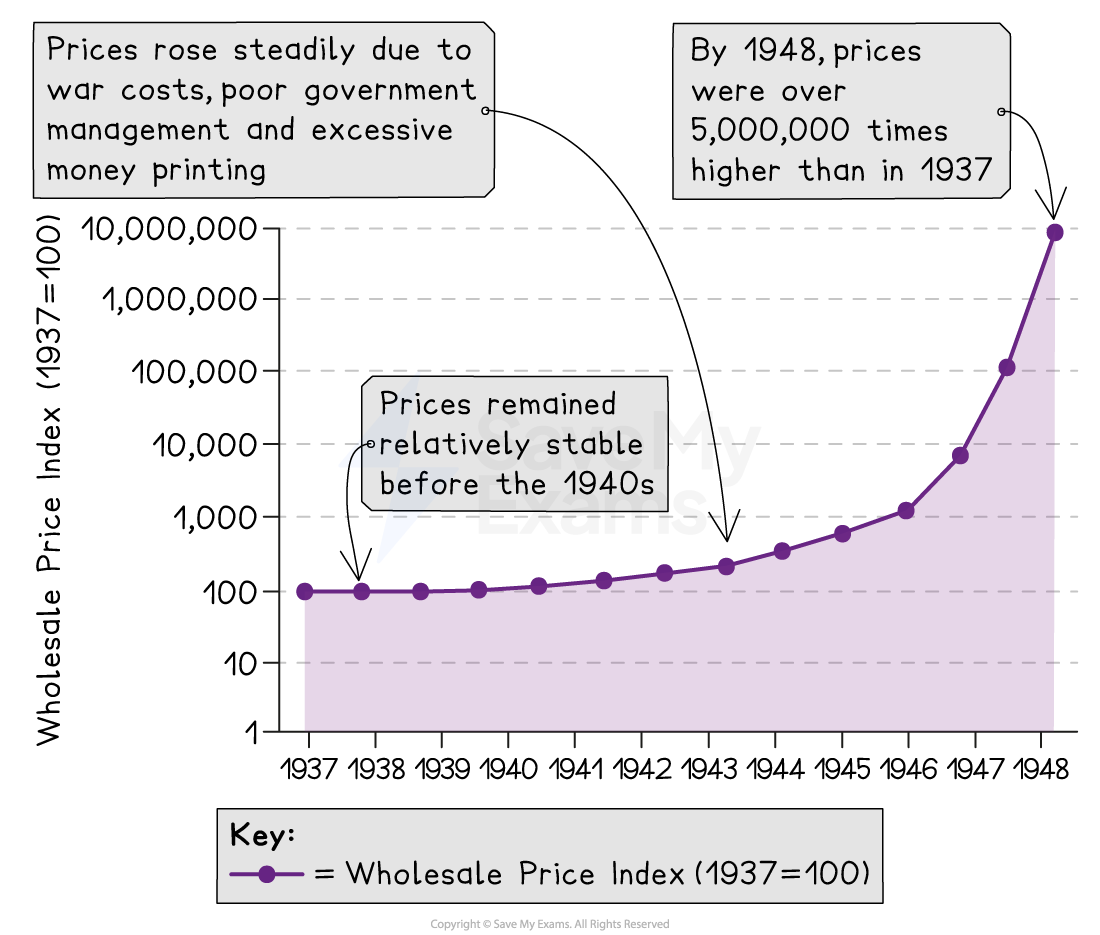
Inflation became a major problem during the 1940s, particularly during the Second Sino-Japanese War and the later stages of the Chinese Civil War
The GMD printed large amounts of money to finance military spending
This caused the value of Chinese currency to collapse
Hyperinflation destroyed savings and caused severe hardship for urban workers, civil servants, and middle-class families
Rising food prices and declining wages increased public dissatisfaction with the GMD
Economic impact of war
Decades of conflict severely damaged the Chinese economy through the destruction of farmland, transport systems, and industry
Japanese occupation weakened economic production and disrupted trade across large areas of China
Many civilians experienced unemployment, famine, and financial instability during the war years
The GMD were unable to restore economic stability, which increased support for alternative political movements, such as the CCP
CCP economic organisation
Mao believed that economic reform was essential for winning peasant loyalty during the Chinese Civil War
CCP forces gained support because communist leaders were often viewed as less corrupt and more disciplined than GMD officials
Taxes within communist-controlled areas were usually lower and more predictable than those imposed by warlords or nationalist authorities
Communist economic policies aimed to protect peasant production to maintain rural support
The CCP relied heavily upon peasants for food, recruits, shelter, and intelligence
This made rural economic support crucial for communist survival
Economic improvements within communist regions strengthened the CCP’s reputation as a government capable of addressing ordinary people’s needs
Economic impact of the Sino-Japanese War
Weakening of the GMD economy
The Sino-Japanese War between 1937 and 1945 placed enormous pressure on the GMD economy because military spending increased dramatically
Japanese occupation deprived the GMD of important industrial regions and tax revenues
Economic collapse and inflation became increasingly severe during the war years
CCP advantages
The CCP expanded its influence within rural northern China
In this region, communist forces organised local economies and agricultural production more effectively than the GMD
Communist-controlled areas often appeared more stable and economically organised than regions under nationalist control
Economic hardship caused by war encouraged many peasants to support communist promises of reform and equality
Importance of economic factors
Economic hardship created:
Widespread dissatisfaction with existing political structures
Increased support for revolutionary change
Mao and the CCP successfully connected communist policies with the immediate economic needs of peasants and workers
The economic failures of the GMD weakened confidence in nationalist rule while strengthening the CCP’s image as a more effective and disciplined alternative
However, economic factors alone did not explain Mao’s emergence because ideology, social conditions, nationalism, and military conflict also played major roles
Historiography
Orthodox InterpretationOrthodox historians argue that the CCP's economic reforms genuinely improved peasant conditions and were essential in gaining rural support
Revisionist Interpretation
Revisionist historians argue that GMD's economic collapse and wartime disruption contributed more to communist victory than the success of the CCP's economic policies themselves

Unlock more, it's free!
Join the 100,000+ Students that ❤️ Save My Exams
the (exam) results speak for themselves:

Was this revision note helpful?
