Role of ideas (DP IB History: SL): Revision Note

Summary
This note will explore the role of ideology in the emergence of Mao Zedong as the authoritarian leader of China
Mao altered the Marxist-Leninist ideology to suit China’s overwhelmingly rural and peasant-based society
He also paired the communist ideology with nationalism and anti-imperialism
The Chinese Communist Party's (CCP's) promises of land redistribution, social equality, and an end to landlord exploitation enabled Mao to gain widespread peasant support
Ideological appeal became increasingly important because the Guomindang (GMD) appeared corrupt, ineffective, and disconnected from the needs of ordinary Chinese people
Background conditions in China
Collapse of the Qing Dynasty
The collapse of the Qing Dynasty following the Xinhai Revolution in 1911 created a prolonged period of political fragmentation and instability in China
Competing warlords controlled different regions of China
This weakened the central authority
The failure of the new Republic of China to establish political stability or economic reform contributed to widespread dissatisfaction amongst intellectuals, workers, and peasants
Weaknesses of the Guomindang (GMD)
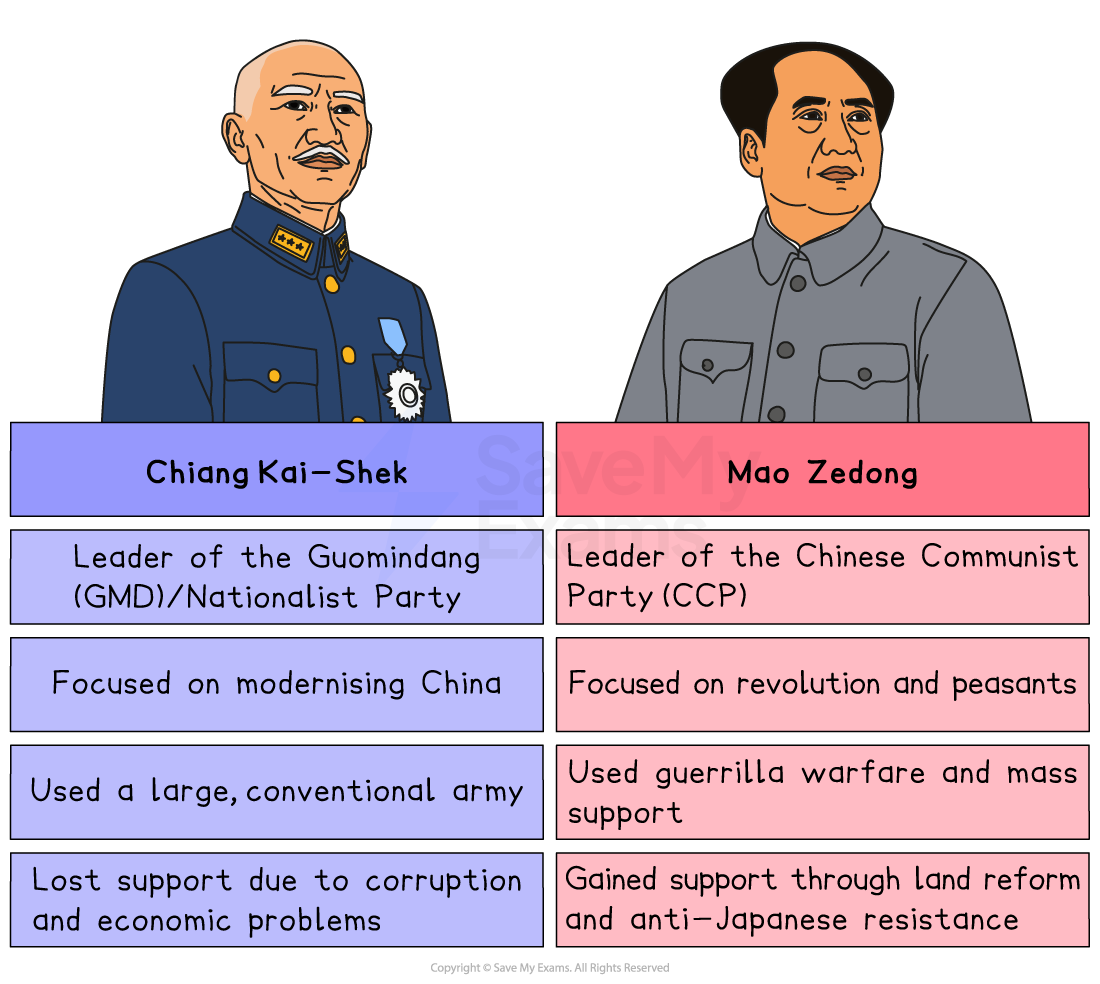
Under the leadership of Chiang Kai-shek, the GMD increasingly lost support due to:
Corruption
Inflation
Military failures
These demonstrated the government’s inability to solve China’s social and economic problems
Many peasants remained trapped in extreme poverty due to high rents, debt and landlord exploitation
The GMD failed to introduce meaningful land reform policies
Chiang decided to focus on the destruction of the communists rather than combatting the invading Japanese forces (in 1931)
This damaged support for the GMD, as they were seen as militarily inadequate and failing to protect China
Examiner Tips and Tricks
Strong IB responses should consistently connect ideological appeal to wider economic, political, and military conditions rather than discussing ideas in isolation
Always explain why communist ideas appealed specifically to peasants, workers, and nationalist intellectuals within the context of Chinese instability
Influence of Marxism-Leninism
Founding of the CCP
The CCP was officially founded in Shanghai in July 1921 by a small group of Chinese intellectuals
They had become increasingly influenced by Marxist ideas following the success of the Russian Revolution
Early communist leaders such as Chen Duxiu and Li Dazhao viewed Marxism as a solution to:
China’s weakness
Foreign domination
Social inequality
Soviet advisers from the Comintern played an important role in helping organise the CCP during its early years
This demonstrated the international influence of communist ideology
Traditional Marxist ideology
Traditional Marxist theory argued that a communist revolution would emerge within industrial societies
The urban proletariat would overthrow the capitalist bourgeoisie
China, however, remained predominantly agricultural
Approximately 80–90% of the population were poor peasants rather than industrial workers
Mao recognised that strict Marxist theory could not succeed within Chinese conditions
This led him to adapt the fundamentals of communist ideology to suit rural China
Maoism and the role of the peasantry
Mao’s adaptation of communist ideology
Mao argued that the peasantry, rather than the urban working class, represented the true revolutionary force within China
This is because peasants experienced severe economic exploitation and formed the overwhelming majority of the population
This adaptation of Marxism became known as Maoism
It represented one of Mao’s most significant ideological contributions to the communist movement
Appeal to the peasantry
The CCP promised:
Land redistribution
Lower rents
Reduced taxation
Destruction of landlord power
This appealed strongly to peasants who had experienced decades of poverty and exploitation
In communist-controlled areas during the 1930s and 1940s, the CCP often reduced rents and redistributed land, allowing peasants to experience direct economic benefits from communist rule
Mao’s emphasis on peasant mobilisation allowed the CCP to expand its rural support base far more effectively than the GMD had done
Importance of land reform
Land reform became one of the CCP’s most powerful ideological tools
It was the redistribution of land from wealthy landlords to poor peasants in order to reduce inequality and improve living standards
It linked the communist revolution directly to improvements in everyday peasant life
By portraying landlords as exploiters and class enemies, the CCP encouraged peasants to view communism as both socially just and economically beneficial
Nationalism and anti-imperialism
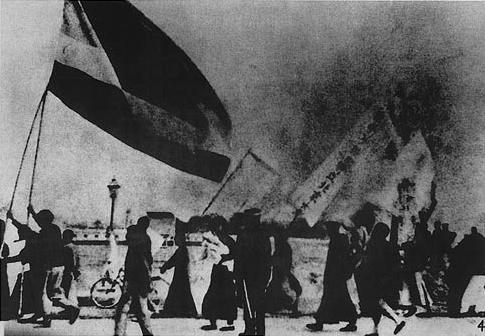
May Fourth Movement (1919)
The May Fourth Movement emerged after the Treaty of Versailles
The Treaty of Versailles transferred German territory in Shandong to Japan rather than returning it to China
This caused widespread outrage
The May Fourth protests began in Beijing on 4 May 1919, and they stimulated the growth of:
Chinese nationalism
Anti-imperialism
Interest in radical political ideologies such as Marxism
Many future CCP leaders became politically radicalised during this period because they believed Western liberal democracies had failed China
The CCP as defenders of China
In 1931, the Japanese invaded Manchuria
This was followed by the outbreak of the Sino-Japanese War in 1937
The CCP increasingly presented itself as the patriotic defender of China against foreign imperialism
CCP guerrilla forces actively resisted Japanese occupation in northern China, helping the communists gain support amongst peasants living under Japanese threat
In contrast, Chiang Kai-shek’s earlier focus on suppressing communists rather than resisting Japan created the impression that the GMD lacked genuine nationalist commitment
The Long March
Key facts
The Long March took place between 1934 and 1935
CCP forces were forced to retreat from Jiangxi due to the GMD military encirclement campaigns
Approximately 80,000–100,000 communists began the march
Only around 8,000–10,000 people survived the journey of roughly 9,000 kilometres
Importance of the Long March
The Long March became a powerful propaganda symbol
It portrayed the communists as heroic, disciplined, and determined revolutionaries willing to sacrifice themselves for the survival of the movement
During the Zunyi Conference of 1935, Mao emerged as the dominant leader of the CCP
This marked a crucial turning point in his rise to power
The march also allowed communist ideology to spread across rural China as the CCP and the Red Army travelled through numerous provinces
Yan’an period (1935–1945)
Importance of Yan’an
After the Long March, the CCP established its headquarters in Yan’an
It became the ideological and organisational centre of the communist movement
Yan’an served as a training centre where party members studied:
Communist ideology
Revolutionary discipline
Mao’s political theories
Growth of Mao’s authority
Mao gradually gained control over the CCP during the Yan’an period by promoting his own interpretation of Marxism-Leninism as the official ideology of the party
Mao’s speeches and writings increasingly became central to CCP's political education
They contributed to the early development of his cult of personality
CCP propaganda and ideological control
Methods of propaganda
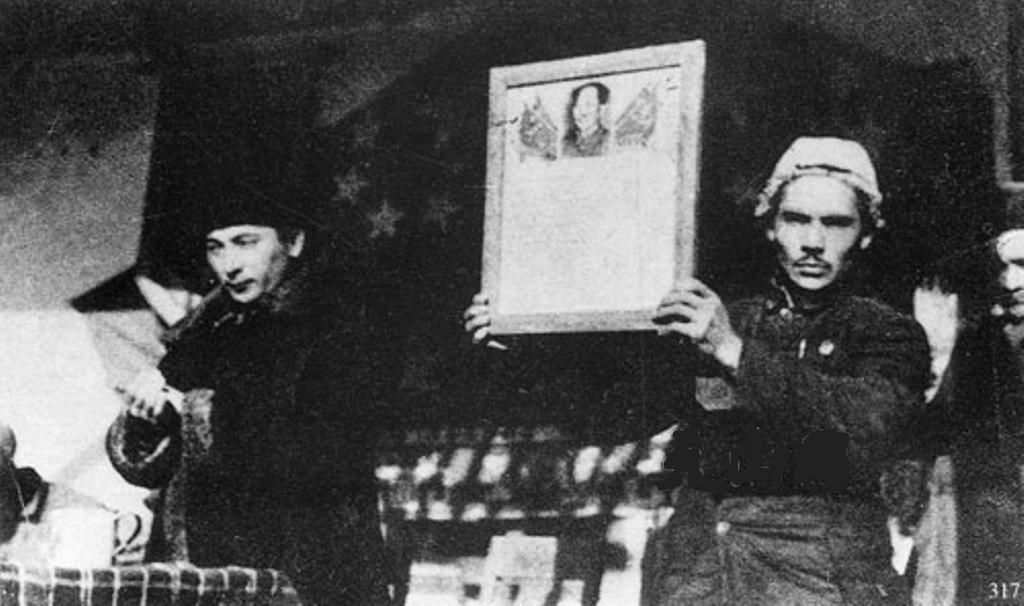
The CCP used newspapers, pamphlets, posters, and political slogans to spread communist ideology throughout rural and urban China
Communist propaganda was deliberately written in simple language
This meant that peasants with little education could understand ideas about:
Class struggle
Revolution
Land reform
Posters and pamphlets often portrayed landlords and the GMD as corrupt exploiters, while presenting the CCP as defenders of ordinary Chinese people
During the Sino-Japanese War, propaganda frequently showed communist soldiers heroically resisting Japanese imperialism, helping the CCP gain nationalist support
During the Yan’an period, Mao increasingly became the focus of CCP propaganda
His speeches and writings were presented as the solution to China’s political and economic problems
CCP propaganda successfully linked communism with:
Nationalism
Anti-imperialism
Social justice
Peasant liberation
This allowed the party to gain far greater support than the increasingly corrupt and unpopular GMD
Comparison with the GMD
Communist propaganda portrayed the CCP as disciplined, honest, and closely connected to the needs of peasants and workers
By contrast, the GMD became associated with corruption, inflation, military incompetence, and repression, particularly during the later stages of the Chinese Civil War
Importance of ideology in Mao’s emergence
Strengths of CCP ideology
Mao’s adaptation of Marxism succeeded because it directly addressed the realities of Chinese society, particularly:
Peasant poverty
Anti-imperialist nationalism
Communist ideology enabled the CCP to present itself as a revolutionary alternative to the failures of both warlordism and GMD rule
The combination of nationalism, land reform, and promises of equality allowed the CCP to attract broad support across rural China
Limits of ideology
Although ideology played a central role in Mao’s emergence, CCP's success also depended heavily upon the GMD's weaknesses, as well as:
Japanese invasion
Civil war conditions and effective communist military organisation
Without the political failures of the GMD and the disruption caused by war, communist ideology alone may not have been sufficient to bring Mao to power
Historiography
Orthodox interpretation
Orthodox historians argue that Mao’s revolutionary ideology successfully mobilised peasants and transformed the CCP into a genuine mass movement.
Revisionist interpretation
Revisionist historians often argue that CCP victory depended more heavily on wartime conditions, GMD failures, and military strategy than on ideology alone.
Examiner Tips and Tricks
Examiner expectations for IB History essays:
Judgement throughout
Not just in conclusion—every paragraph should argue:“This was more significant because…”
Comparison of factors
Never say “X caused Y” alone—always:“X was more significant than Y because…”
Conceptual focus
Every paragraph should make a judgement about significance, cause, change, or perspective, and compare ideas (e.g. propaganda vs force), rather than telling the story of eventsBalance of evidence and analysis
Evidence proves knowledge
Analysis earns marks

Unlock more, it's free!
Join the 100,000+ Students that ❤️ Save My Exams
the (exam) results speak for themselves:

Was this revision note helpful?
