External threats (DP IB History: SL): Revision Note

Summary
Mao's regime faced several external threats from foreign powers and international tensions during the Cold War
Key challenges came from the United States, Taiwan, and later the Soviet Union
These threats reinforced Mao's belief that China was under constant danger from hostile capitalist and imperialist forces
Mao often used external threats to justify tighter political control and strengthen national unity behind the CCP
Although foreign tensions created security concerns, none posed an immediate threat to the survival of Mao's regime
The United States and the Korean War (1950–53)
The outbreak of the Korean War represented the first major external challenge to the newly established People's Republic of China
When UN forces led by the United States approached the Chinese border at the Yalu River, Mao feared a direct threat to Chinese security
China intervened in the war in October 1950 with the "People's Volunteer Army," leading to a costly conflict with American-led forces
The war resulted in approximately 180,000 Chinese military deaths and placed a significant strain on China's economy
Mao used the conflict to portray China as defending itself against foreign aggression, strengthening nationalist support for the regime
Rather than weakening Mao's rule, the Korean War enhanced his domestic legitimacy by presenting the CCP as the defender of Chinese sovereignty
Case Study
Korean War 1950-1953
The Korean War (1950–1953) was a conflict between North Korea (supported by the communist bloc) and South Korea (backed by the United Nations, mainly the USA)
It began when North Korea invaded the South in June 1950, aiming to unify Korea under communism
UN forces pushed the North back, but when they advanced close to the Chinese border, China entered the war in late 1950
China supported North Korea by sending the People’s Volunteer Army
Mao’s government intervened mainly for security reasons: it feared a hostile, US-backed Korea on its border after UN troops moved toward the Yalu River
China also wanted to support fellow communist states and strengthen its position in the Cold War
The war ended in 1953 with an armistice, restoring the border near the 38th parallel and leaving Korea divided
Taiwan and the Nationalist threat
After losing the Chinese Civil War in 1949, Chiang Kai-shek and the Guomindang (GMD) government retreated to Taiwan
The GMD continued to claim that it was the legitimate government of all China
The United States protected Taiwan through military and diplomatic support, preventing Mao from launching a successful invasion
The First and Second Taiwan Strait Crises (1954–55 and 1958) increased tensions between China, Taiwan, and the United States
Mao viewed Taiwan as a symbol of an unfinished revolution and a continuing challenge to the CCP's legitimacy
Taiwan remained a persistent political and ideological threat, but the GMD lacked the capacity to overthrow Mao's regime from the island
Case Study
Taiwan Strait Crises
The Taiwan Strait Crises were two periods of military tension between Mao’s China and the United States over control of offshore islands held by Taiwan, which was governed by Chiang Kai-shek’s Nationalist government after 1949
First Crisis (1954–55):
China shelled the offshore islands of Quemoy and Matsu
The United States responded by signing the Sino-American Mutual Defense Treaty with Taiwan
The crisis ended after a limited Chinese bombardment and diplomatic pressure
Second Crisis (1958):
China again bombarded Quemoy and Matsu
The United States supplied Taiwan and considered military retaliation
China eventually reduced shelling, and no full-scale war broke out
Examiner Tips and Tricks
Focus on how these external threats affected Mao's rule, not just on the events themselves
The strongest examples are the Korean War, the Taiwan Strait Crisis, and the Sino-Soviet Split
For evaluation questions, argue that external threats rarely weakened Mao's control and often strengthened his position by encouraging nationalism and justifying authoritarian measures
The Sino-Soviet split
During the 1950s, China and the Soviet Union maintained a close alliance based on shared communist ideology
Relations deteriorated during the late 1950s and 1960s due to ideological disagreements and competition for leadership of the communist world
Mao criticised Soviet leader Nikita Khrushchev for pursuing peaceful coexistence with the West
In 1960, the Soviet Union withdrew thousands of advisers from China, disrupting industrial and technological projects
Border disputes led to armed clashes along the Ussuri River in 1969
The possibility of Soviet military action became one of the most serious external security threats Mao faced
The Sino-Soviet Split isolated China internationally and created the danger of conflict with another communist superpower
International isolation
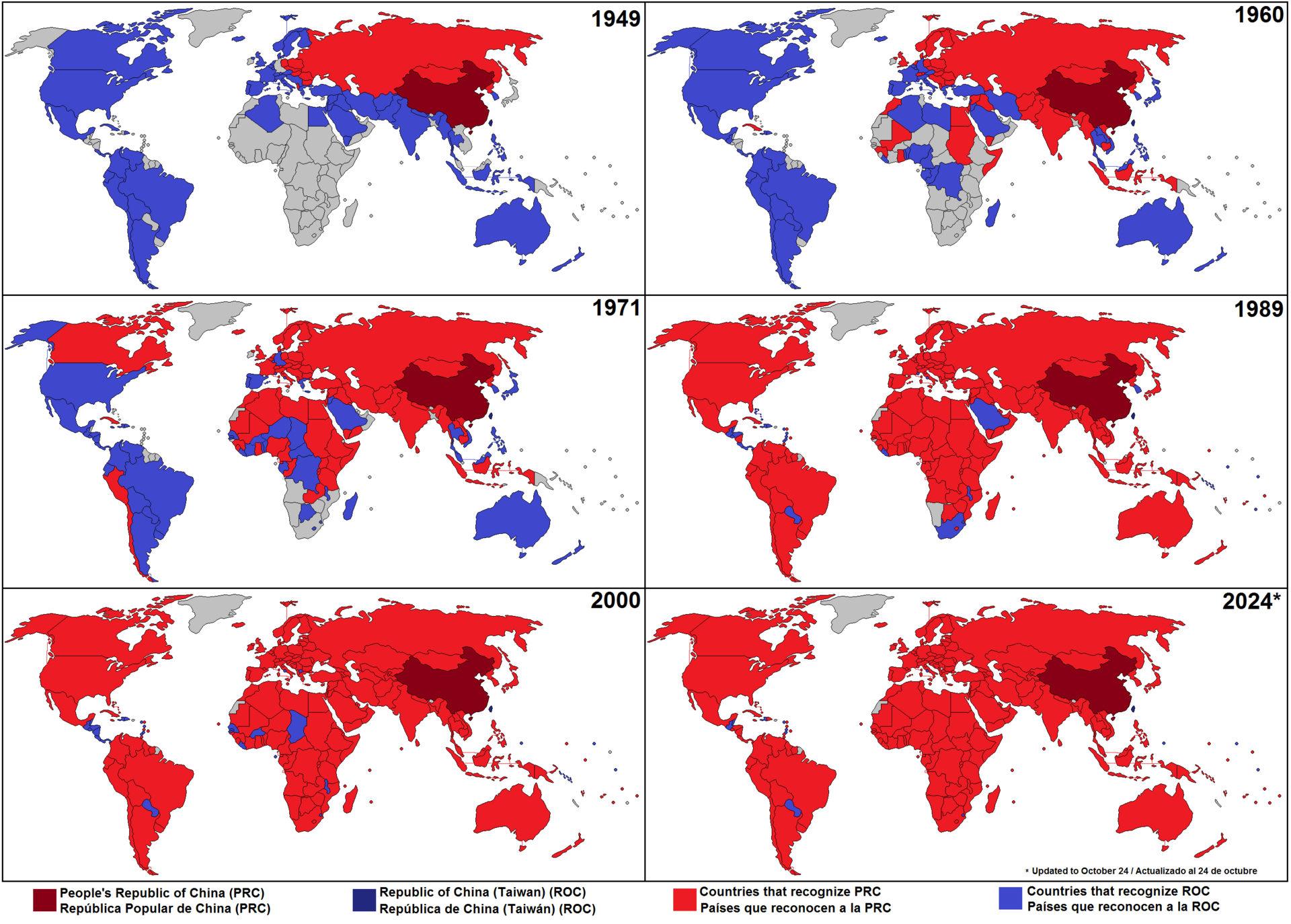
Many Western countries refused to recognise the People's Republic of China after 1949 (see map below)
China was excluded from the United Nations, while Taiwan held China's seat until 1971
Economic sanctions and diplomatic isolation limited China's international influence
Mao frequently portrayed China as surrounded by hostile capitalist powers seeking to contain communism
Isolation reinforced the CCP's emphasis on self-reliance and suspicion of foreign influence
International isolation increased security concerns but also strengthened Mao's ability to justify political control and ideological conformity
Border and regional tensions
China fought a brief border war with India in 1962 over disputed Himalayan territories
Tensions with neighbouring states reinforced Mao's belief that China faced constant external threats
Military spending and defence preparations remained important throughout Mao's rule
External conflicts were often used to encourage patriotism and support for the CCP
Although these disputes rarely threatened the regime directly, they contributed to a climate of permanent vigilance and militarisation
Why external threats failed to overthrow Mao
The CCP maintained firm control over the military through the People's Liberation Army (PLA), which could rid Mao of threats to security
Foreign powers generally sought to contain China rather than directly remove Mao from power
External threats often strengthened nationalist support for the regime
Mao successfully portrayed opposition to China as evidence of foreign imperialism and hostility
The existence of external enemies allowed the CCP to justify greater political control and suppress dissent
Historiography
Traditional (Orthodox) Historians
Historians such as Jung Chang argue that Mao exaggerated foreign threats to strengthen his personal authority and justify repression
Revisionist Historians
Historians such as Maurice Meisner argue that many of the threats were genuine Cold War security concerns and helped explain Mao's emphasis on national defence
Worked Example
How to use historiography in exam questions:
The key is that historiography should support your argument, not replace it. A common mistake is simply dropping in a historian's name without explaining how it relates to the question.
For example:
Question: "To what extent did foreign threats contribute to the maintenance of Mao's rule?"
Instead of writing:Jung Chang argues Mao exaggerated foreign threats, however Meisner argues that these threats were genuine concerns.
Write: While Jung Chang argues that Mao exaggerated foreign threats to justify repression, Maurice Meisner contends that many of these threats were genuine Cold War security concerns. Although China did face real external dangers, Mao frequently exploited these crises to strengthen ideological conformity and eliminate dissent. Therefore, foreign threats both shaped policy and provided opportunities for Mao to consolidate his authoritarian rule.

Unlock more, it's free!
Join the 100,000+ Students that ❤️ Save My Exams
the (exam) results speak for themselves:

Was this revision note helpful?
