Legal methods (DP IB History: SL): Revision Note

Summary
Mao used laws, campaigns, and state institutions to eliminate opposition and strengthen CCP control after 1949
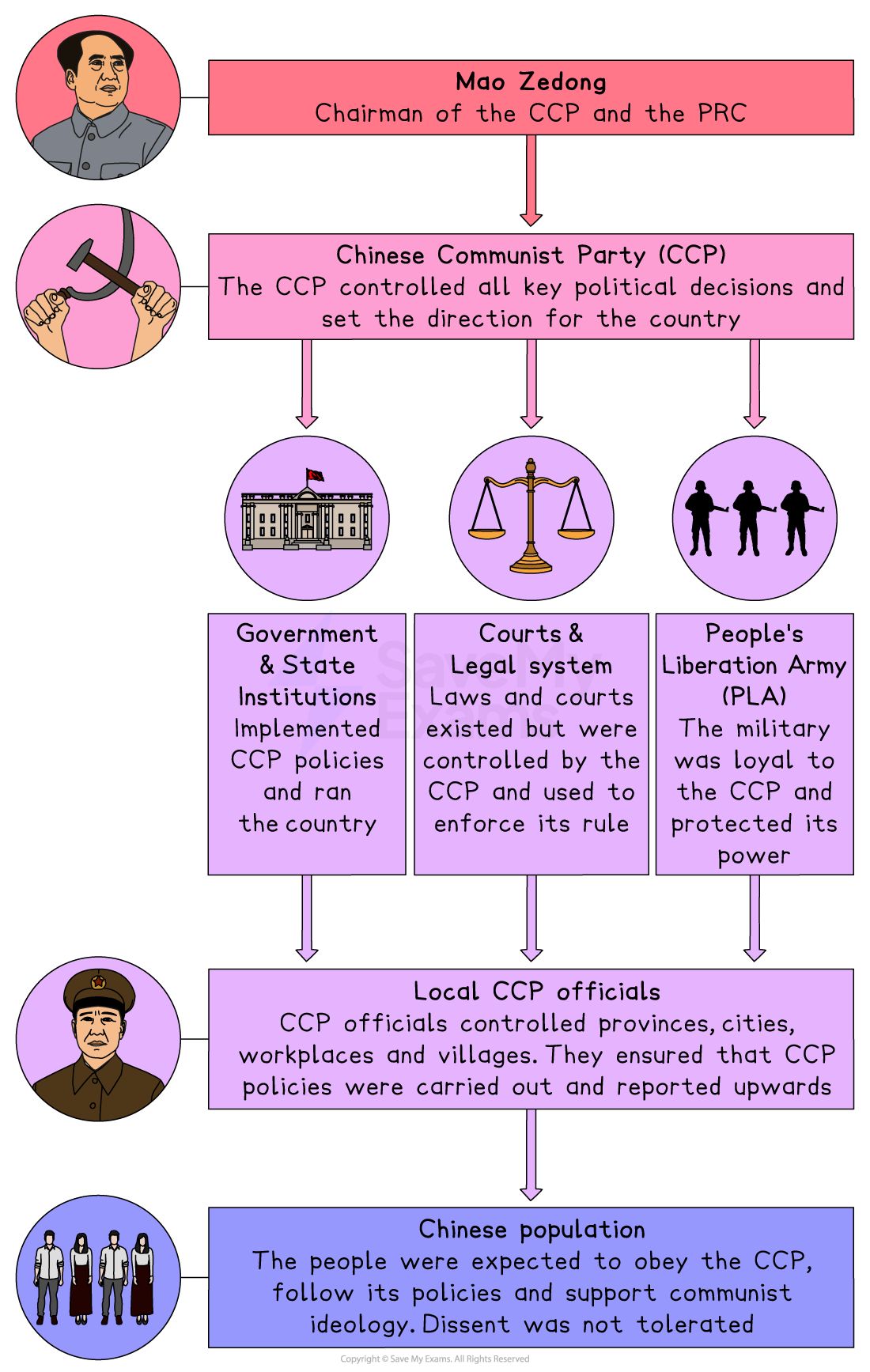
The CCP established a one-party state in which political, legal, and judicial systems operated under party control
Laws and campaigns were used to suppress real and perceived enemies of the regime, including former GMD supporters, landlords, intellectuals, and political critics
Although many measures were presented as legal reforms designed to improve Chinese society, they also increased state control and reduced individual freedoms
Establishment of a one-party state
Following the establishment of the People's Republic of China on 1 October 1949, the CCP became the only political party with real power
This prevented organised political opposition from developing
The Common Programme (1949) acted as a temporary constitution and provided the legal foundations for communist rule, whilst emphasising the leadership of the CCP
The 1954 Constitution:
Formally established China as a socialist state
Gave legal legitimacy to CCP authority
Although real power remained concentrated within the party leadership
While the constitution appeared to guarantee rights and political participation, the CCP controlled all major government institutions and prevented challenges to its authority
The legal framework created after 1949 helped Mao present communist rule as legitimate whilst ensuring that political power remained firmly under CCP control
Examiner Tips and Tricks
Be sure to explain that the one-party state meant that political, legal and military power ultimately came from Mao and the CCP. This helped Mao maintain authoritarian control
Suppression of opposition
Suppression of Counter-Revolutionaries Campaign (1950–1953)
This campaign was introduced in October 1950
It aimed to eliminate individuals considered a threat to the communist revolution and strengthen the CCP's control over the newly established state
The campaign targeted a wide range of groups, including:
Former GMD officials
Landlords
Religious leaders
Businessmen accused of opposing socialism
Suspected spies
Public accusation meetings and trials were organised to expose alleged enemies of the state and demonstrate the power of the CCP
Citizens were encouraged to report suspected counter-revolutionaries, helping the party expand its influence into local communities and workplaces
Punishments included imprisonment, forced labour, and execution, with official figures reporting around 712,000 executions, although some estimates are significantly higher
The campaign created widespread fear and discouraged criticism of Mao's regime
Hundred Flowers Campaign (1956–1957)
Mao encouraged intellectuals, academics, and professionals to express criticisms of the CCP under the slogan "Let a hundred flowers bloom, let a hundred schools of thought contend"
The campaign was presented as an opportunity for constructive criticism that would help improve government performance
Many intellectuals criticised:
Corruption
Bureaucracy
Inefficiency
Restrictions on freedom of speech
Excessive CCP control
The scale and nature of the criticism surprised Mao and exposed significant dissatisfaction with communist rule
The campaign helped identify critics of the regime and revealed individuals who were unwilling to conform fully to CCP ideology
Anti-Rightist Campaign (1957–1959)
Mao quickly ended the Hundred Flowers Campaign and launched the Anti-Rightist Campaign in response to growing criticism
Individuals who had spoken out were labelled "Rightists" and accused of opposing socialism and communist rule
Approximately 300,000–550,000 people were persecuted through dismissal from employment, imprisonment, political persecution, or labour camp sentences
The campaign discouraged future criticism because many Chinese citizens became fearful of expressing political opinions
Intellectuals were brought under closer CCP control, reducing the possibility of organised opposition
Reforming society through law
Marriage Law (1950)
Introduced in May 1950, the Marriage Law aimed to modernise Chinese society by:
Banning arranged marriages
Promoting greater equality between men and women
Women were given greater freedom to choose their marriage partners and were granted legal rights to divorce
The law helped the CCP gain support amongst many women and younger Chinese who welcomed social reform
At the same time, the law increased state influence over family life by allowing the government to regulate relationships and traditional social practices
Land Reform Law (1950)
The CCP introduced land reform legislation to redistribute land from wealthy landlords to poor peasants and reduce economic inequality in rural China
Millions of peasants received land, helping the CCP gain support amongst the majority rural population
Landlords were often publicly criticised, punished, or executed during the implementation of land reform
The policy weakened traditional rural elites and strengthened CCP authority within the countryside
Campaigns against corruption
Three-Antis Campaign (1951)
The Three-Antis Campaign was introduced in December 1951 to target corruption, waste, and bureaucratism (the three-antis) amongst government officials and CCP members
The campaign increased party discipline and reinforced the expectation that officials should remain loyal to Mao and the CCP
Investigations and public criticism sessions encouraged self-confession and strengthened central control over local officials
Five-Antis Campaign (1952)
Introduced in January 1952 and aimed primarily at businessmen and industrialists in China's cities
The campaign targeted bribery, tax evasion, fraud, theft of state property, and economic espionage (the five offences)
Many business owners faced heavy fines, public humiliation, and investigation, while others were forced to cooperate more closely with the state
The campaign reduced the independence of private business and increased government control over the economy
Examiner Tips and Tricks
Make sure you explain clearly that the anti-campaigns had different aims
The main aims:
To increase government control over all sectors of society
To target those groups that might oppose Maoism
Controlling the legal system
Courts and legal institutions were expected to support the goals of the CCP rather than operate independently from government influence
Judges were often selected based on political loyalty, ensuring that legal decisions reflected communist priorities
Laws were frequently used to justify political campaigns and punish perceived opponents of the regime
The legal system, therefore, functioned as an instrument of CCP control rather than a mechanism for limiting state power
By controlling the legal system, Mao ensured that opposition could be suppressed while maintaining the appearance of legality
Importance of legal methods
Legal methods provided Mao with a framework through which opposition could be removed, and the CCP's authority could be strengthened
Laws and political campaigns helped legitimise repression by presenting it as necessary for defending the revolution and building socialism
Campaigns such as the Suppression of Counter-Revolutionaries and the Anti-Rightist Campaign created fear and discouraged criticism of the regime
Social and economic reforms increased support for the CCP, whilst weakening groups that might challenge communist authority
Historiography
Orthodox Interpretation
Historians such as Maurice Meisner argue that Mao's legal reforms helped stabilise China after decades of war and created the foundations of a modern socialist state.
Revisionist Interpretation
Other historians such as Jung Chang and Frank Dikötter argue that legal institutions primarily served as tools of political repression and were designed to strengthen CCP authority rather than protect individual rights.

Unlock more, it's free!
Join the 100,000+ Students that ❤️ Save My Exams
the (exam) results speak for themselves:

Was this revision note helpful?
