Solving Inequalities (Edexcel IGCSE Further Pure Maths): Revision Note
Exam code: 4PM1

Solving Linear Inequalities
What is a linear inequality?
An inequality tells you that one expression is greater than (“>”) or less than (“<”) another
“⩾” means “greater than or equal to”
“⩽” means “less than or equal to”
A linear inequality only has constant terms (numbers with no letters) and terms in x (and/or y)
but no x2 terms or terms with other powers of x
3x2 > 12 is not a linear inequality (it is a quadratic inequality)
How do I solve linear inequalities?
Solving linear inequalities is just like solving linear equations
Follow the same rules, but keep the inequality sign throughout
Changing the inequality sign to an equals sign changes the meaning of the problem
When you multiply or divide both sides by a negative number, you must flip the sign of the inequality
e.g. 1 < 2
Multiply both sides by –1 (negative number)
It becomes –1 > –2 (sign flips)
Never multiply or divide by a variable (x)
It could be positive or negative
The safest way to rearrange is simply to add & subtract to move all the terms onto one side
You also need to know how to
use set notation
deal with “double” inequalities
How do I represent linear inequalities using set notation?
We use curly brackets and a colon in set notation
means "x is in the set such that ..."
e.g. the set of all x such that x is greater than 3 is written
If x is between two values
you can write it as a single set
e.g. if x is greater than 3 and less than or equal to 5, then in set notation
or you can write it as separate sets, using the intersection symbol,
so the above example could also be written in set notation as
Either way will get the marks, unless a question specifically asks for one or the other
If x is less than one value OR greater than another value (disjoint sets)
then the two end values must be written in separate sets using the union symbol,
e.g. if x is less than 3 or greater than or equal to 5, then in set notation
How do I solve double inequalities?
Inequalities such as can be solved by doing the same thing to all three parts of the inequality
Use the same rules as solving linear inequalities
Examiner Tips and Tricks
Do not change the inequality sign to an equals when solving linear inequalities
You will lose marks in an exam for doing this.
Remember to reverse the direction of the inequality sign when multiplying or dividing by a negative number!
Worked Example
(a) Solve the inequality .
This is a double inequality, so any operation carried out to one side must be done to all three parts.
Use the expression in the middle to choose the inverse operations needed to isolate x.
Add 1 to all three parts.
Remember not to change the inequality signs.
Divide all three parts by 3.
3 is positive so there is no need to flip the signs.
(b) Write your answer to part (a) in set notation as the intersection of two sets.
Rewrite your answer using the set notation rules discussed above
Worked Example
Solve the inequality .
Subtract 5 from both sides, keeping the inequality sign the same
Now divide both sides by -2.
However because you are dividing by a negative number, you must flip the inequality sign
The final answer is normally written with the number first, but you won't be penalised for writing the x first so long as the inequality sign is the correct way around
or
Solving Quadratic Inequalities
What are quadratic inequalities?
A quadratic inequality is an inequality with a term in x2 (but no higher powers of x)
Solving the inequality requires solving the corresponding quadratic equation
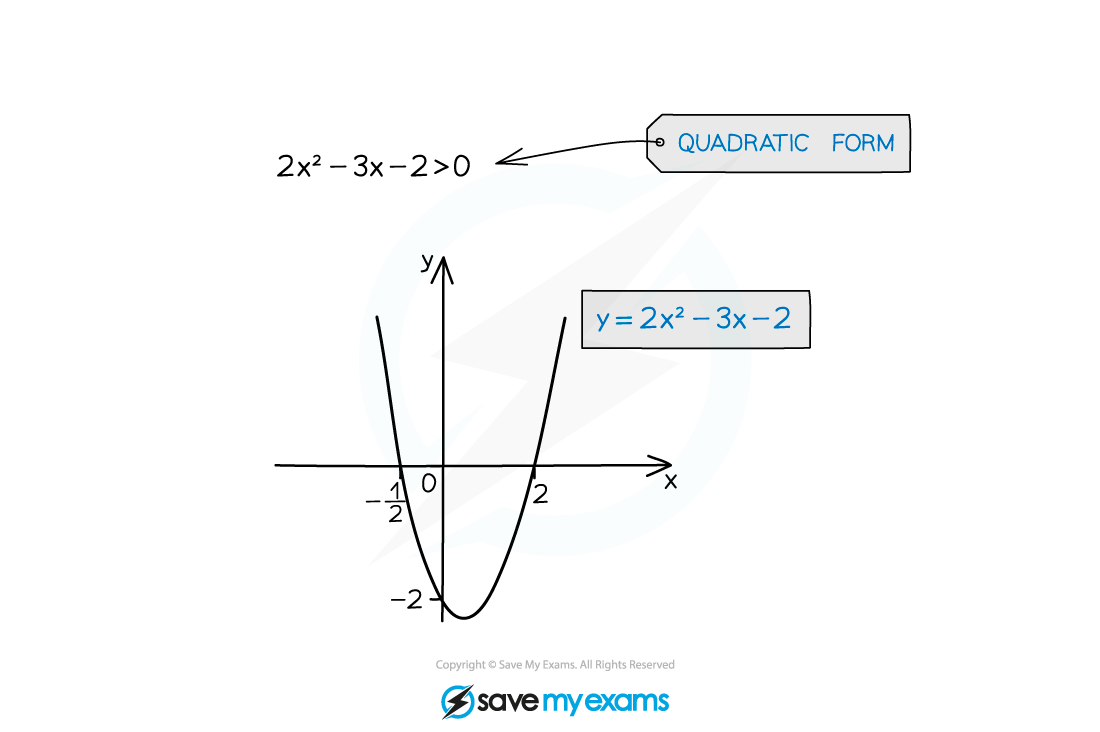
Sketching a quadratic graph is essential
How do I solve quadratic inequalities?
STEP 1
Rearrange the inequality into quadratic form with a positive squared termax2 + bx + c > 0 with a > 0
The inequality sign may be >, <, ≤ or ≥
STEP 2
Find the roots of the quadratic equationSolve ax2 + bx + c = 0 to get x1 and x2 where x1 < x2
STEP 3
Sketch a graph of the quadratic and label the rootsAs the squared term is positive it will be "U" shaped
STEP 4
Identify the region that satisfies the inequalityFor ax2 + bx + c > 0 you want the region above the x-axis
The solution is x < x1 or x > x2
It is x ≤ x1 or x ≥ x2 if the original inequality was ≥ instead of >
For ax2 + bx + c < 0 you want the region below the x-axis
The solution is x > x1 and x < x2
This is more commonly written as x1 < x < x2
It is x ≥ x1 and x ≤ x2 (x1 ≤ x ≤ x2) if the original inequality was ≤ instead of <
Avoid multiplying or dividing by a negative number
If unavoidable, remember to “flip” the inequality sign (so < → >, ≥ → ≤, etc)
Avoid multiplying or dividing by a variable (x)
The variable could be negative
Multiplying or dividing by x2 is allowed
However this can create extra invalid solutions
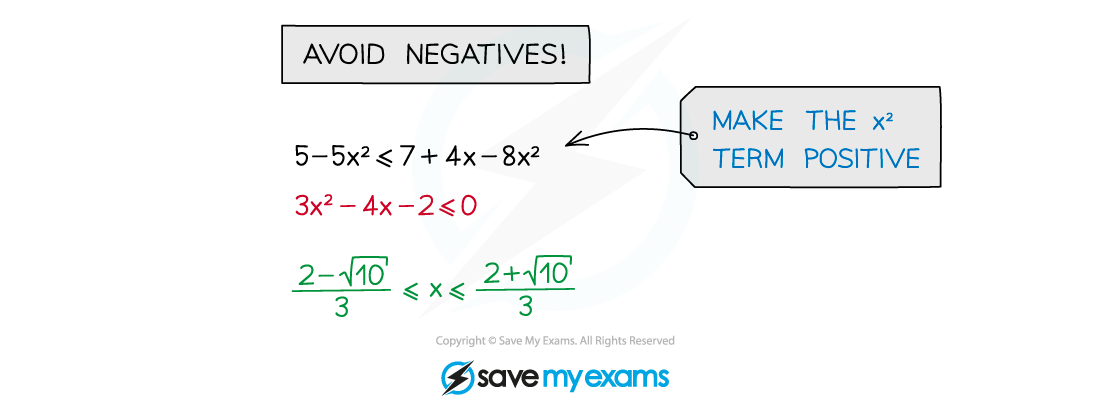
Do rearrange to make the x2 term positive
Examiner Tips and Tricks
Always start by rearranging to a quadratic with positive squared term
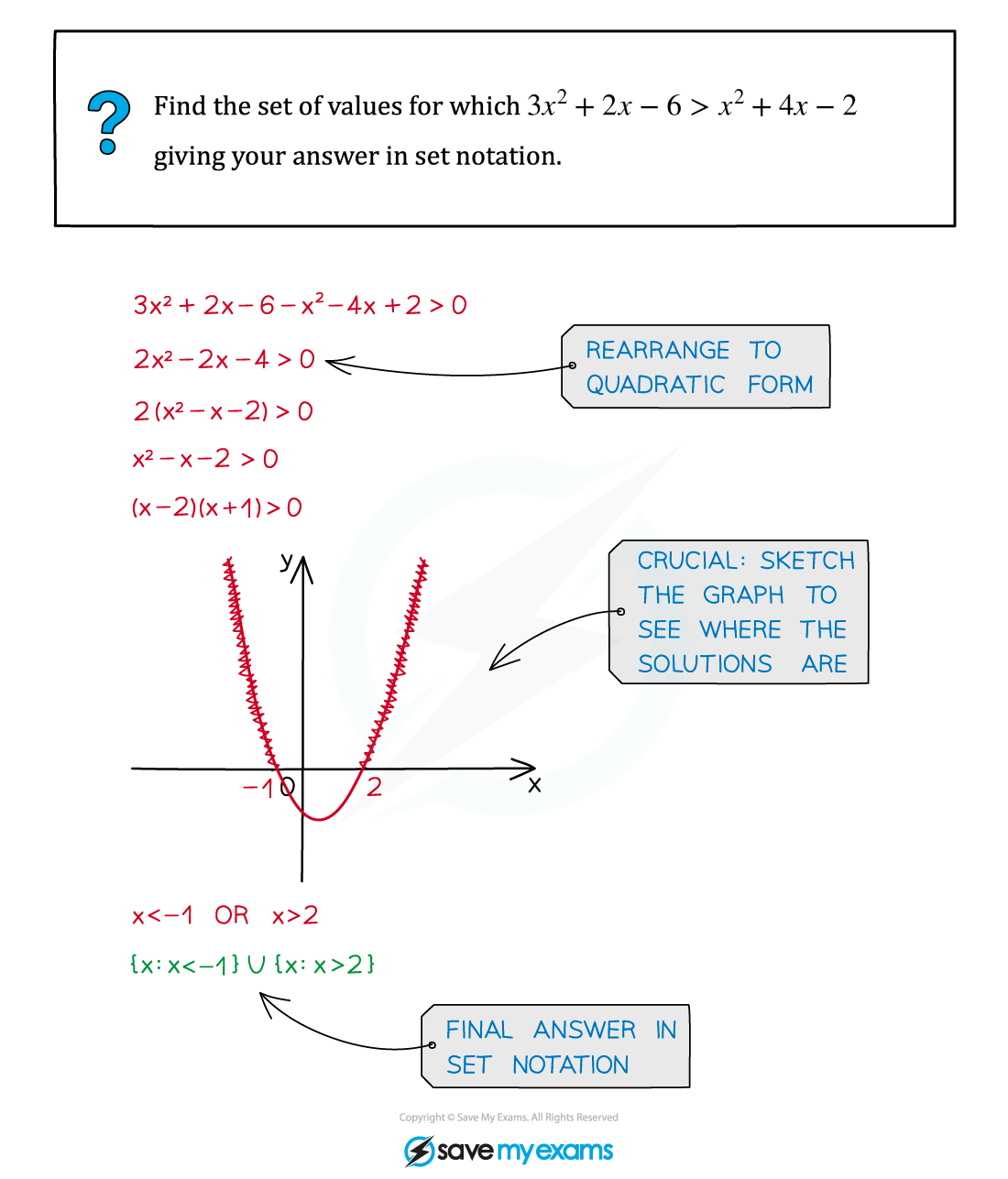
Always sketch a graph of the quadratic before deciding the final answer
Worked Example

Unlock more, it's free!
Join the 100,000+ Students that ❤️ Save My Exams
the (exam) results speak for themselves:

Was this revision note helpful?
Build on this topic
