Graphs of Trigonometric Functions (Edexcel IGCSE Further Pure Maths): Revision Note
Exam code: 4PM1

Graphs of Trigonometric Functions
What are the graphs of trigonometric functions?
The trigonometric functions sin, cos and tan all have special periodic graphs
periodic means the graphs repeat over certain intervals
You need to know their properties and how to sketch them for a given domain
You must be able to do this for either degrees or radians
Sketching the trigonometric graphs can help to
Solve trigonometric equations and find all solutions
Understand transformations of trigonometric functions
What are the properties of the graphs of sin x and cos x?
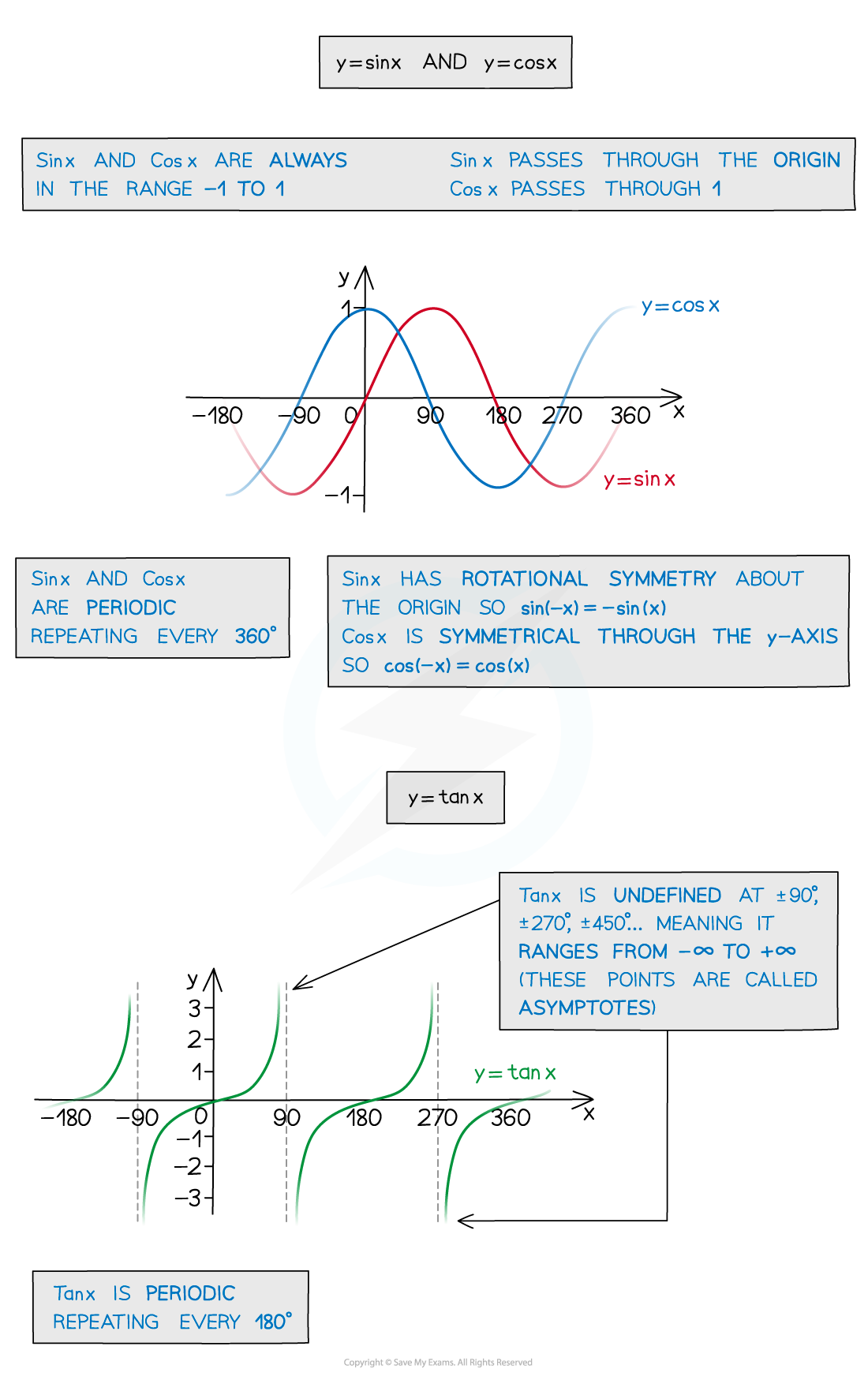
The graphs of sin x and cos x are both periodic
They repeat every 360° (2π radians)
The angle measurement will always be on the x-axis
Either in degrees or radians
The corresponding value of the function will always be on the y-axis
You need to know the domain and range of sin and cos
Domain:
I.e. all real number values of x
Including 'angles' less than 0° and greater than less than 360°
Range:
sin and cos can never take values greater than 1 or less than -1
The amplitude of the graphs of sin x and cos x is 1
The graphs of sin x and cos x are translations of one other
sin x passes through the origin (0, 0)
translate sin x 90° ( radians) to the left to get cos x
cos x passes through (0, 1)
translate cos x 90° ( radians) to the right to get sin x
What are the properties of the graph of tan x?
The graph of tan x is periodic
It repeats every 180° (π radians)
The angle measurement will always be on the x-axis
Either in degrees or radians
The graph of tan x is undefined at ± 90°, ± 270° etc
There are vertical asymptotes at these points on the graph
In radians this is radians, radians, etc
You need to know the domain and range of tan
Domain: (degrees) or (radians)
I.e. all values (positive or negative) except where the asymptotes appear
Range:
tan x can take any real number value
How do I sketch trigonometric graphs?
You may need to sketch a trigonometric graph
so you will need to remember the key features of each one
The following steps may help you sketch a trigonometric graph
STEP 1
Check whether you should be working in degrees or radians
Check the interval given in the question
If you see π in the given interval then work in radians
STEP 2
Label the x-axis in multiples of 90°Or multiples of if you are working in radians
Make sure you cover the entire given interval on the x-axis
STEP 3
Label the y-axisfor sin x or cos x
No specific points on the y-axis for tan x
STEP 4
Draw the graphKnowing exact values will help with this
e.g. sin(0) = 0 and cos(0) = 1
Mark the important points on the axis first
If you are drawing the graph of tan x
put the asymptotes in first
If you are drawing sin x or cos x
mark where the maximum and minimum points will be
Try to keep the symmetry (and rotational symmetry) as you sketch
This will help when using the graph to find solutions
Examiner Tips and Tricks
Sketch all three trig graphs on your exam paper so you can refer to them as many times as you need to!
Worked Example
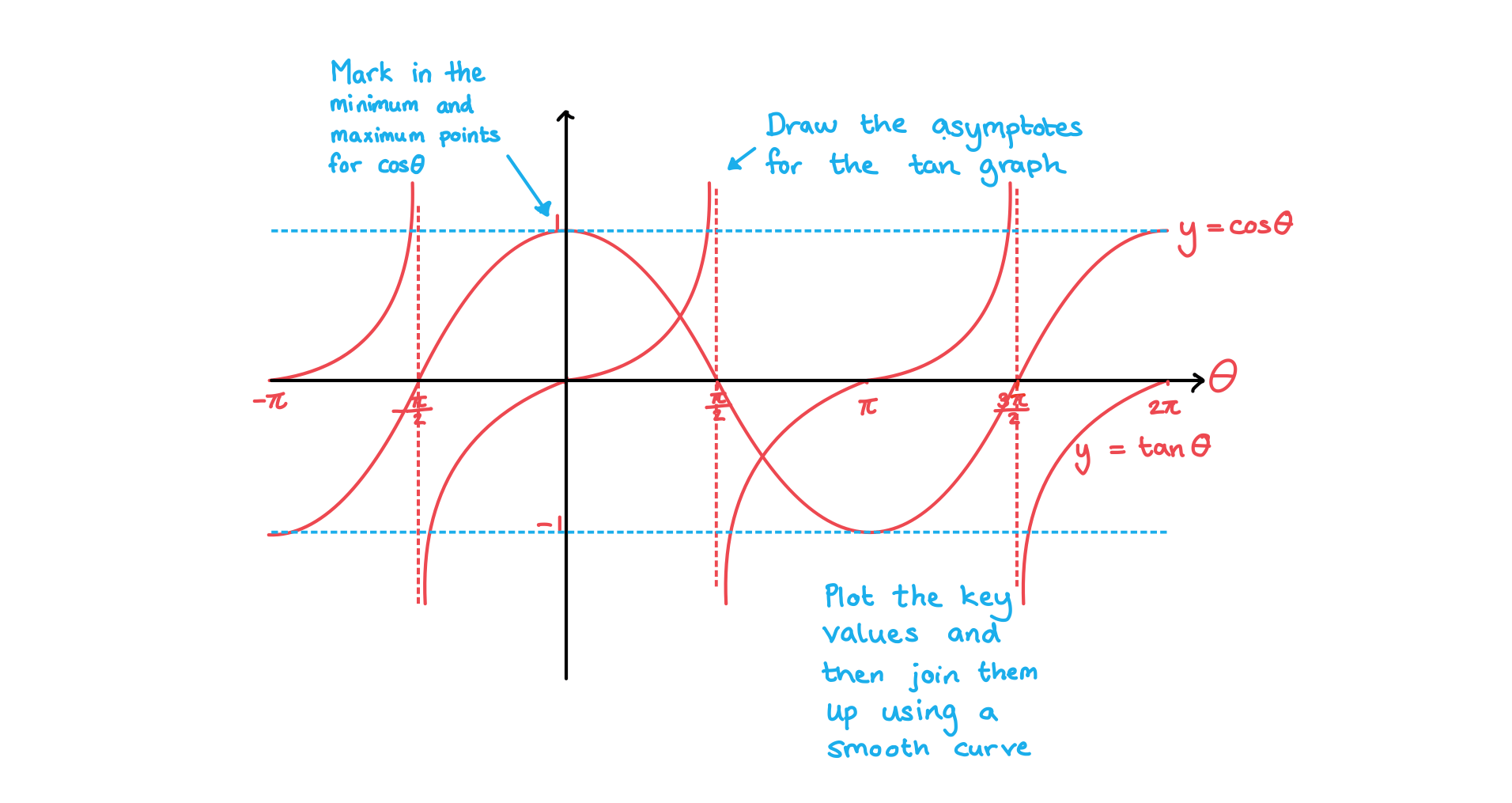
Sketch the graphs of and on the same set of axes in the interval . Clearly mark the key features of both graphs.
Using Trigonometric Graphs
How can I use a trigonometric graph to find extra solutions?
Your calculator will only give you one solution to an equation such as
This solution is called the primary value
However sin, cos and tan are periodic
So there are an infinite number of solutions to an equation like
On the exam you will be given an interval in which your solutions should be found
This could either be in degrees or in radians
If you see π or some multiple of π then you must work in radians
The following steps will help you use the trigonometric graphs to find additional solutions
STEP 1
Sketch the graph for the given function and intervalCheck whether you should be working in degrees or radians
Label the axes with the key values
STEP 2
Draw a horizontal line going through the y-axis at the value you are looking fore.g. if you are looking for the solutions to
then draw the horizontal line going through the y-axis at
The number of times this line intersects the graph in the given interval
is the number of solutions within the interval
STEP 3
Find the primary value and mark it on the graphIt may be an exact value that you know
Or else you can use your calculator to find it
STEP 4
Use the symmetry of the graph to find all the solutions in the intervalThis will involve adding or subtracting from the key values on the graph
What patterns can be seen from the graphs of trigonometric functions?
The graph of sin x has rotational symmetry about the origin
So
Also
or in radians
The graph of cos x has reflectional symmetry about the y-axis
So
Also
or in radians
The graph of tan x repeats every 180° (π radians)
So for
or in radians
The graphs of sin x and cos x repeat every 360° (2π radians)
So for
or in radians
And for
or in radians
Examiner Tips and Tricks
Always check what the interval for solutions is in the question
Worked Example
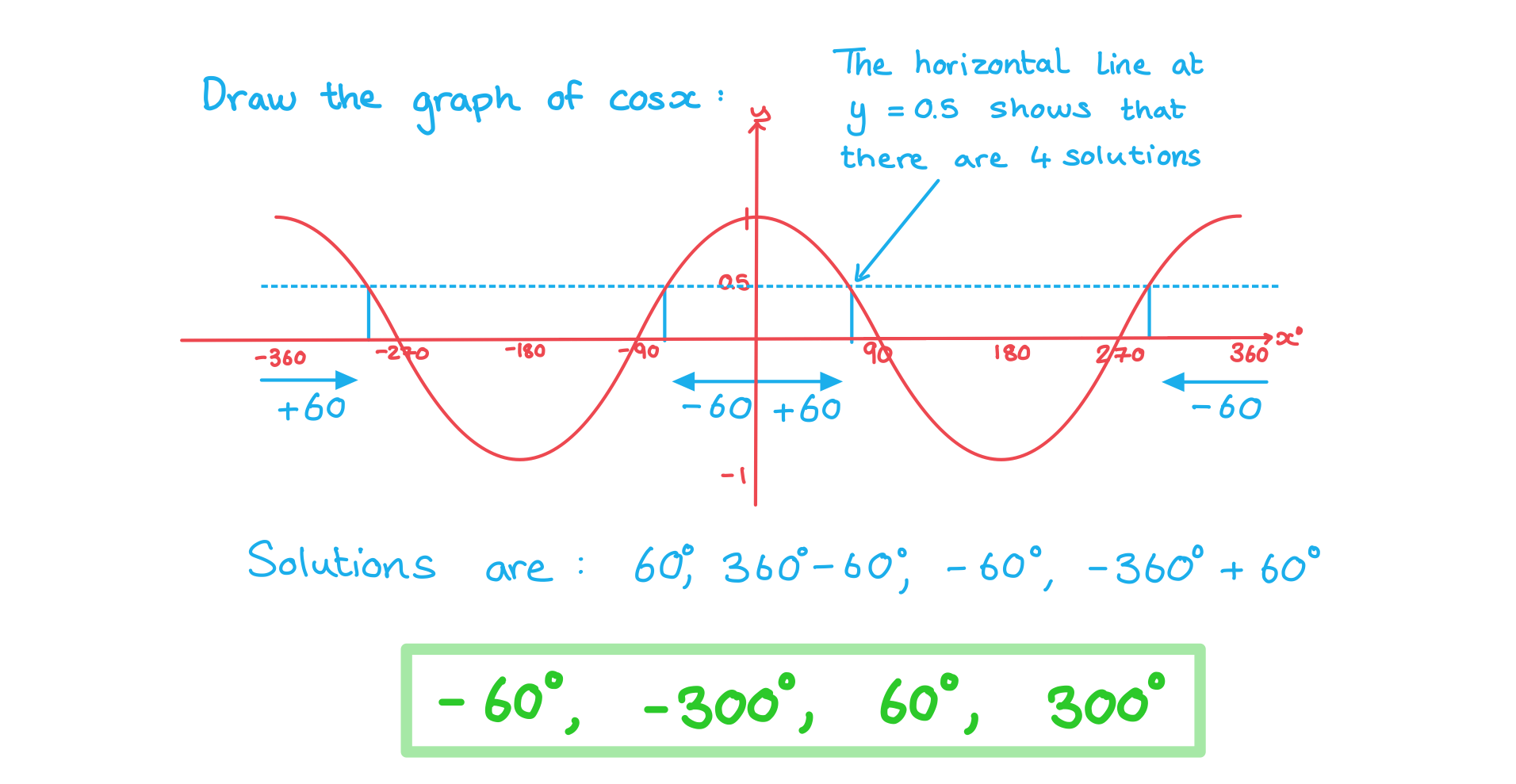
One solution to is . Find all the other solutions in the interval .

Unlock more, it's free!
Join the 100,000+ Students that ❤️ Save My Exams
the (exam) results speak for themselves:

Was this revision note helpful?
Build on this topic
