Volumes of Revolution (Edexcel IGCSE Further Pure Maths): Revision Note
Exam code: 4PM1

Volumes of Revolution About the x-axis
What is a volume of revolution about the x-axis?
A solid of revolution is formed
when an area bounded by a function and the lines and
is rotated radians about the -axis
The volume of revolution is the volume of this solid
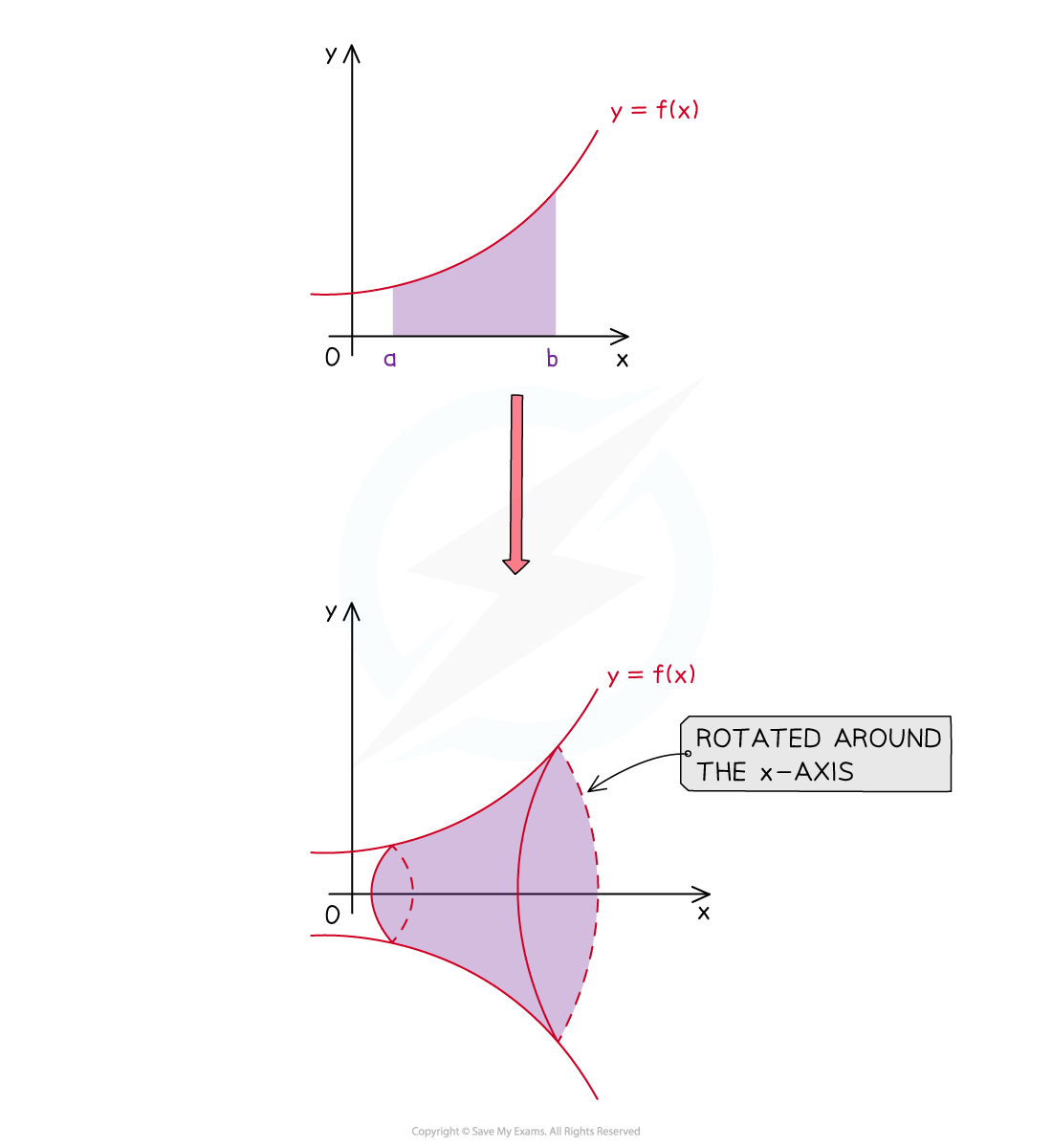
Be careful – the ’front’ and ‘back’ of this solid are flat
they were created from straight (vertical) lines
3D sketches can be misleading!
What is the formula for a volume of revolution about the x-axis?
The volume of revolution of a solid rotated radians () about the -axis between and is given by:
This is not given on the exam formula sheet, so you need to remember it
Note that is the area of the circular cross-section of the solid at any value of
That might help you remember the form of the volume integral
is a function of
i.e.
and are the equations of the (vertical) lines bounding the area
( is the 'left boundary' and is the 'right boundary')
and may be given in the question
one boundary may be the -axis ()
the -axis intercepts of may also be boundaries
How do I calculate the volume of revolution about the x-axis?
STEP 1
Identify the limits andThese may be given in the question
or be indicated on a graph in the question
Sketching the graph of can help if the graph is not provided
STEP 2
Square the functione.g.
or
STEP 3
Evaluate the integral in the volume formulaAn answer may be required in exact form
i.e. as a multiple of
Examiner Tips and Tricks
Don't panic if involves a square root
The square root will disappear when you find
Don't forget to bring back in after working out the integral
In my experience that is a very common student error
Worked Example
Find the volume of the solid of revolution formed by rotating the region bounded by the graph of , the coordinate axes and the line by radians about the -axis. Give your answer as an exact value.
Start by finding the values of and for the formula
'Bounded by the coordinate axes' tells us that the -axis () is one boundary
The question tells us that is the other one
So and
If in doubt, drawing a sketch can help

Now square the function
Substitute everything into
Work out the definite integral
Put that value back into the volume formula
Don't forget to include the !
The question asks for an exact value answer, so leave the answer in terms of
Volume

Unlock more, it's free!
Join the 100,000+ Students that ❤️ Save My Exams
the (exam) results speak for themselves:

Was this revision note helpful?
Build on this topic
