Linear Trigonometric Equations (Edexcel IGCSE Further Pure Maths): Revision Note
Exam code: 4PM1

Linear Trigonometric Equations
How do I solve trigonometric equations?
Trigonometric equations can have an infinite number of solutions
For an equation in or
you can add or subtract 360° (or 2π radians) to each solution to find more solutions
For an equation in
you can add or subtract 180° (or π radians) to each solution to find more solutions
When solving a trigonometric equation
You will be given a interval of values within which the answers must lie
You need to find all the answers within that range
Using the inverse function on your calculator will only give you the primary value
This may or may not be in the required interval
The other values can be found with the help of:
your knowledge of trigonometric exact values
the unit circle
the graphs of trigonometric functions
How are basic trigonometric equations solved?
This means equations in the form , or
It can be helpful to sketch the graph of the trigonometric function first
Use the given interval of values as the domain for your graph
The intersections of the graph of the function and the line will show you
The location of the solutions
The number of solutions
You will be able to use the symmetry properties of the graph to find other values within the given interval
The methods for finding all solutions are:
For the equation
The primary value is
By symmetry, a secondary value is
Either or might not actually be in the given interval!
Then all values within the given interval can be found using
where as appropriate
For the equation
The primary value is
By symmetry, a secondary value is
Either or might not actually be in the given interval!
Then all values within the given interval can be found using
where as appropriate
For the equation
The primary value is
might not actually be in the given interval!
Then all values within the given interval can be found using
where as appropriate
How do I handle more complicated equations?
You may need to use algebra to get an equation into one of the basic forms
For example,
Subtract 3 from both sides
Factorise
This gives you two basic equations to solve
Trigonometric identities and/or addition formulae may also be needed
Examiner Tips and Tricks
Remember that your calculator will only give you the primary value
You need to be able to find all other solutions within the given interval
Sketching the trig graphs (or any other useful diagrams) can be a huge help!
Worked Example
Solve the equation , finding all solutions in the interval .
First isolate
Use calculator or knowledge of exact trig values to find
Note that the interval is given in radians, so we must work in radians!
Use symmetry of the cos function to find
Now add or subtract (multiples of) radians to find other solutions in the interval
Any other additions or subtractions of would take us outside the interval
Linear Trigonometric Equations (ax + b)
How can I solve equations with transformations of trig functions?
This means equations of the form sin(ax+b) = k, cos(ax+b) = k or tan(ax+b) = k
Trigonometric equations in these forms can be solved in more than one way
The easiest method is to consider the transformation of the angle as a substitution
Let u = ax + b
Transform the given interval for the solutions in the same way as the angle
For example if the given interval is 0° ≤ x ≤ 360° the new interval will be
(a (0°) + b) ≤ u ≤ (a (360°) + b)
Solve the equation to find the primary value for u
Find all the other solutions in the transformed range for u
Undo the substitution
i.e.
Convert all of the u solutions back into corresponding solutions for x
Another method would be to sketch the transformation of the function
If you use this method then you will not need to use a substitution for the range of values
Examiner Tips and Tricks
If you use substitution and transform the interval
remember to convert answers back at the end!
Worked Example
Solve the equation , finding all solutions in the interval
We'll use the substitution
Rewrite the equation in terms of and rearrange
Now we need to transform the interval as well
Substitute the interval limits into
Use calculator or knowledge of exact trig values to find the primary value
Use symmetry of cos function to find the secondary value
Sketch the graph of over the transformed interval
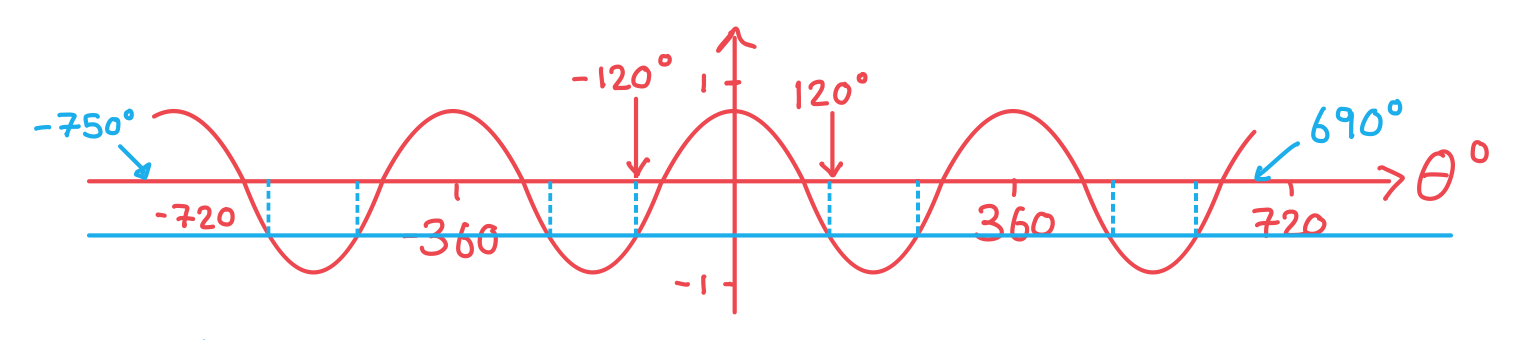
This shows that there are 8 places where
Find these by adding or subtracting (multiples of) to and
Invert the substitution
Substitute the values into to find the corresponding values

Unlock more, it's free!
Join the 100,000+ Students that ❤️ Save My Exams
the (exam) results speak for themselves:

Was this revision note helpful?
Build on this topic