Areas Between Curves (Edexcel IGCSE Further Pure Maths): Revision Note
Exam code: 4PM1

Area Between a Curve and a Line
What do we mean by 'area between a curve and a line'?
Areas whose boundaries include a curve and a (non-vertical) straight line can be found using integration
For an area under a curve a definite integral will be needed
For an area under a line the shape formed will be a trapezium or triangle
basic area formulae can be used rather than a definite integral
(although a definite integral would still work)
The area required could be the sum or difference of areas under the curve and line
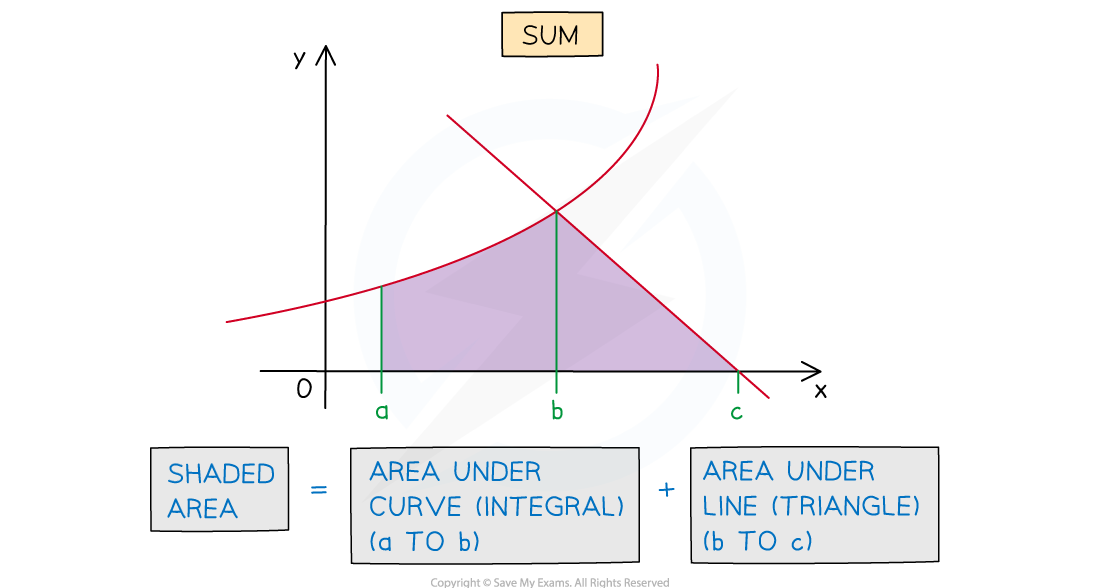
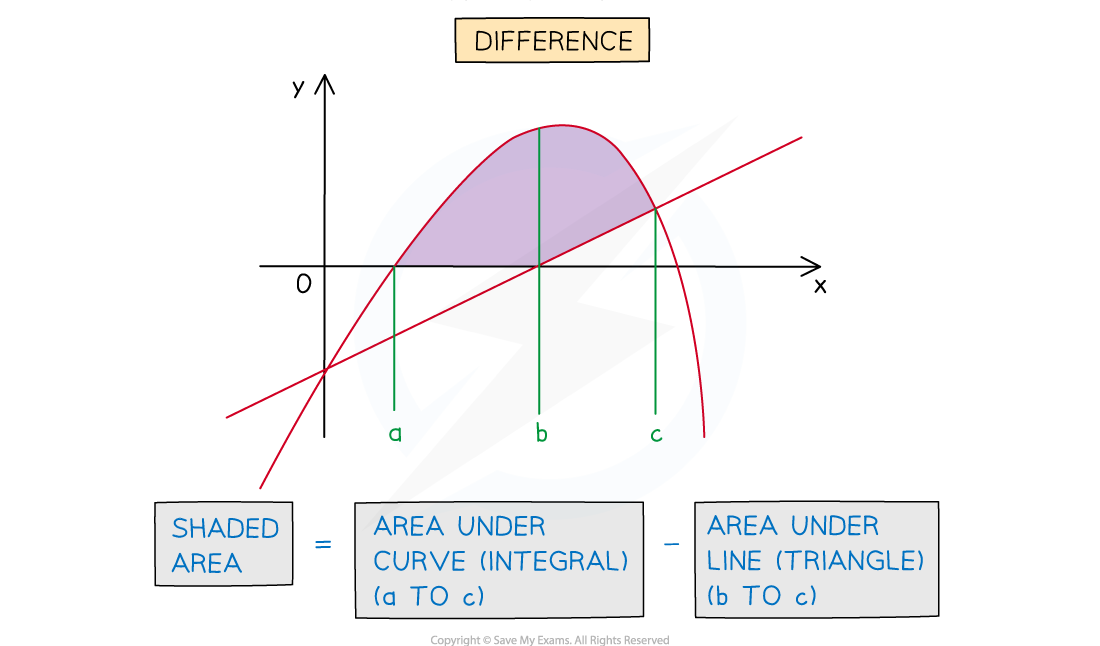
How do I find the area between a curve and a line?
STEP 1
If not given, sketch the graphs of the curve and line on the same diagramSTEP 2
Find the intersections of the curve and the lineIf no diagram is given this will help identify the area(s) to be found
STEP 3
Determine whether the area required is a sum or differenceCalculate the area under a curve using a integral of the form
Calculate the area under a line using
for a triangle
for a trapezium
For a trapezium, y-coordinates will be needed for a and b
and the height h will lie parallel to the x-axis
Those areas will need to be added or subtracted, depending on the question
STEP 4
Evaluate the definite integral(s)Then find the sum or difference of areas as required
Examiner Tips and Tricks
Add information to any diagram provided
intersections between lines and curves
mark and shade the area you’re trying to find
If no diagram is provided, sketch one!
Worked Example
The region is bounded by the curve with equation and the line with equation.
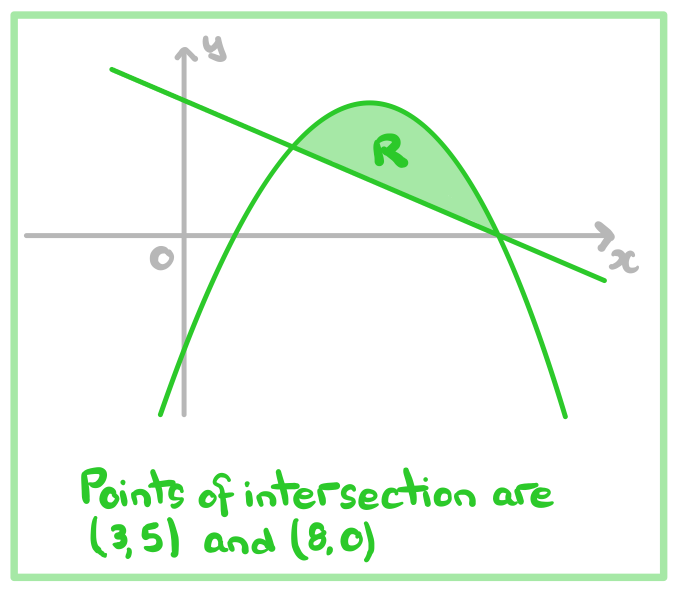
(a) Sketch the graphs of the curve and the line on the same set of axes.
Be sure to Identify and label the region on your sketch, and indicate the points of intersection between the curve and the line. You may assume without proof that the curve's -axis intercepts all lie on the positive -axis.
Because of the minus sign in front of , the curve will be an 'upside down u-shaped' parabola
We need to find the points of intersection of the curve and line
Set their equations equal and solve to find the -coordinates
So the curve and line intersect when and when
Substitute into the equation of the line to find the corresponding -coordinates
So the points of intersection are and
That gives us enough information to sketch the graphs
(b) Find the area of region
Here we're going to need a difference of areas: (area under curve)(area under line)
The area under the line is a right-angled triangle with vertices at , and
So the height is and the base is
For the area under a curve we need to use a definite integral between and
For the area of , subtract the area of the triangle from the area under the curve
Area Between 2 Curves
What do we mean by 'area between two curves'?
Areas whose boundaries include two curves can be found by integration
The area between two curves will be the difference of the areas under the two curves
both areas will require a definite integral
Finding points of intersection may involve a more awkward equation than solving for a curve and a line
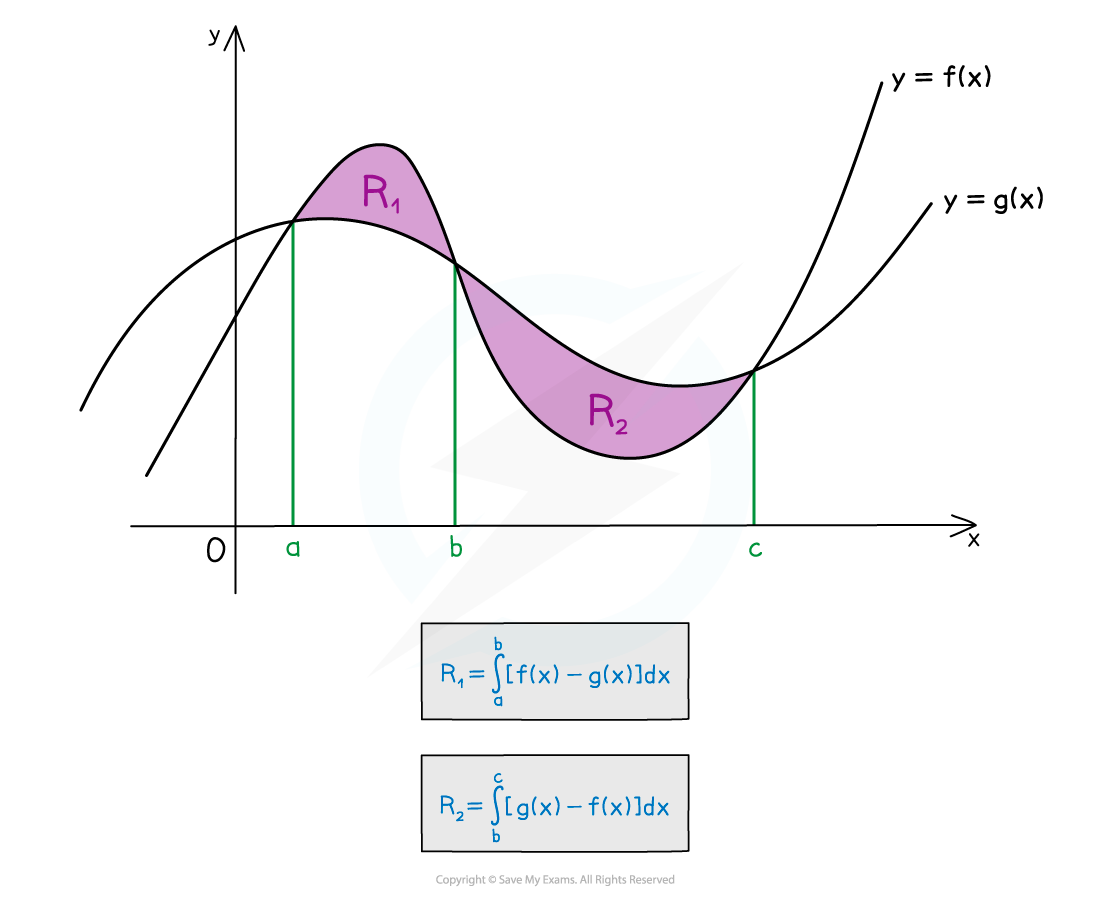
How do I find the area between two curves?
STEP 1
If not given, sketch the graphs of both curves on the same diagramSTEP 2
If not given, find the intersections of the two curvesThese are needed to identify the area(s) to be calculated
and also to set up the correct integrals
STEP 3
Determine which curve is the ‘upper’ boundary for each regionFor each region, the area is given by definite integral of the form
is the function forming the ‘upper’ boundary
is the function forming the ‘lower’ boundary
Be careful when there is more than one region
Which functions form the ‘upper’ and ‘lower’ boundaries can change
STEP 4
Evaluate the definite integral(s)If there is more than one region, add their areas together to find the total area
As long as '' in the integrals is always the upper function
then
This means you don't have to worry about negative integrals
even if part or all of the area between the curves is below the x-axis
Examiner Tips and Tricks
Add information to any given diagram as you work through a question
intersections between curves
mark and shade the area you're trying to find
If no diagram is provided sketch one
Worked Example
The diagram below shows the curves with equations and , where and .
Find the area of the shaded region.
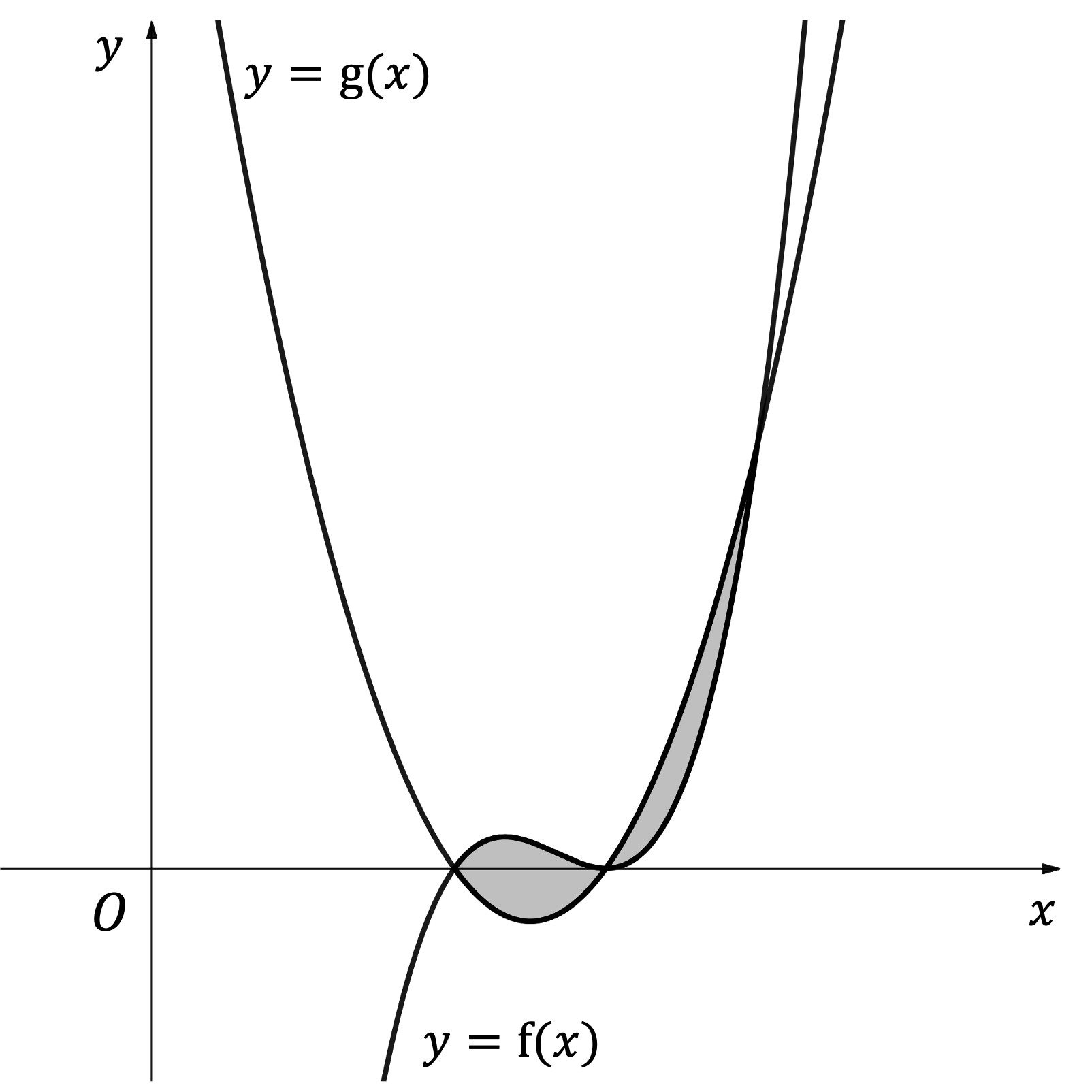
Start by finding the points of intersection
Set the equations of the curves equal to each other, and solve to find the -coordinates
It's tempting to expand the brackets on the left-hand side of the equation
Actually. here it will be more useful to factorise the right-hand side
Note that we don't need to know the corresponding -coordinates here!
We have two regions here
The first region is from to , and is the 'upper curve'
The second region is from to and is the 'upper curve'
Now just add the two areas together to get the total area
Area of the shaded region

Unlock more, it's free!
Join the 100,000+ Students that ❤️ Save My Exams
the (exam) results speak for themselves:

Was this revision note helpful?
Build on this topic
