Riemann Sums & Definite Integrals (College Board AP® Calculus BC): Free Response Questions

2 hours52 questions
1
3 points

t (minutes)

0

15

30

45

60

75

90

v(t) (inches per minute)

1.4

1.8

0.7

1.1

1.9

2.1

1.5

A snail is traveling in one direction along a straight line with velocity v(t), in inches per minute at time t minutes, where v is a continuous function of t. Selected values of v(t) for 0≤t≤90 are shown in the table above.

Use a midpoint Riemann sum with three subintervals of equal length and values from the table to approximate ∫090v(t)dt. Show the computations that lead to your answer. Using correct units, explain the meaning of ∫090v(t)dt in terms of the snail's travel.

2a
1 point
Graph of function f shows a curve peaking at y=7 around x=1, with x and y axes ranging between -4 and 4, and -1 and 7 respectively.

The graph of a differentiable function f on the closed interval [-4, 4] is shown in the figure above. The graph of f has a local maximum at the point (1, 7). Let g(x)=3+∫1xf(t)dt for −4≤x≤4.

Find a trapezoidal approximation of ∫−44f(x)dx using four subintervals of length ∆x=2.

2b
3 points

Find g(1), g'(1) and g''(1).

3
3 points

t

(seconds)

0

30

60

80

100

120

f(t)

(liters per second)

0

0.008

0.012

0.008

0.004

0

A customer is filling up a bottle of olive oil from a large container in a health food shop. The rate of flow of the olive oil is modeled by a differentiable function f, where f(t) is measured in liters per second and t is measured in seconds since filling the bottle began. Selected values of f(t) are given in the table.

Using correct units, interpret the meaning of ∫30100f(t) dt in the context of the problem. Use a right Riemann sum with the three subintervals [30, 60], [60, 80], and [80, 100] to approximate the value of ∫30100f(t)dt

4a
2 points

x

-3

0

4

10

15

f(x)

8

6

5

1

0

Let f be a function that is twice differentiable and decreasing for all real numbers. The above table gives values of f for selected points in the interval −3≤x≤15.

Evaluate ∫−315(10−2f'(x))dx. Show the work that leads to your answer.

4b
2 points

Use a left Riemann sum with subintervals indicated by the data in the table to approximate ∫−315f(x)dx. Show the work that leads to your answer.

4c
1 point

Is your approximation in part (b) greater than or less than ∫−315f(x)dx? Give a reason for your answer.

5
3 points

Let f be the function defined by f(x)=sinx+ex. Let g be the function defined by g(x)=∫0xf(t)dt.

Find g(π), g'(π) and g''(π).

6
2 points

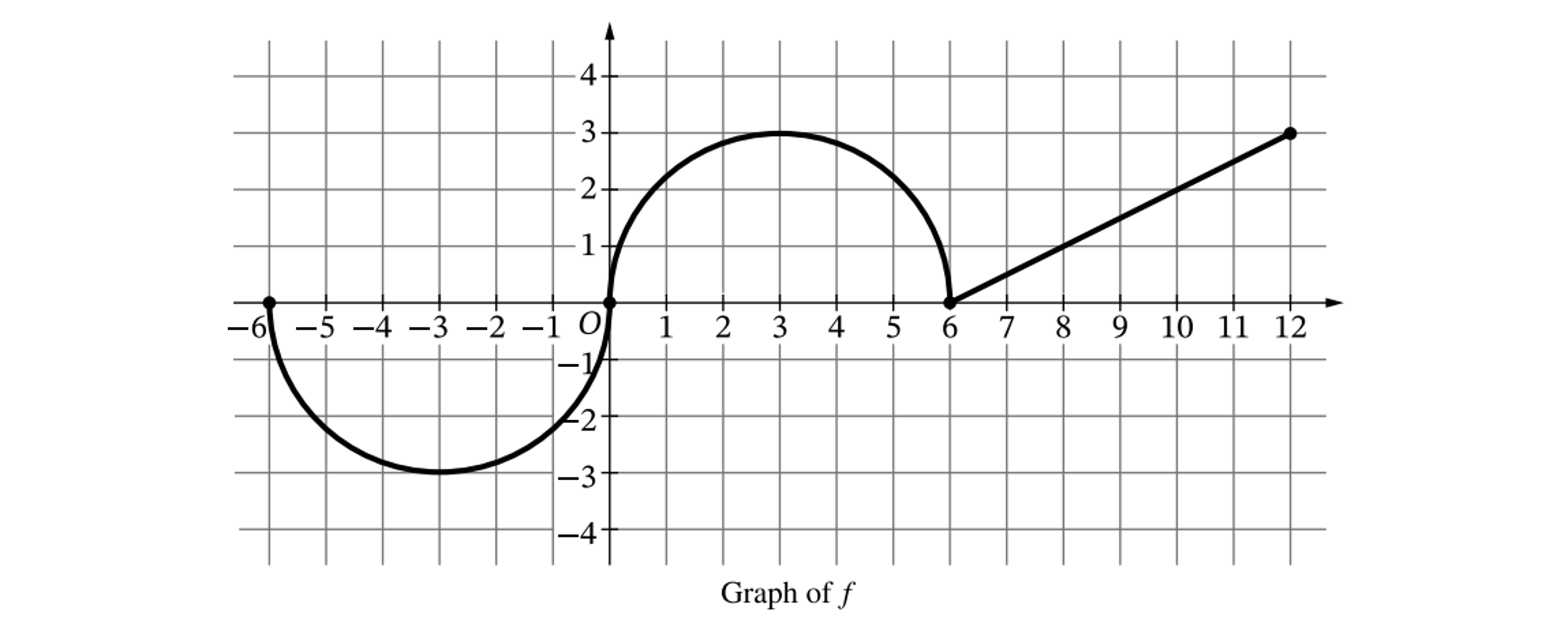
The continuous function f is defined on the closed interval −6≤x≤12. The graph of f, consisting of two semicircles and one line segment, is shown in the figure.

Graph of function f: a U-shaped curve from (-6,0) to (0,0), rising to (3,3), dropping to (6,0), then a straight line to (12,3).

Let g be the function defined by g(x)=∫6xf(t) dt.

Find g'(8). Give a reason for your answer.

1
2 points
The graph of a function f consisting of four line segments connecting the points (-4, 0) and (-1, 4), (-1, 4) and (1, 3), (1, 3) and (2, -3), and (2, -3) and (4, 0)

Let f be a continuous function defined on the closed interval −4≤x≤4. The graph of f, consisting of four line segments, is shown above. Let g be the function defined by g(x)=∫0xf(t) dt.

On what open intervals is the graph of g concave up? Give a reason for your answer.

2a
1 point

x

0

1

3

6

f(x)

12

10

7

11

f'(x)

-1

-2

3

1

f is a differentiable function. The table shown gives values of the function f and its first derivative at selected values of x.

Let g be the function defined by g(x)=2x3+∫0xf'(t) dt. Find g(3). Show the work that leads to your answer.

2b
3 points

Is the function g defined in part (a) increasing, decreasing, or neither at x=3? Justify your answer.

3a
2 points

r

(meters)

0

0.5

1

2

3

f(r)

(kilograms per square meter)

2

5

9

12

14

The density of algae on the surface of a circular garden pond at a distance of r meters from the center of the pond is given by an increasing, differentiable function f, where f(r) is measured in kilograms per square meter. Values of f(r) for selected values of r are given in the table above.

The total mass, in kilograms, of algae in the pond is given by the integral expression  2π∫03rf(r) dr. Approximate the value of  2π∫03rf(r) dr  using a right Riemann sum with the four subintervals indicated by the data in the table.

3b
2 points

Is the approximation found in part (a) an overestimate or underestimate of the total mass of algae in the pond? Explain your reasoning.

4a
2 points

t (minutes)

0

3

7

12

15

M(t) (degrees Fahrenheit)

212.0

165.8

125.9

97.3

87.0

The temperature of coffee in a mug at time t is modeled by a strictly decreasing, twice-differentiable function M, where M(t) is measured in degrees Fahrenheit and t is measured in minutes. At time t=0, the temperature of the coffee is 212°F. The mug of coffee is then left to cool, beginning at time t=0. Values of M(t) at selected times t for the first 15 minutes are given in the table above.

Use the data in the table to evaluate ∫015M'(t) dt. Using correct units, interpret the meaning of ∫015M'(t) dt in the context of this problem.

4b
3 points

For 0≤t≤15, the average temperature of the water in the mug is 115∫015M(t) dt. Use a left Riemann sum with the four subintervals indicated by the data in the table to approximate 115∫015M(t) dt. Does this approximation overestimate or underestimate the average temperature of the coffee over these 15 minutes? Explain your reasoning.

4c
2 points

For 15≤t≤20, the function M that models the coffee temperature has first derivative given by M'(t)=−18.45e−0.125t. Based on the model, what is the temperature of the coffee at time t=20?

5
5 points

Let f be the function defined by f(x)=∫1x(1t+t)2dt for x≥1.

Find f(3), f'(3) and f''(3).

6
3 points
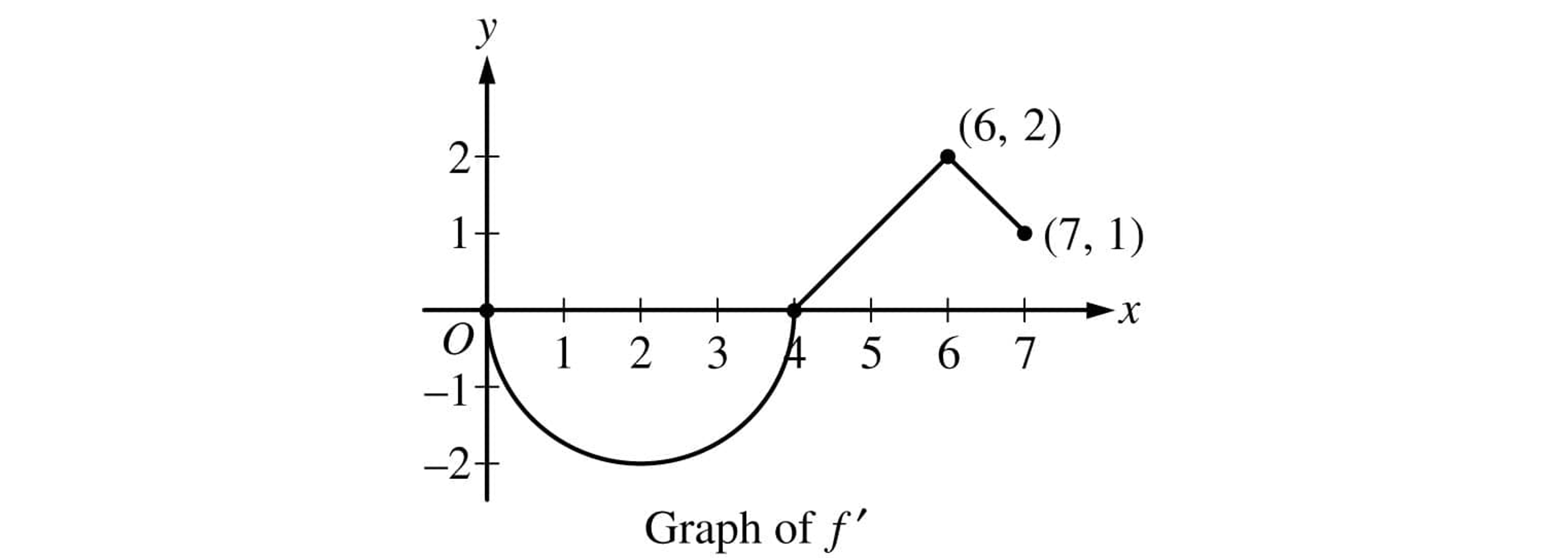
Graph of f′: semicircle from (0,0) to (4,0) dipping to y = −2, then line up to (6,2) and line down to (7,1) on x–y axes.

Let f be a differentiable function with f(4)=3. On the interval 0≤x≤7, the graph of f', the derivative of f, consists of a semicircle and two line segments, as shown in the figure above.

Find f(0) and f(5).

7a
2 points
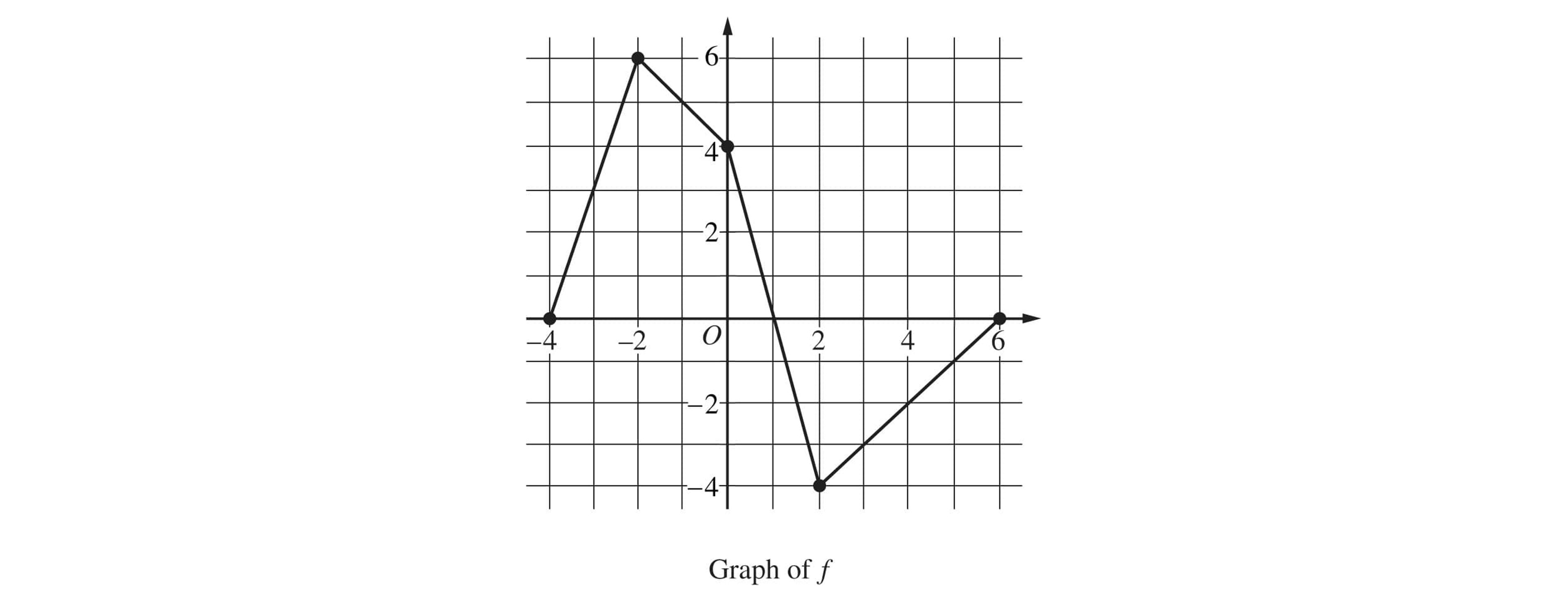
Piecewise linear graph of f through points (−4,0), (−2,6), (0,4), (2,−4) and (6,0) on an x‑y grid from −4 to 6 and −4 to 6.

Let f be a continuous function defined on the closed interval −4≤x≤6. The graph of f, consisting of four line segments, is shown above. Let G be the function defined by G(x)=∫0xf(t)dt.

On what open intervals is the graph of G concave up? Give a reason for your answer.

7b
3 points

Let P be the function defined by P(x)=G(x)·f(x). Find P'(3).

1
3 points

x

0

10

20

30

40

f(x)

2

6

7

9

11

f is a continuous function which is increasing on the interval [0, 40]. The table shown gives values of the function f at selected values of x.

Using relevant approximations with all the data in table, find an interval of shortest width which contains the exact value of ∫040f(x)dx. Justify why your interval is valid.

2
3 points
A graph of f', the derivative of the function f, consisting of a line segment connecting points (0, 5) and (2, 5), another line segment connecting points (2, 5) and (5, 0), and a semicircle of radius 2 below the x-axis connecting points (5, 0) and (9, 0)

The function f is defined on the closed interval [0, 9] and satisfies f(3)=2. The graph of f', the derivative of f, consists of two line segments and a semicircle, as shown in the figure above.

Find the absolute minimum value of f on the closed interval [0, 9]. Justify your answer.

3a
3 points
Graph of function f with shaded region R. Points marked at (-3, 1) and (3, -2). The region R is in the second quadrant and is bounded by the graph of f, the vertical line x=-3  and the coordinate axes. From 0 to 4 the graph is linear.

The graph of the differentiable function f, shown for −3≤x≤4, is linear for 0≤x≤4. Let R be the region in the second quadrant bounded by the graph of f, the vertical line x=−3 and the x- and y- axes. The area of region R is 12.

The function g is defined by g(x)=∫0xf(t)dt. Find the values of g(−3), g(2) and g(3).

3b
4 points

The function h is defined by h(x)=∫−3xf'(t)dt. Find the values of h(3), h'(3) and h''(3).

4a
3 points

t (seconds)

0

5

10

20

30

50

h'(t) (feet per second)

2

3

5

11

19

41

A person is on a roller coaster ride which rises vertically rapidly. The height of the person from the ground is modeled by the twice-differentiable function h(t) for 0≤t≤50, where t is measured in seconds and h(t) is measured in feet. Values of h'(t) at selected values of t are shown in the table above. Initially, the person is 1 foot above the ground.

Use a trapezoidal sum with five subintervals indicated by the table to estimate the height of the person at time t=50 seconds.

4b
1 point

It is known that the function h''(t) is increasing on the interval 0≤t≤50.

Is your approximation in part (a) greater than or less than the height of the person from the ground, as predicted by the model, at time t=50 seconds? Give a reason for your answer.

5a
2 points

Let f be the function defined by f(x)=4x2+x+32x2 for x>0.

Evaluate ∫13f(x)dx.

5b
3 points

Let g be the function defined by g(x)=∫1xf''(t)dt for x>0.

Evaluate ∫13g(x)dx.

6a
3 points

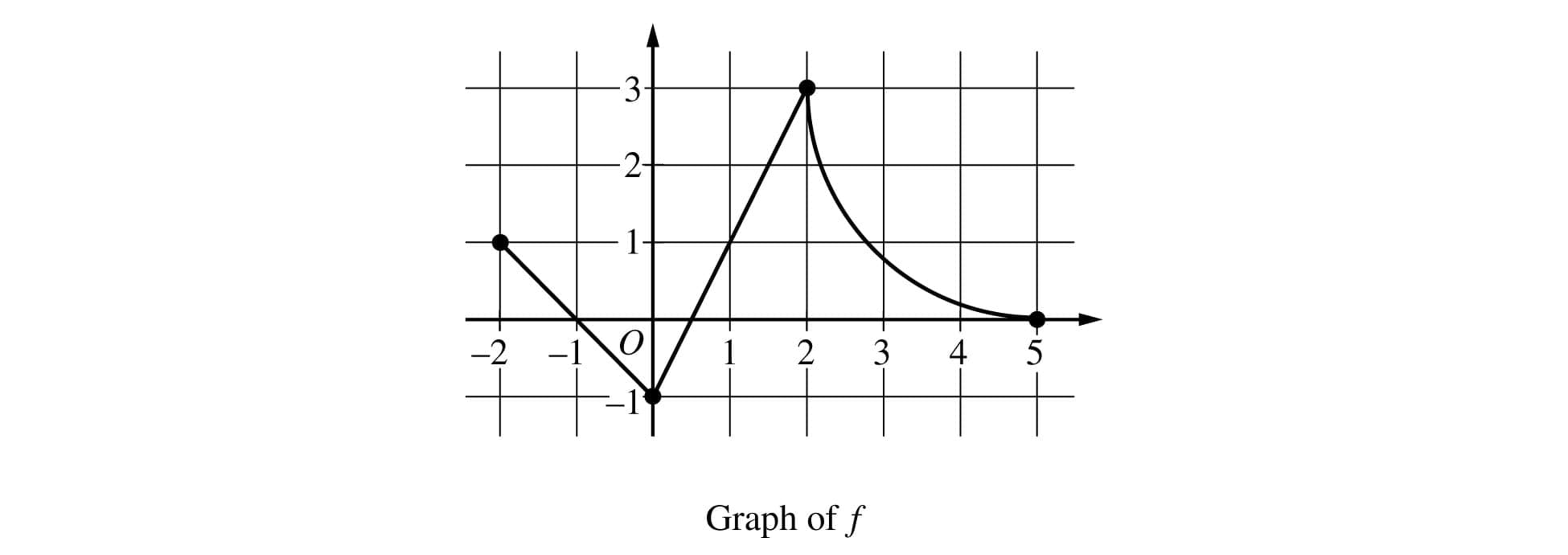
The continuous function f is defined on the closed interval −6≤x≤5. The figure below shows a portion of the graph of f, consisting of two line segments and a quarter of a circle centered at the point (5,3). It is known that the point (3,3−5) is on the graph of f.

Graph of function f: piecewise curve from (−2,1) down to (0,−1), up to (2,3), then decaying smoothly to (5,0) on Cartesian axes.

If ∫−65f(x)dx=7, find the value of ∫−6−2f(x)dx. Show the work that leads to your answer.

6b
2 points

Evaluate ∫35(2f'(x)+4)dx.

6c
3 points

The function g is given by g(x)=∫−2xf(t)dt. Find the absolute maximum value of g on the interval −2≤x≤5. Justify your answer.

7a
2 points

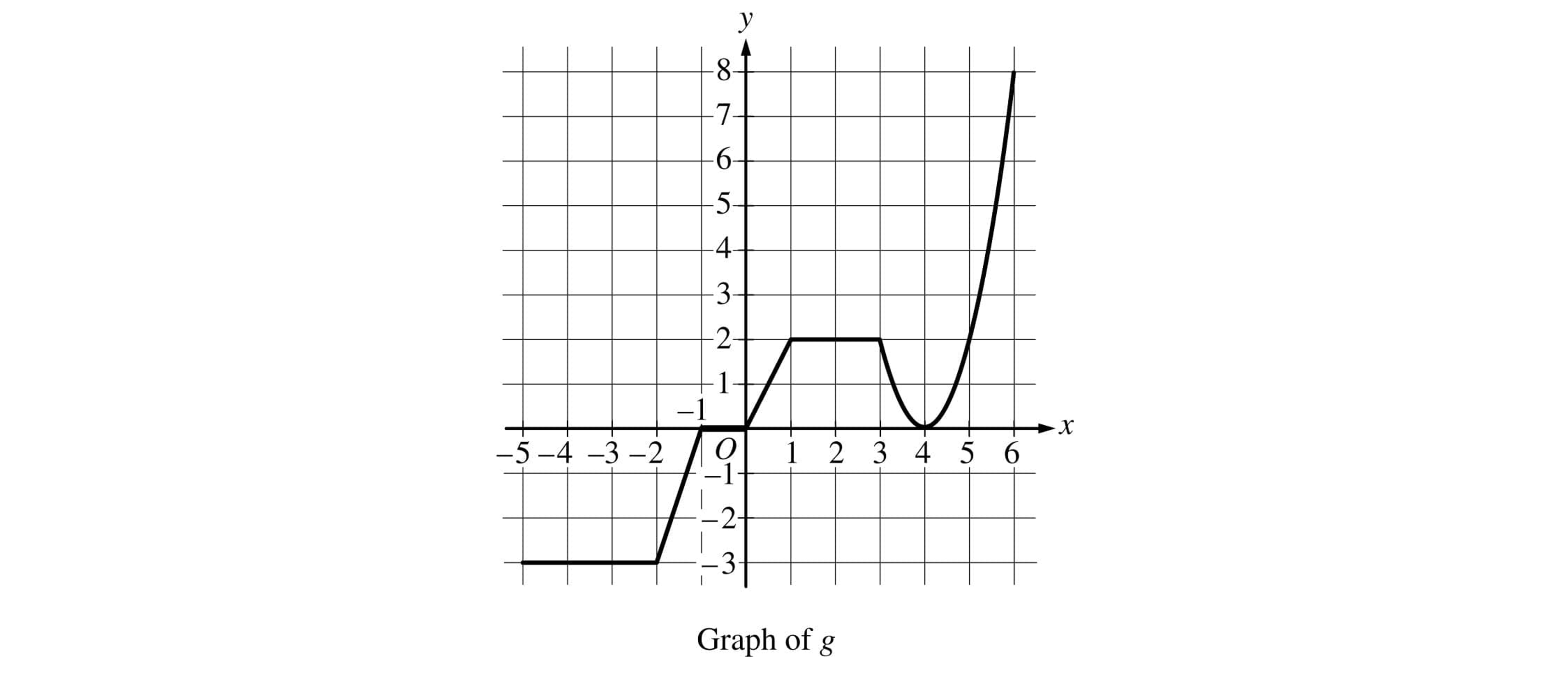
The graph of the continuous function g, the derivative of the function f, is shown below. The function g is piecewise linear for −5≤x<3, and g(x)=2(x−4)2 for 3≤x≤6.

Graph of function g: piecewise line, flat at y = −3 for x ≤ −2, rising to (0,0), then to (1,2), flat to x = 3, dip to (4,0), curve up past y = 8 by x = 6.

If f(1)=3, what is the value of f(−5)?

7b
3 points

Evaluate ∫16g(x) dx.

8
3 points

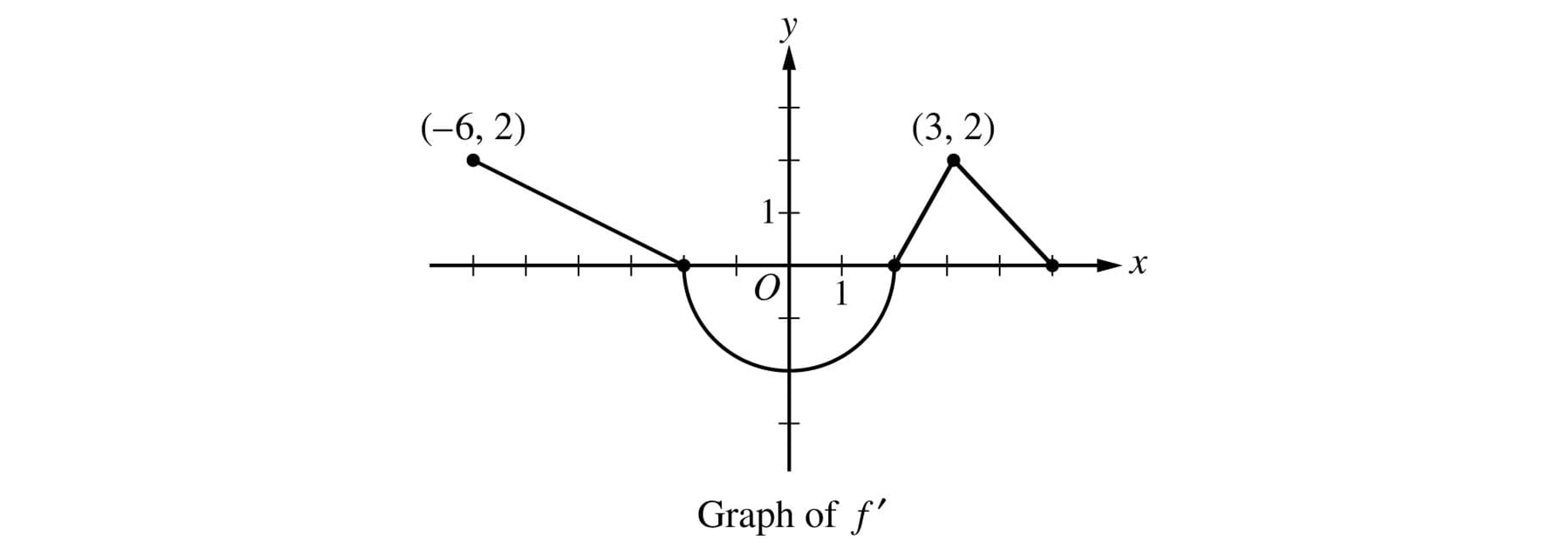
The function f is differentiable on the closed interval [−6,5] and satisfies f(−2)=7. The graph of f', the derivative of f, consists of a semicircle and three line segments, as shown below.

Graph of f′: piecewise curve from point (−6,2) sloping to (−2,0), semicircle below x-axis to (1,0), then triangle peaking at (3,2) and ending at (5,0).

Find the values of f(−6) and f(5).

9a
2 points
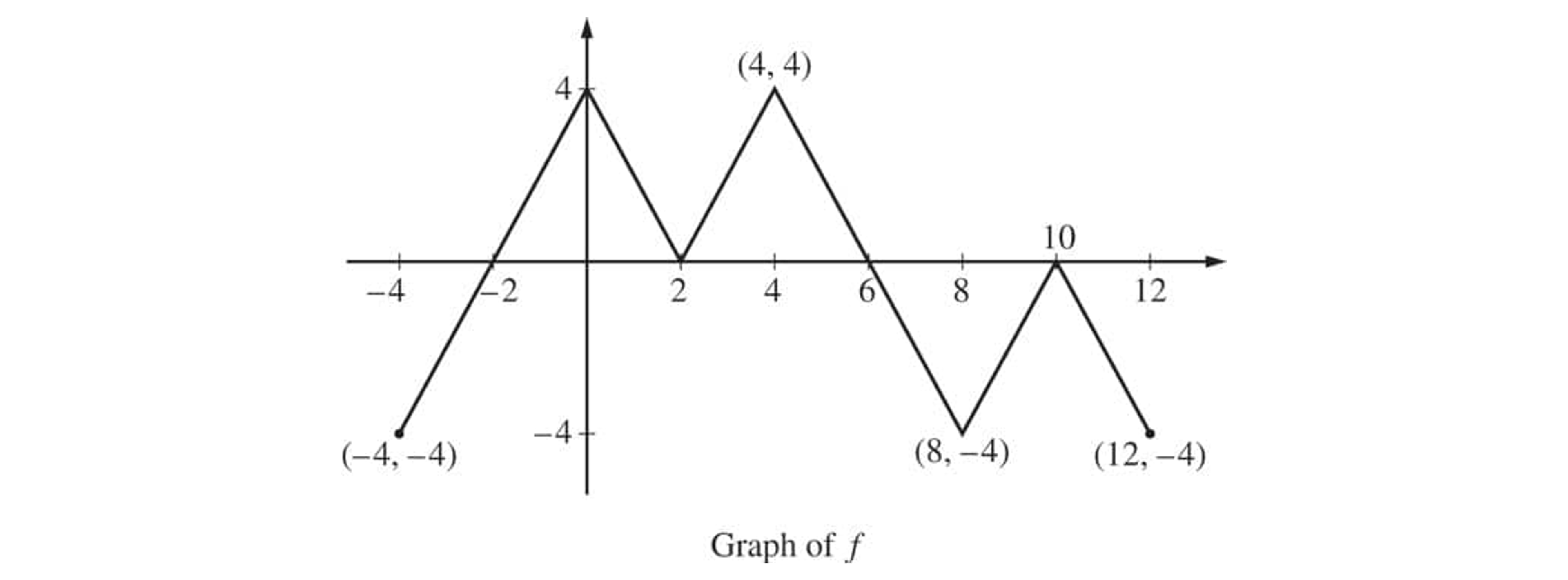
Piecewise linear graph of f joining points (−4,−4), (−1,4), (2,0), (4,4), (6,0), (8,−4), (10,0) and (12,−4) on x–y axes.

The figure above shows the graph of the piecewise-linear function f. For −4≤x≤12, the function g is defined by

g(x)=∫2xf(t) dt

Does g have a relative minimum, a relative maximum, or neither at x=10? Justify your answer.

9b
1 point

Does the graph of g have a point of inflection at x=4? Justify your answer.

9c
4 points

Find the absolute minimum value and the absolute maximum value of g on the interval −4≤x≤12. Justify your answers.

9d
2 points

For −4≤x≤12, find all intervals for which g(x)≤0.

10a
3 points

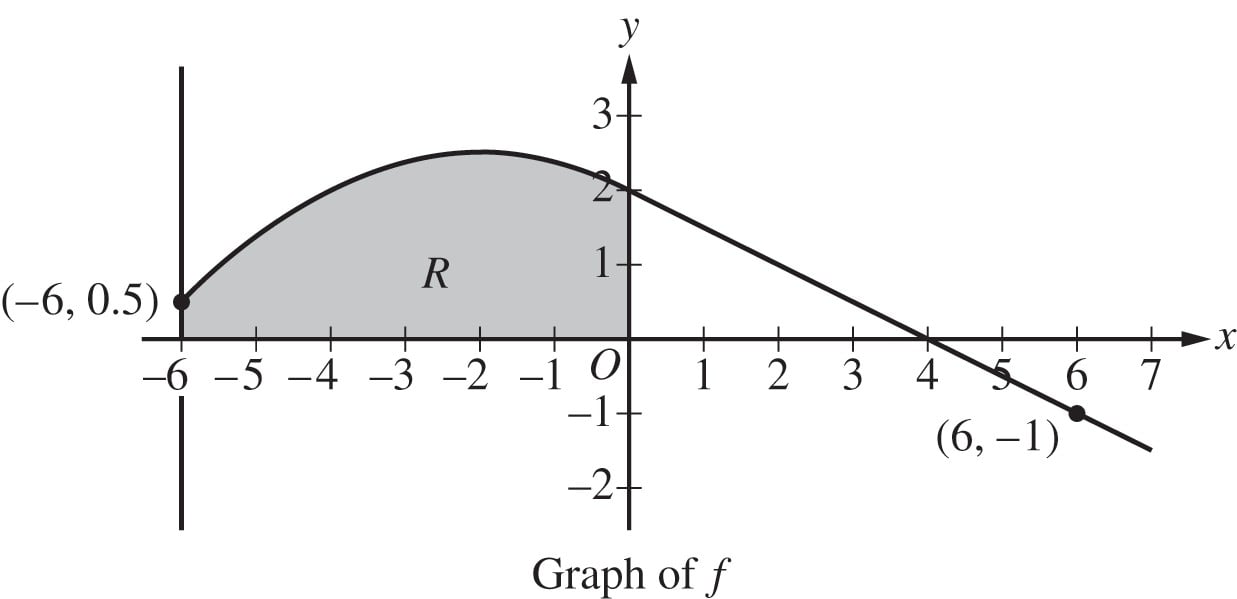
The graph of the differentiable function f, shown below for −6≤x≤7, has a horizontal tangent at x=−2 and is linear for 0≤x≤7. Let R be the region in the second quadrant bounded by the graph of f, the vertical line x=−6, and the x- and y-axes. Region R has area 12.

Graph of function f showing a shaded region R under a curved arc from x = −6 to 0 and a straight decreasing line from (0, 2) through (6, −1).

The function g is defined by g(x)=∫0xf(t) dt. Find the values of g(−6), g(4), and g(6).

10b
2 points

For the function g defined in part (a), find all values of x in the interval 0≤x≤6 at which the graph of g has a critical point. Give a reason for your answer.

10c
4 points

The function h is defined by h(x)=∫−6xf'(t) dt. Find the values of h(6), h'(6), and h''(6). Show the work that leads to your answers.