All About Me (AQA GCSE Polish): Revision Note
Exam code: 8688
All about me
For the topic of all about me, you need to be able to give basic details about yourself
This includes your name, age, nationality and what you look like, including negatives
You will learn about essential grammar points like cases (especially nominative and genitive), gender, plural nouns and adjective agreements
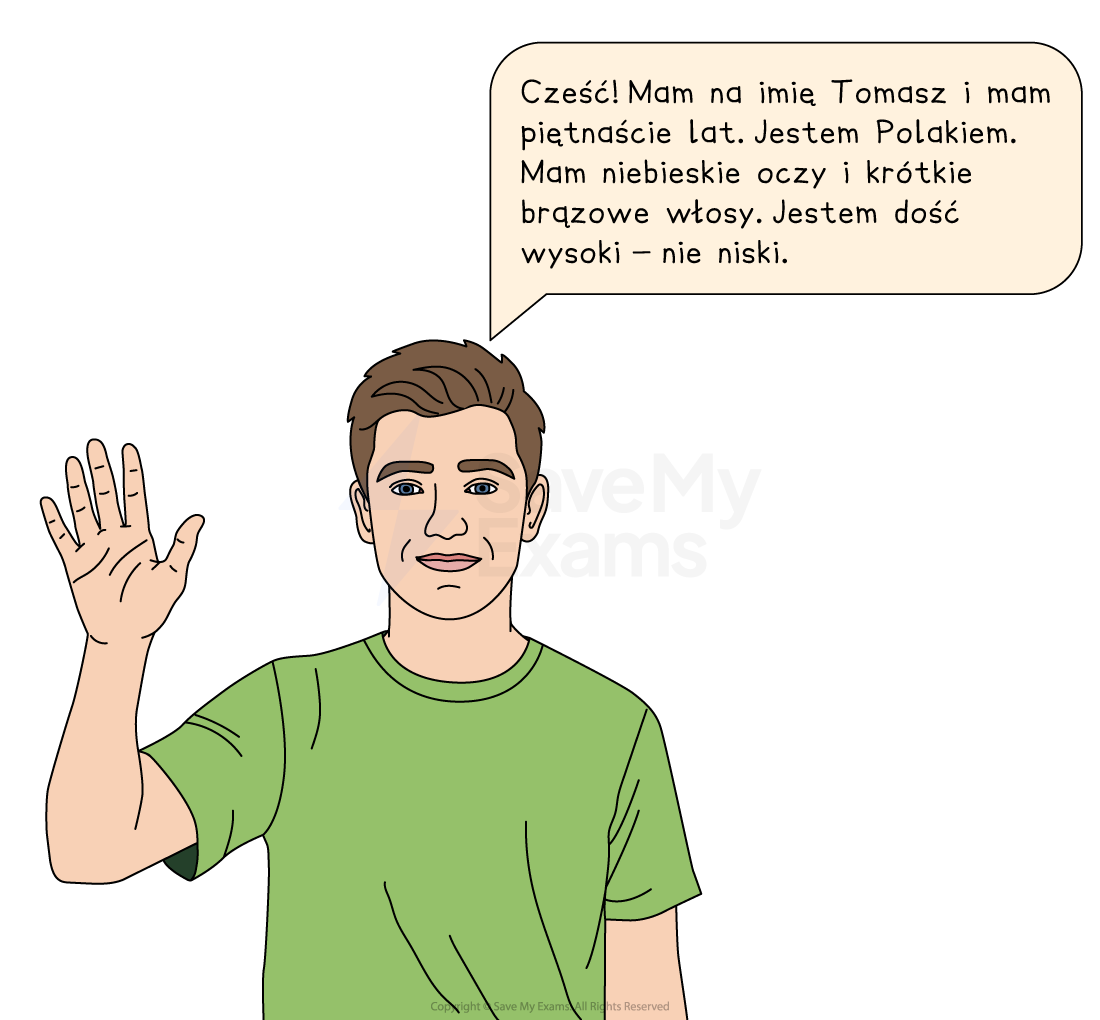
Hello! My name is Tomasz and I am 15. I am Polish. I have blue eyes and short, brown hair. I am quite tall - I am not short.
All about me: vocabulary
Some useful words and phrases you'll need for the topic of "All about me" are:
O mnie - All about me
Nazywam się - I am called / my name is
Mam ... lat - I am ... years old
Urodziłem/ urodziłam się … I was born …
Mieszkam w…- I live in
Pochodzę z …..- I come from
Mam - I have
Jestem - I am
Nie jestem - I am not
Mam ... oczy - I have ... eyes
Mam ... włosy - I have ... hair
Category | Polish | Part of speech | English |
|---|---|---|---|
Hair and eyes | oczy | n(pl) | eyes |
włosy | n(pl) | hair | |
białe | adj | white | |
niebieskie | adj | blue | |
blond | adj | blond | |
brązowe | adj | brown | |
czarne | adj | black | |
zielone | adj | green | |
krótkie | adj | short | |
długie | adj | long | |
Physical appearance | wysoki (m) | adj | tall, high |
niski (m) | adj | short | |
szczupły (m) | adj | slim | |
duży (m) | adj | big | |
wysportowany (m) | adj | fit, sporty | |
mały (m) | adj | small | |
ładny (m) | adj | pretty | |
piękny (m) | adj | beautiful | |
brzydki (m) | adj | ugly | |
gruby (m) | adj | fat | |
Personality | pomocny (m) | adj | helpful |
spokojny (m) | adj | calm | |
zabawny (m) | adj | funny | |
szczery (m) | adj | honest | |
miły (m) | adj | nice | |
dziwny | adj | strange, odd | |
bezczelny | adj | cheeky | |
uprzejmy | adj | polite | |
Nationalities | Niemiec Niemka | n(m) n(f) | German |
Anglik Angielka | n(m) n(f) | English | |
Francuz Francuzka | n(m) n(f) | French |
In Polish, all nationality nouns—such as “Polak”, “Polka”, “Niemiec”, “Francuzka”—are written with a capital letter because they refer to specific people belonging to a nation
When the word is an adjective describing something related to a country (for example: language, food, culture), it is written with a lowercase letter
"Polak” (male) and “Polka” (female) are Polish nationality nouns that change form depending on gender, unlike English, which uses one form (“English”) for everyone
In Polish, adjectives change their form depending on the grammatical gender of the noun
Polish has three genders:
masculine (for male people and many things e.g. brat)
feminine (for female people and many things e.g. siostra)
neuter (for some things, like “child”)
The adjective must match the noun
Easy rule to remember:
masculine → -y / -i → wysoki
feminine → -a → wysoka
neuter → -e → wysokie
Examiner Tips and Tricks
It is important to practise using vocabulary to gain confidence and achieve maximum marks. Say your name, your age and give a brief description of yourself in Polish. Use a negative too. If you need more support, try writing it down and reading it aloud.
Higher tier only
Category | Polish | Part of speech | English |
|---|---|---|---|
Hair and eyes | czarne | adj | black |
rude | adj | red (hair), ginger | |
kręcone | adj | curly | |
Personality | towarzyski | adj | sociable |
niegrzeczny | adj | naughty | |
cierpliwy | adj | patient | |
hojny | adj | generous | |
zrównoważony | adj | balanced | |
żywy | adj | lively | |
niezawodny | adj | reliable | |
pewny siebie | adj | self-confident | |
zarozumiały | adj | conceited | |
szalony | adj | crazy | |
Nationalities | Hiszpan, Hiszpanka Hiszpanie, Hiszpanki | n (f,m) n (pl) | Spain/Spaniard/Spanish |
Włoch, Włoszka Włosi, Włoszki | n (f,m) n (pl) | Italy/Italian |
In Polish, nationality nouns change their form depending on gender and number, and all of them are written with a capital letter. Here is how the forms differ:
Amerykanin – a male American (singular, masculine)
Amerykanka – a female American (singular, feminine)
Amerykanie – a mixed group or a group of men (plural, masculine personal)
Amerykanki – a group of women (plural, feminine)
The spelling changes because Polish grammar requires nationality words to show:
gender (masculine vs. feminine)
number (singular vs. plural)
type of group (mixed/men vs. only women)
Examiner Tips and Tricks
In Polish, adjectives formed from country names are written with a lowercase letter.
They describe origin, language, culture, or products, so they are not treated as proper nouns.
Polish language - język polski
American culture -amerykańska kultura
French food -francuskie jedzenie

Unlock more, it's free!
Join the 100,000+ Students that ❤️ Save My Exams
the (exam) results speak for themselves:

Was this revision note helpful?
