Mobile Technology: Exam Skills (AQA GCSE Polish): Revision Note
Exam code: 8688
The topic of 'Mobile Technology' can appear in any of the exams - you might need to understand others talking about devices they use, or to speak, read and write about your own experiences with technology
Use the vocabulary and grammar we have seen so far to take a closer look at some typical exam questions and how you might tackle them
Mobile technology: listening
In the listening exam, you may be asked to complete the table in Polish based on information from the text
Read the sentence stems carefully before you listen to the recording so you know what information to look for
Make sure your answer matches the time frame given, for example in the past, now or in the future
You do not need to write full sentences unless the question asks you to
Foundation tier
Worked Example
Kasia talks about her use of mobile technology
Complete the table. Answer both parts of the question in Polish
Answer | |
|---|---|
Example: w przyszłości | będzie korzystać z telefonu mniej |
w przeszłości | |
obecnie |
Answers
w przeszłości: często korzystała z telefonu, żeby grać w gry i oglądać filmy
obecnie: kontaktuje się z przyjaciółmi i szuka informacji do szkoły
Examiner Tips and Tricks
Look carefully at the time reference in the question: in the past, nowadays or in the future
The text may contain information about all three time periods, so make sure you choose the information that matches the question
You do not need to write a full sentence — a short, accurate phrase is enough
Higher tier
Worked Example
You are listening to a Polish radio programme about mobile technology
Write the correct letter to indicate the answers to the questions
Do czego rozmówca najczęściej używa telefonu?
A | do robienia zdjęć i nagrywania filmów |
B | do kontaktowania się z przyjaciółmi i rodziną |
C | do grania w gry i słuchania muzyki |
Co rozmówca mówi o korzystaniu z telefonu w przyszłości?
A | kupi nowy telefon |
B | będzie korzystać z telefonu mniej |
C | pobierze nową aplikację |
Answers
B (Na co dzień najczęściej używam telefonu do kontaktowania się z przyjaciółmi i rodziną.)
B (W przyszłości chciałbym korzystać z telefonu mniej.)
Examiner Tips and Tricks
Read all the options before listening. This helps you know what information to listen for
Listen for key words, but do not choose an answer just because you hear the same word
The recording may mention all three options, but only one will answer the question correctly
Listen carefully for negatives such as nie, nigdy, rzadko and mało — they can completely change the meaning
Mobile technology: speaking
In part 1 of the speaking exam, you will take part in a role play with your teacher
You will be given a situation and five tasks to complete in Polish
These questions will help you to practise speaking about the topic of 'mobile technology'
The Role Play is one of the tasks in the speaking exam. You will have approximately 2 minutes to complete the role play.
Worked Example
Talk to your teacher about mobile technology and how you use it. Describe:
kiedy i gdzie najczęściej korzystasz z telefonu?
?do czego używasz telefonu na co dzień
zalety nowoczesnej technologii
! Unprepared task — your teacher might ask: Opowiedz o problemie związanym z telefonem
technologia mobilna w przyszłości?
Answers
1. Powiedz, kiedy i gdzie najczęściej korzystasz z telefonu.
Najczęściej korzystam z telefonu po szkole, kiedy jestem w domu. Używam go też w autobusie, kiedy jadę do szkoły. W weekendy mam więcej czasu, więc korzystam z telefonu częściej.
I usually use my phone after school when I am at home. I also use it on the bus when I travel to school. At weekends, I have more free time, so I use my phone more often.
2. Powiedz, do czego używasz telefonu na co dzień.
Na co dzień używam telefonu do wysyłania wiadomości i słuchania muzyki. Często robię też zdjęcia i korzystam z internetu. Telefon pomaga mi również w nauce.
Every day, I use my phone to send messages and listen to music. I often take photos and use the internet too. My phone also helps me with my studies.
3. Opowiedz o zalecie nowoczesnej technologii.
Moim zdaniem największą zaletą nowoczesnej technologii jest to, że ułatwia nam życie. Możemy szybko znaleźć informacje i kontaktować się z innymi ludźmi. Na przykład mogę porozmawiać z rodziną, nawet jeśli mieszkamy daleko od siebie.
In my opinion, the biggest advantage of modern technology is that it makes our lives easier. We can quickly find information and communicate with other people. For example, I can talk to my family even if we live far away from each other.
4. Opowiedz o problemie związanym z telefonem.
Ostatnio miałem problem z telefonem, ponieważ bateria bardzo szybko się rozładowywała. Było to bardzo denerwujące, ponieważ nie mogłem długo korzystać z telefonu. Na szczęście kupiłem nową ładowarkę i problem zniknął.
Recently, I had a problem with my phone because the battery was running out very quickly. It was very annoying because I couldn't use my phone for long. Fortunately, I bought a new charger and the problem disappeared.
5. Powiedz, jak technologia mobilna zmieni się w przyszłości.
Myślę, że w przyszłości telefony będą jeszcze bardziej zaawansowane. Będziemy mogli używać ich do większej liczby rzeczy, na przykład do nauki i pracy. Mam nadzieję, że technologia będzie pomagać nam w codziennym życiu.
I think that in the future phones will be even more advanced. We will be able to use them for more things, for example for studying and working. I hope that technology will help us in our everyday lives.
In part 2 of the speaking exam, your teacher asks you five questions about a photo card
Three are printed on the card; two are unprepared
This question will help you to practise describing a photo on the topic of 'Mobile technology'
Worked Example
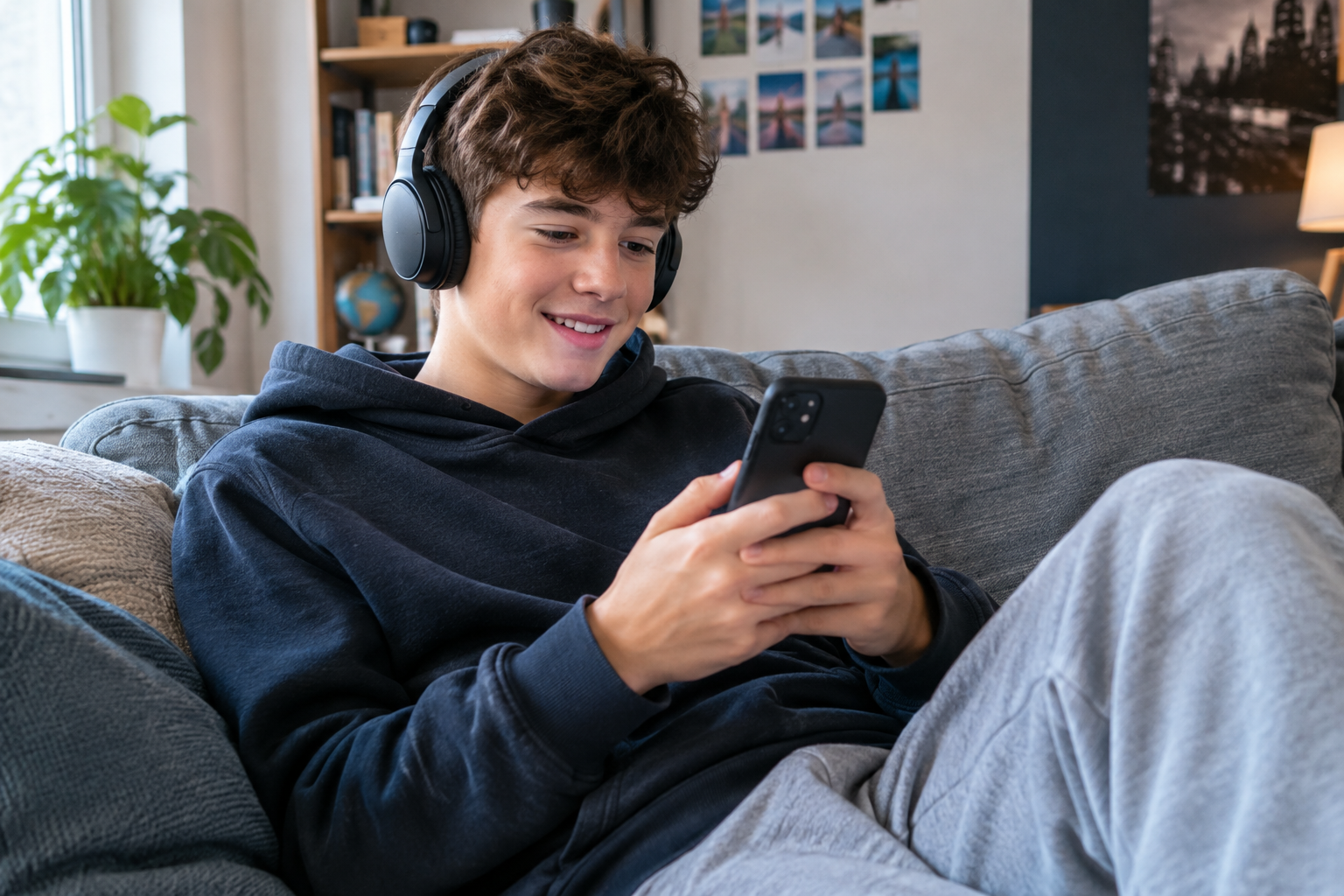
Opowiedz, co widzisz na fotografii?
Answer
Na zdjęciu widzę nastolatka, który korzysta z telefonu komórkowego. Siedzi na kanapie i patrzy na ekran telefonu. Wygląda na zadowolonego i bardzo skupionego. Myślę, że wysyła wiadomości do przyjaciół albo korzysta z mediów społecznościowych. Być może słucha również muzyki lub ogląda film. Uważam, że telefon komórkowy jest dla niego ważnym elementem codziennego życia.
In the photo, I can see a teenager who is using a mobile phone. He is sitting on a sofa and looking at the phone screen. He looks happy and very focused. I think he is sending messages to his friends or using social media. Perhaps he is also listening to music or watching a video. I think that the mobile phone is an important part of his everyday life.
Examiner Tips and Tricks
Use the acronym PALM to help you describe a photo - People, Action, Location, Mood. Identify the aspects of PALM in the example answer above.
In the General Conversation part of the Polish speaking exam, you will answer questions from your teacher about the theme you have chosen
You should be ready to give opinions, explain your ideas and justify your answers
You will also be given a second theme by your teacher
Your teacher may ask follow-up questions, so try to develop your answers rather than giving very short responses
The total time for the General Conversation is 3- 5 minutes at Foundation Tier and up to 5-7 minutes at Higher Tier
Your teacher will move on to the second topic at the appropriate point during the conversation
At Higher Tier, aim to use a wider range of vocabulary, different tenses and more complex structures
Here are some example questions to practise
Worked Example
Czy masz telefon komórkowy? Jak często z niego korzystasz?
Do czego najczęściej używasz telefonu?
Jakie aplikacje masz na telefonie?
Czy wolisz pisać wiadomości czy rozmawiać przez telefon? Dlaczego?
Czy telefon jest ważny w twoim codziennym życiu? Dlaczego?
Jakie są zalety posiadania smartfona?
Jakie są wady korzystania z telefonu komórkowego?
Answers
Tak, mam smartfon i korzystam z niego codziennie. Używam go głównie do kontaktowania się z przyjaciółmi i słuchania muzyki.
Najczęściej używam telefonu do wysyłania wiadomości, korzystania z mediów społecznościowych i oglądania filmów. Czasami używam go również do nauki.
Mam wiele aplikacji, na przykład aplikacje do słuchania muzyki, oglądania filmów, kontaktowania się z przyjaciółmi i nauki języków.
Wolę pisać wiadomości, ponieważ jest to szybkie i wygodne. Mogę również odpowiadać wtedy, kiedy mam czas.
Tak, telefon jest bardzo ważny w moim codziennym życiu, ponieważ pomaga mi kontaktować się z rodziną i przyjaciółmi oraz znaleźć potrzebne informacje.
Jedną z największych zalet smartfona jest możliwość szybkiego kontaktowania się z innymi osobami. Można również korzystać z internetu, robić zdjęcia i używać różnych przydatnych aplikacji.
Jedną z wad jest to, że można spędzać zbyt dużo czasu przed ekranem. Może to negatywnie wpływać na zdrowie i sprawić, że będziemy spędzać mniej czasu z rodziną i przyjaciółmi.
Examiner Tips and Tricks
Remember to ask your teacher a question!
At the end of the General Conversation, you are expected to ask your teacher a question related to the topic
Prepare a few simple questions in advance so you feel confident
Make sure your question is relevant to the topic
You do not have to wait until the end to ask a question
Mobile technology: reading
In Section C of the reading exam, you will translate a few sentences from Polish into English
There are 9 marks in total for this section
Foundation tier
Worked Example
Translate the following text into English.
Niedawno kupiłam nowy telefon, ale mam z nim mały problem. Aplikacje nie zawsze działają dobrze i czasami nie mogę korzystać z internetu. W przyszłym tygodniu pójdę do sklepu z moją mamą, żeby poprosić o pomoc. Mam nadzieję, że szybko rozwiążemy ten problem.
Answer
I recently bought a new phone, but I have a small problem with it. The apps do not always work properly, and sometimes I cannot use the internet. Next week, I will go to the shop with my mum to ask for help. I hope we will solve this problem quickly.
Higher tier
Worked Example
Translate this email from your Polish friend Kuba into English.
Słyszałem, że ostatnio kupiłeś nowy telefon, ale masz problemy z jego aplikacjami i bardzo denerwuje Cię to, że nie możesz korzystać z mediów społecznościowych. Gdybyś miał więcej wolnego czasu w przyszłym tygodniu, moglibyśmy razem wybrać się do sklepu i kupić nowy smartfon. Wyobraź sobie, że moje marzenia się spełniają, ponieważ dostałem propozycję pracy w firmie zajmującej się technologią, więc trzymaj za mnie kciuki w najbliższy piątek o godzinie 14.00.
Answer
I heard that you recently bought a new phone, but you are having problems with its apps and you are very annoyed that you cannot use social media. If you had more free time next week, we could go to the shop together and buy a new smartphone. Imagine, my dreams are coming true because I have been offered a job at a technology company, so keep your fingers crossed for me next Friday at 2 p.m.
Examiner Tips and Tricks
Read the whole text first before translating. Do not start translating word by word immediately
Do not translate word for word. Translate the meaning naturally into English
Pay attention to pronouns and who is doing the action: kupiłeś = you bought, dostałem = I got / I was offered
Be careful with time expressions:
w przyszłym tygodniu → next week
w najbliższy piątek → this coming Friday / next Friday
o godzinie 14.00 → at 2 p.m
Mobile technology: writing
In the writing exam, you need to write a response in Polish guided by bullet points
Foundation tier
In the Foundation writing paper, there is a question where you write approximately 90 words in response to four bullet points
You must write something about each bullet point
Worked Example
You are writing an article for a Polish school magazine about mobile technology.
Write about:
Kiedy ostatnio używałeś/używałaś telefonu komórkowego i do czego?
Jedna zaleta i jedna wada smartfonów.
Jak używasz telefonu w szkole?
Co będziesz robić ze swoim telefonem w przyszłości?
Answer
Wczoraj wieczorem używałem telefonu, żeby kontaktować się z przyjaciółmi i słuchać muzyki. Zaletą smartfona jest to, że można szybko znaleźć informacje i robić zdjęcia. Jednak wadą jest to, że można spędzać zbyt dużo czasu online. Czasami telefon pomaga mi w nauce, ponieważ mogę korzystać ze słownika i wyszukiwać informacje do szkoły. W zeszłym roku używałem telefonu głównie do grania w gry. W przyszłości będę korzystać z telefonu mniej, ponieważ chcę mieć więcej czasu na sport i spotkania z rodziną.
Yesterday evening, I used my phone to keep in touch with my friends and listen to music. One advantage of a smartphone is that you can quickly find information and take photos. However, one disadvantage is that you can spend too much time online. Sometimes my phone helps me with my studies because I can use a dictionary and search for information for school. Last year, I mainly used my phone to play games. In the future, I will use my phone less because I want to have more time for sport and meeting my family.
Examiner Tips and Tricks
You do not need to write equal amounts for each bullet point - a short sentence per point is enough
Make sure every bullet point is covered
Higher tier
In the writing paper, there is a question where you write approximately 90 words in response to four bullet points
The same question appears on both the Foundation and Higher papers
Worked Example
You are writing an article for a Polish school magazine about mobile technology.
Write about:
W jaki sposób smartfony zmieniły życie młodych ludzi? Jakie są ich największe zalety i wady?
Jak według ciebie będzie wyglądało korzystanie z telefonów komórkowych w przyszłości?
Write your text in Polish in about 150 words.
Answer
Moim zdaniem smartfony bardzo zmieniły życie młodych ludzi. Dzięki nim możemy szybko kontaktować się z rodziną i przyjaciółmi oraz łatwo znaleźć potrzebne informacje. Często korzystam z telefonu podczas nauki, na przykład aby sprawdzić znaczenie słowa lub znaleźć materiały do szkoły. Jednak smartfony mają również wady, ponieważ niektórzy młodzi ludzie spędzają zbyt dużo czasu w mediach społecznościowych i zaniedbują naukę, sport oraz kontakty z rodziną. Uważam, że najważniejsze jest korzystanie z technologii w rozsądny sposób. W przyszłości telefony będą prawdopodobnie jeszcze bardziej nowoczesne i przydatne. Być może będziemy używać ich częściej do nauki i pracy. Mam jednak nadzieję, że ludzie nie staną się całkowicie zależni od technologii. Osobiście chciałbym korzystać z telefonu odpowiedzialnie i nadal mieć dużo czasu na spotkania z bliskimi, sport oraz inne zainteresowania.
In my opinion, smartphones have changed young people's lives a lot. Thanks to them, we can quickly keep in touch with family and friends and easily find the information we need. I often use my phone when studying, for example to check the meaning of a word or find materials for school. However, smartphones also have disadvantages because some young people spend too much time on social media and neglect their studies, sport and contact with their families. I think the most important thing is to use technology sensibly. In the future, phones will probably become even more modern and useful. Perhaps we will use them more often for studying and work. However, I hope that people will not become completely dependent on technology. Personally, I would like to use my phone responsibly and still have plenty of time to meet my loved ones, play sport and pursue other interests.
Examiner Tips and Tricks
Use a variety of connectives: jednak, ponieważ, dlatego, mimo że, poza tym
Do not simply list ideas. Develop each point with a reason, example or consequence

Unlock more, it's free!
Join the 100,000+ Students that ❤️ Save My Exams
the (exam) results speak for themselves:

Was this revision note helpful?
