Brown v Board of Education, 1954 (Edexcel IGCSE History: Paper 1: Depth Studies): Revision Note
Exam code: 4HI1

Timeline & Summary
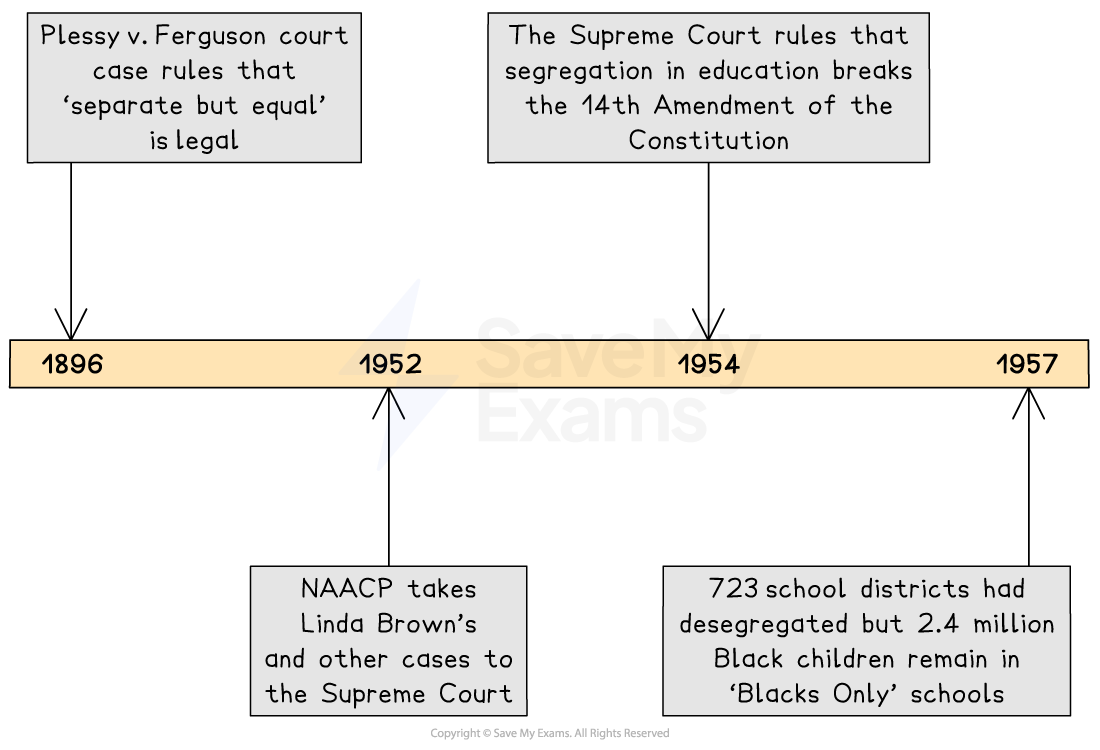
From the 1940s, the NAACP challenged segregation in education through the law courts
This is because school spending showed that separate was not equal
In Brown v. Board of Education of Topeka, on 17 May 1954, the Supreme Court ruled unanimously that school segregation was unconstitutional
The decision had a very limited immediate impact
It caused a backlash in the Deep South, including the growth of White Citizens' Councils
Its real importance was as a legal precedent that gave civil rights campaigners hope and led to more cases
The murder of 14-year-old Emmett Till in 1955 and the acquittal of his killers shocked the USA
It increased awareness of the extreme racism in the South
The importance of Brown v Board of Education of Topeka, 1954
Schools and the civil rights movement
In many states across the USA, Black and white pupils had to attend separate schools
State government spending per pupil could be over four times more for white pupils
Civil rights groups felt this was an area where they could attack the separate but equal principle of Plessy v. Ferguson
From the 1940s, the National Association for the Advancement of Colored People (NAACP) focused on challenging segregation in education through the law courts
The NAACP had previously tried to end segregation through Congress
It met with little success because many politicians opposed it
To try to keep education segregated, some states gave more money to Black schools
Examiner Tips and Tricks
Please do not use 'coloured' to refer to Black Americans in your exam answers. However, as this term is included in the official name of the NAACP, you are permitted to use ‘coloured’ in this context. You may prefer to refer to the organisation by its abbreviation.
Linda Brown
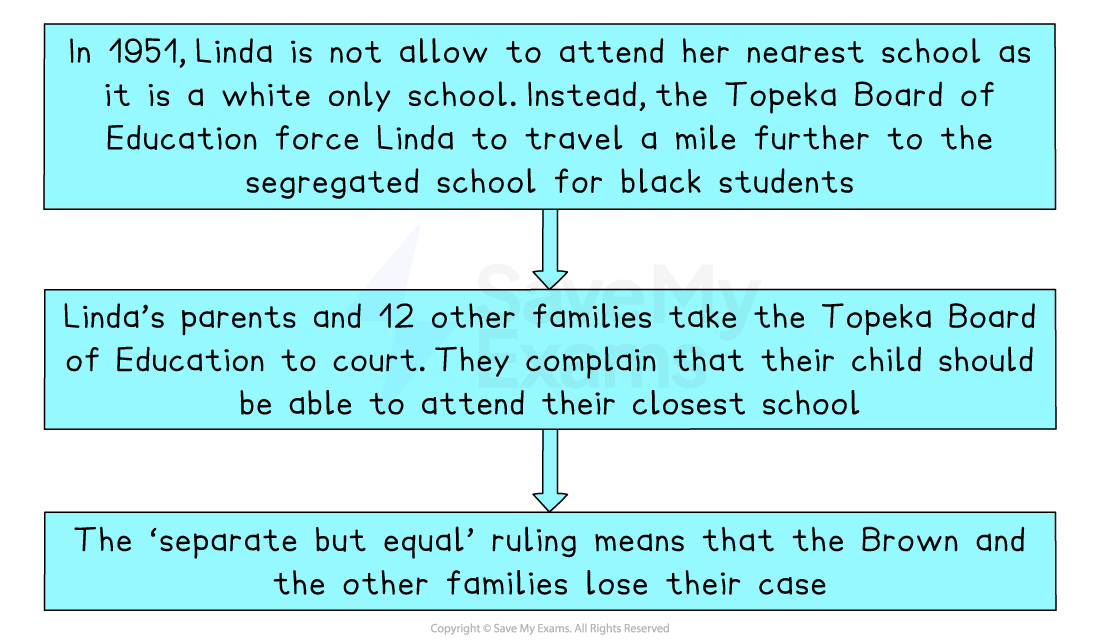
Linda Brown was a Black student from Kansas who had to walk past a school for white students before she reached her nearest ‘Blacks only’ school
Her family believed this was unfair
With the support of the NAACP, her father, Oliver Brown, and 12 other families took the local Topeka Board of Education to court
Brown v. Topeka, 1954
The case, Brown v. Board of Education of Topeka, went to the Supreme Court
Brown’s lawyers argued that segregated education led to poorer results, mental stress and lower self-esteem for Black students
The lawyers stated that, as a result, segregation went against the Fourteenth Amendment of the Constitution, which promises all citizens "the equal protection of the laws"
In December 1952, the Supreme Court voted to hear more legal advice on the case
They avoided making a ruling
In September 1953, Chief Justice Fred Vinson died
His replacement as Chief Justice was Earl Warren, who opposed segregation
On 17 May 1954, the Supreme Court ruled that:
The USA had changed since the Plessy v. Ferguson case
All US citizens should have a good education
The NAACP were right that segregated education was unconstitutional
It set no timeframe to desegregate schools
In May 1955, a second ruling (Brown II) ordered schools to desegregate
This ruling had no deadline, so Southern states were able to delay desegregation for years
"With all deliberate speed"
Supreme Court, Brown II ruling, 31 May 1955

Reaction outside the Deep South
Schools in towns and cities outside the Deep South started to integrate
Progress was slow
Black pupils' education suffered
Some Black teachers lost their jobs
Many Black schools that had provided a good education were closed
During integration, Black students and their families faced anger
In some towns and cities, segregation became more extreme because of white flight
This is when white people left areas that had a large number of Black residents
The negative effects were at their worst in the Deep South
Reaction in the Deep South
In the Deep South, the day of the decision became known as Black Monday
This was because the ruling was announced on Monday 17 May 1954
Many white southerners were furious and determined to keep segregation
The first White Citizens' Council was set up in Indianola, Mississippi
Many more followed across the South
The Councils organised protests and petitions that put pressure on state authorities to resist integration
Many members were also inspired to join the Ku Klux Klan (KKK)
This is the white supremacist group that Black Americans feared above any other
Long-term impact
The verdict was a great victory for the NAACP
It brought an increased awareness of Black civil rights
It provided a new legal precedent
It led to many more legal cases and campaigns for desegregation
For the first time, the US political system, or at least the Supreme Court, seemed to be willing to support Black citizens
This gave civil rights campaigners new hope that the system could bring about change
Examiner Tips and Tricks
Remember that Brown v. Topeka had both positive and negative effects. In an effects question, try to mention the legal victory as well as the reactions in the Deep South. This gives your answer balance.
The death of Emmett Till, 1955
Who was Emmett Till?
Emmett Till was a 14-year-old Black boy from Chicago who was murdered in Mississippi in 1955
There were no segregation laws where he came from in the North but he was killed whilst visiting relatives in Mississippi
Why was Emmett Till murdered?
Emmett Till was accused of flirting with, whistling at and touching the white 21-year-old wife of store owner Roy Bryant
Several nights later, Bryant and his half-brother, J.W. Milam, abducted Till at gunpoint from his uncle’s house
His body was discovered floating in a river days later, having been severely beaten and shot in the head
The significance of Emmett Till to the civil rights movement
Emmett Till’s mother decided to have an open casket at his funeral and photographs of his mutilated face were published by many national newspapers
Bryant and Milam were arrested for kidnapping before Till's body was found
The images and story of the boy’s death caused national outrage
When Bryant and Milam stood trial, an all-white, all-male jury took just over one hour to find them not guilty
In 1956, Bryant and Milam admitted the murder in an interview they sold to Look magazine
They could not be tried again for the same crime
The trial generated anger and publicity, leading many more people to become sympathetic to and involved with the civil rights movement
This included Black and white Americans
The killers of Emmett Till were never punished
Some historians believe that what happened to Emmett Till was the catalyst for the civil rights movement
How far did Brown v. Board of Education change race relations in America?
Evidence of change
Brown broke the Plessy v. Ferguson precedent
For the first time, the Supreme Court said that segregated schools were unconstitutional
It was a great victory for the NAACP and led to many more legal cases and campaigns for desegregation
It showed that the Supreme Court was prepared to help Black Americans
This gave campaigners new hope
Schools in towns and cities outside the Deep South began to integrate
Evidence of limited change
Progress was slow
Integration often did not benefit Black pupils or teachers, because they faced hostility
Teachers lost jobs
Many Black schools were closed
White flight made segregation more extreme in some towns and cities
The case caused a backlash in the Deep South
This included the White Citizens' Councils, the growth of the Ku Klux Klan and increased violence, such as the murder of Emmett Till
Conclusions
Two criteria help to judge how far Brown changed race relations:
how much it changed the law
how much it changed daily life
On the law, the change was large
Brown v. Topeka overturned a precedent that had stood for nearly 60 years
On daily life, the change was small
In the Deep South relations got worse before they got better
Therefore, Brown changed the law much more than it changed race relations in the 1950s
However, it made later change possible
Worked Example
'The Brown v Board of Education of Topeka decision (1954) did little to change race relations in the 1950s.'
How far do you agree? Explain your answer.
You may use the following in your answer:
the NAACP
the White Citizens' Councils.
You must also use information of your own.
(16)
Partial answer:
In the Deep South, Brown v. Topeka made race relations worse in the short term. Many white southerners were furious, and the White Citizens' Councils that were set up across the South organised petitions and protests that pressured state authorities to resist integration. Because the authorities resisted, the integration of schools in the Deep South was not enforced in practice. At the same time, many Council members joined the Ku Klux Klan and violence towards Black people increased, as the murder of Emmett Till in 1955 showed. Therefore, Black Americans in the South felt less safe after Brown than before it.
Examiner Tips and Tricks
You must cover at least three aspects: the two prompts and at least one point of your own. If you do not, your answer cannot reach Level 4 and is capped at 10 marks.
To reach Level 4 in the 16-mark question, set out how you will judge whether Brown did little to change race relations in the 1950s, for example whether it changed daily life as well as the law and whether its effects were felt within the 1950s or only later. State it in your introduction and use it to reach your conclusion.

Unlock more, it's free!
Join the 100,000+ Students that ❤️ Save My Exams
the (exam) results speak for themselves:

Was this revision note helpful?