The Civil Rights Act 1957 & the Revival of the Ku Klux Klan (Edexcel IGCSE History: Paper 1: Depth Studies): Revision Note
Exam code: 4HI1

Summary
By 1957, the Supreme Court had acted on civil rights
The president and Congress had not, partly because of opposition from Southern politicians
The Civil Rights Act of 1957 was passed after a long fight
However, it was a weakened version that aimed to protect Black voting rights
The Act had little immediate impact
However, it was the first time in 82 years that the federal government had acted
It led to another Act in 1960
After Brown v. Topeka and the Montgomery Bus Boycott, branches of the Ku Klux Klan reappeared across the South
They used more extreme violence, including bombs
By the end of the 1950s, a civil rights movement was building
However, progress in practice was slow and there was a long way to go
The significance of the Civil Rights Act, 1957
Why Congress and the president had not acted
By 1957, one of the three parts of the federal government, the Supreme Court, had taken action on Black civil rights in education and public transport
However, the president and Congress had yet to act
The Democratic president, Truman, tried to get a civil rights bill passed in 1948
It was blocked by Republicans for political reasons, and by Dixiecrats
When Truman was replaced by the Republican president Eisenhower in 1953, it was hoped that he would push his own civil rights bill through Congress
Eisenhower's position
Eisenhower declared himself to be in support of Black civil rights
However, he seemed unwilling to act
Like many politicians, he believed that changing the law would not really work until people's attitudes towards Black Americans changed
He was also aware of how strongly people valued states' rights
He did not want the federal government to interfere in what was seen as states' affairs
However, the achievements of Brown v. Board of Education of Topeka and the Montgomery Bus Boycott, and the extremely violent reactions to them, put pressure on the president and Congress for a federal law to help Black Americans achieve civil rights
Passing the Act
A civil rights bill was introduced in 1956
It was not passed because of Southern resistance
Dixiecrats then tried to delay and destroy a revised bill in 1957
Strom Thurmond, a leading Dixiecrat, used a filibuster
This is a tactic of making a very long speech to delay or block a vote
He spoke for a record 24 hours and 18 minutes
Partly because of the work of Lyndon Johnson, the Democrats' leader in the Senate, a weakened version of the bill was finally passed
President Eisenhower signed the Civil Rights Act on 9 September 1957
What the Act did
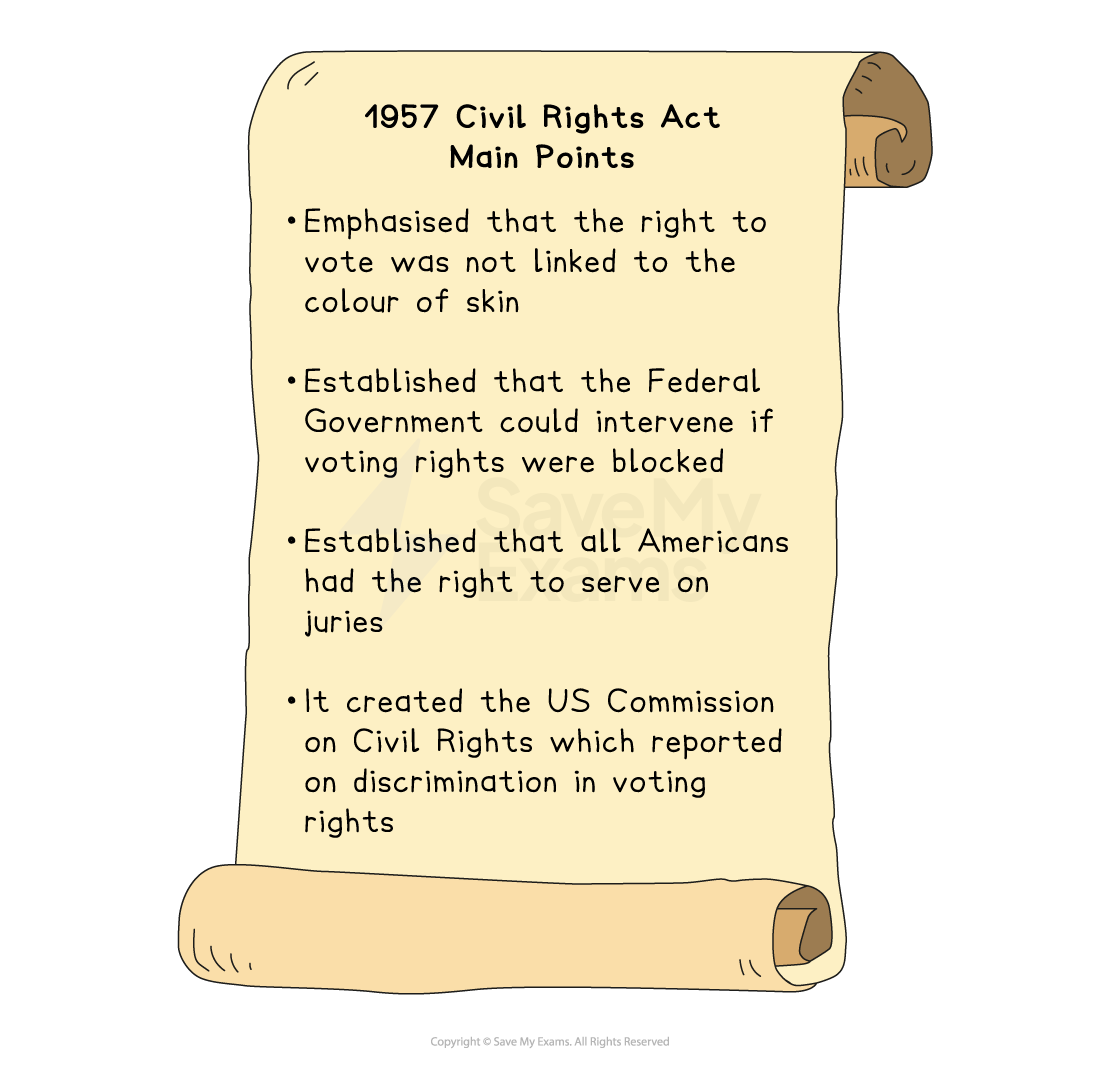
The Act focused on trying to increase the number of Black voters
It set up the US Commission on Civil Rights
This began investigating how Black Americans were prevented from voting in different places
The significance of the Act
The Act had little immediate impact
Although federal courts could take action, juries in the South were often opposed to civil rights
As a result, they were likely to reach not guilty verdicts
The Act was not very significant in improving civil rights for Black Americans
However, it was a hugely important first step
It was the first time in 82 years that the federal government had acted to try to improve the civil rights of Black Americans in law
It showed that Congress was at last willing to do something
Eisenhower thought that the Act would satisfy campaigners and stop the protests, which were damaging the USA's international reputation, but the opposite happened
Civil rights activists were disappointed that the Act did not go as far as they wanted
They became even more determined to press for further reform
Congress passed another Civil Rights Act in 1960
This introduced:
federal inspections of local voter registration records
penalties for anyone that stopped people from registering or voting
However, the two Acts together improved the number of Black Americans registering to vote by only 3%
Examiner Tips and Tricks
A significance answer should show both sides of the Act. It had little immediate impact, but it was a first step and led to the 1960 Act.
The revival of the Ku Klux Klan (KKK)
Who the Klan were
The Ku Klux Klan was a racist organisation, started in 1865
They believed in the superiority of White Anglo-Saxon Protestant (WASPs)
A white supremacist is someone who believes that White people are better than people of other races
The Klan was the White supremacist group that Black Americans feared above any other
Why the Klan revived
The initial growth of the Klan began after Brown v. Board of Education of Topeka, when many White southerners were furious and determined to maintain segregation
Many members of the White Citizens' Councils were inspired to join
The Klan continued to grow as more civil rights protests broke out across the USA and met with some success
The Montgomery Bus Boycott angered the Klan further
What the Klan did
Branches of the Klan reappeared all over the Deep South
Membership grew, although it never reached the level of the 1920s
The Klan once again held meetings encouraging racial hatred
They put burning crosses in front of houses to frighten the people inside
Members wore their traditional long white robes and hoods as a disguise
Their targets were civil rights protestors and supporters, Black or White
As the civil rights movement began to take off and meet with some success, the actions of the Klan became more extreme
They continued to use established methods such as beating, lynching and shooting victims
From January 1956, angered by the Montgomery Bus Boycott, bombs were used against the homes of leaders such as Martin Luther King
It was never proven who carried out each attack
Some Klansmen were tried and convicted, but all-white juries often found them not guilty
Historians believe that Klan members were involved in much of the racial violence throughout the South in the 1950s and 1960s
This was even in incidents that were not directly organised by the Klan
How much progress in civil rights was made by the end of the 1950s?
Evidence of progress
In Brown v. Board of Education of Topeka (1954), the Supreme Court ruled that school segregation was unconstitutional, which broke the Plessy v. Ferguson precedent
The Montgomery Bus Boycott ended bus segregation in Montgomery
Browder v. Gayle led to the integration of public transport more widely
The Civil Rights Act of 1957 was the first time in 82 years that the federal government had acted
It was followed by another Act in 1960
Little Rock showed that the federal government could use troops to enforce a court decision
Events such as the murder of Emmett Till and Little Rock created publicity and increased awareness and support
By 1959, support for further protest was growing
Evidence of limited progress
Brown v. Board of Education of Topeka had a very limited immediate impact
Integration was slow
In the Deep South, it caused a backlash
The Little Rock Nine faced harassment for the whole year
Schools were closed in 1958
Significant school integration did not come until the 1970s
The Civil Rights Acts of 1957 and 1960 improved the number of Black Americans registering to vote by only 3%
The Montgomery Bus Boycott only led to change in one small area
Other facilities remained segregated for many years
Violence against Black Americans increased, with the White Citizens' Councils, the Klan's revival, bombings and the murder of Emmett Till
Conclusions
In law, there was real progress
Examples of this include Brown v. Board of Education of Topeka, Browder v. Gayle and the 1957 Act
In daily life, there was very little progress
Most schools and facilities stayed segregated and voting barely changed
For the movement itself, there was major progress
The 1950s showed that boycotts, court cases and publicity could cause change
Therefore, by the end of the 1950s, civil rights had made much more progress in law and organisation than in the lives of most Black Americans
However, there was still a long way to go
Worked Example
'The main reason for the slow progress of civil rights in the 1950s was the opposition of White southerners.'
How far do you agree? Explain your answer.
You may use the following in your answer:
the Ku Klux Klan
President Eisenhower.
You must also use information of your own.
(16)
Partial answer:
I largely agree that the main reason for the slow progress of civil rights in the 1950s was the opposition of White southerners. I will judge the reasons by how much each one held progress back, and by whether the other reasons were themselves caused by Southern opposition. I will argue that they were, because Southern opposition shaped both the violence and the reluctance of the federal government to act.
Examiner Tips and Tricks
Great 16-mark answers try to have balance in their argument. Whilst you may agree that the opposition of White southerners was the main reason for slow progress, you must also examine how the federal government could have done more to speed it up.
The example above acknowledges the hesitation of the federal government, and a paragraph of this answer would expand on this point further.

Unlock more, it's free!
Join the 100,000+ Students that ❤️ Save My Exams
the (exam) results speak for themselves:

Was this revision note helpful?