The March on Washington & the 'Dream' Speech, 1963 (Edexcel IGCSE History: Paper 1: Depth Studies): Revision Note
Exam code: 4HI1

Summary
Civil rights groups planned a march on Washington DC to show support for the civil rights bill that was being debated in Congress
The authorities feared violence
However, on 28 August 1963, over 250,000 Black and White Americans marched peacefully to the Lincoln Memorial
Martin Luther King gave the final speech
The speech became one of the most famous in history and linked civil rights to American values
The march:
showed wide support
won huge publicity
put pressure on politicians
confirmed King's place as one of the most influential leaders of the civil rights movement
The march did not itself change the law
Kennedy's assassination in November 1963 made the passing of the civil rights bill seem less certain
The Washington March, 1963
Planning the march
1963 marked the 100th anniversary (centenary) of the Emancipation Proclamation
To mark the event, a march on the nation’s capital, Washington DC was suggested by Philip Randolph, the leader of the Brotherhood of Sleeping Car Porters
Randolph argued that a large protest in front of key government buildings, in the capital city, would attract enormous publicity
The major civil rights campaigning groups (the NAACP, CORE, SNCC and the SCLC) all agreed to take part
The protest was to be non-violent and demand that the government pass a new civil rights bill
The authorities' fears
As news of the planned march spread, the Washington authorities were very worried about violence and rioting
President Kennedy tried to persuade the organisers to call it off
The organisers refused
To keep order:
1,000 extra police were brought in
2,000 members of the National Guard were placed on stand-by
The day of the march
On 28 August 1963, over 250,000 demonstrators assembled in central Washington DC
They marched peacefully through the city to the Lincoln Memorial
The National Anthem was sung, followed by prayers, musical performances and speeches
The marchers carried placards with demands such as:
jobs for all
integrated schools
equal rights
decent housing
Celebrities took part, such as:
the singer-songwriter Bob Dylan
the actors Paul Newman and Marlon Brando
The events were broadcast to the world live on television
The 'Dream' speech
Martin Luther King was the final speaker of the day
The words he spoke have gone down in history as the ‘I Have a Dream’ speech
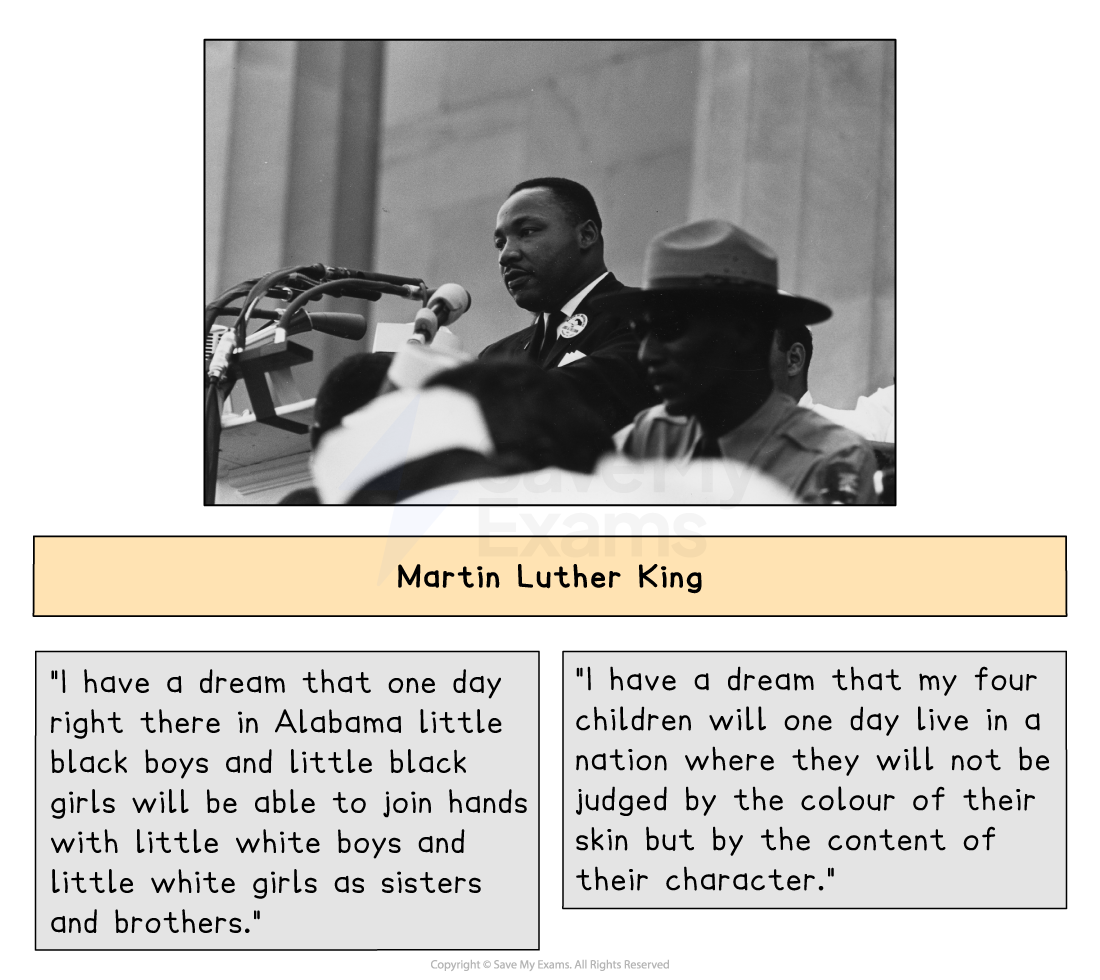
The speech made references to several important sources:
The US Constitution and the Declaration of Independence
Abraham Lincoln, the president who ended slavery
The Bible, hymns and sermons
The idea of the American Dream
Why was the speech so effective?
King linked civil rights directly to the founding documents and the values of the USA
This meant that white Americans who valued those documents were being asked to support, and not to oppose, civil rights
His references to the Bible and to hymns appealed to the many Americans, Black and White, who had a strong Christian faith
The speech was broadcast live
The audience was far larger than the crowd at the Lincoln Memorial
How significant was the March on Washington for the civil rights movement?
Evidence of significance
A huge number of people took part in the march
It showed that civil rights was supported by many people, Black and White
Many observers were impressed by the organisation of such a large protest
The event brought huge publicity to the cause
It put further pressure on politicians
It took place during the period when a civil rights bill was being debated in Congress
It strengthened Martin Luther King's place as one of the most influential leaders of the whole civil rights movement
After the march, civil rights leaders met President Kennedy and Vice President Johnson at the White House
Kennedy promised the protestors that the federal government was committed to seeing the civil rights bill through Congress
The Civil Rights Act was passed in July 1964, less than a year after the march
The pressure the march created helped to secure the law it had demanded
Evidence of limitations
Everyone knew that getting the bill through Congress would not be an easy task
To many civil rights supporters, it seemed even more unlikely when President Kennedy was assassinated on 22 November 1963
Vice President Johnson, a Democrat from the Southern state of Texas, became the new president
The march was a one-day show of support
It did not itself change any laws or end segregation anywhere
The demands on the placards, such as jobs and housing, were not met by the march
Conclusions
Immediately, the march changed little in the USA
It did not itself change any law
Kennedy's death left the bill's future uncertain
For the movement and public opinion, it was very significant
It showed wide support, won huge publicity, increased the pressure on politicians and made King pivotal to the cause
Worked Example
Study Extract G.
Extract G: From an essay on the 'I Have a Dream' speech, published in 2002.
"By all accounts, Dr. King’s speech was considered a tremendous success. It led to his being named “Man of the Year” by “Time” magazine later that year, and the receipt of the Nobel Peace Prize the following year. The speech also played a pivotal role in the continued struggle for civil rights."
What impression does the author give about the importance of Martin Luther King's 'Dream' speech?
You must use Extract G to explain your answer.
(6)
Partial answer:
The author gives the impression that King's speech was a huge success that everyone agreed about. Describing it as a "tremendous success" makes it sound like an outstanding achievement, and beginning by saying that this is the view of all accounts suggests that nobody disagreed. The author also says the speech played a "pivotal role" in the struggle, which makes it sound like a turning point. The author supports this by naming two honours that King received because of his speech, Time's Man of the Year and the Nobel Peace Prize.
Examiner Tips and Tricks
To continue this answer, use your own knowledge to identify what the author leaves out. You could mention that the author does not mention the impact of the wider March on Washington, such as the size and peaceful nature of a crowd of over 250,000 people. Also, the author does not mention the other speakers such as John Lewis of the SNCC and Roy Wilkins of the NAACP who addressed the crowd before King.

Unlock more, it's free!
Join the 100,000+ Students that ❤️ Save My Exams
the (exam) results speak for themselves:

Was this revision note helpful?