The Little Rock Crisis, 1957 (Edexcel IGCSE History: Paper 1: Depth Studies): Revision Note
Exam code: 4HI1

Timeline and Summary
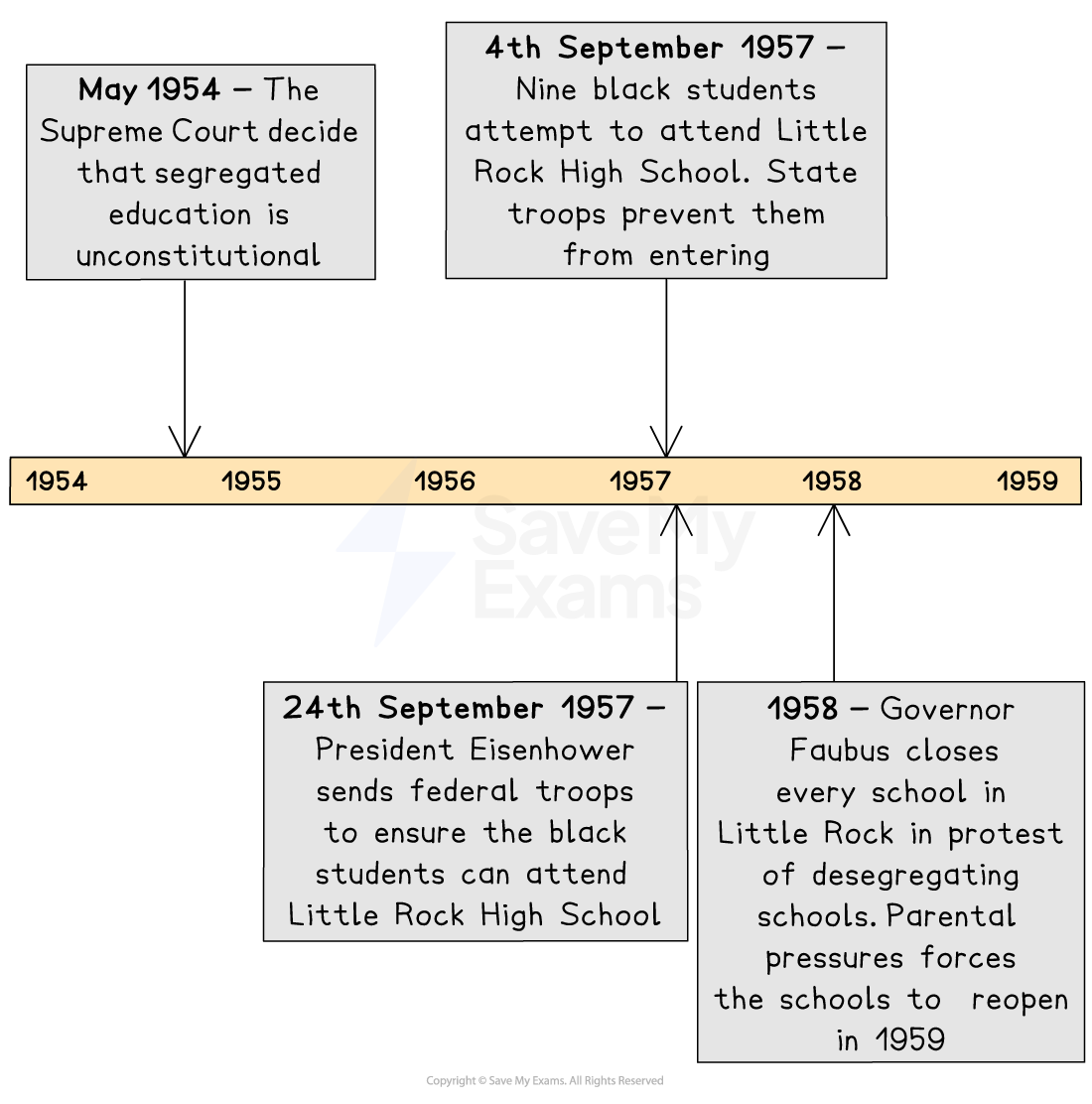
By 1957, almost no schools in the South had been integrated
State authorities and White communities worked to prevent it
In September 1957, Governor Orval Faubus used state troops to stop nine Black students, the Little Rock Nine, entering Central High School in Little Rock, Arkansas
Crowds, riots and media coverage around the world forced President Eisenhower to send federal troops
The nine students began lessons on 25 September
The nine faced harassment for the whole year
In 1958, Faubus closed all high schools in Little Rock
The federal court ruling caused Faubus to reopen them in 1959
Little Rock showed that the federal government could overrule a state
However, it was the publicity, rather than the law, that had the biggest impact
Key events of Little Rock, 1957
Why desegregation was an issue in the South
In 1957, Central High School in Little Rock, Arkansas was forced to desegregate
The Brown v. Topeka ruling stated that segregated schools were unconstitutional
The State Governor of Arkansas was Orval Faubus
Faubus was a strong opponent of school desegregation
Arkansas, a southern state, wanted to keep segregated schools
The Little Rock Nine
The Little Rock Nine were nine Black students who had enrolled at the ‘Whites Only’ Central High School in Little Rock, Arkansas
The students enrolled in 1957, three years after the Supreme Court had ruled that segregation broke the Constitution in the Brown v. Topeka judgement
Originally 75 Black students had applied to join Central High School
Just 17 students were accepted
A campaign of intimidation led to just nine taking up their places
On 3 September 1957, the State Governor, Orval Faubus, claimed there was a danger of violence and public disorder if the Black students enrolled
The evening before he ordered soldiers from the Arkansas State National Guard to surround the school
When the nine Black students arrived for their first day of school on 4 September, their entry was blocked by the soldiers
After a court order, Faubus ordered the National Guard to leave
On 23 September, the nine students were faced with a crowd of 1,000 angry protestors and hundreds of reporters
Fears for their safety meant that police guards escorted the Little Rock Nine home
How did Eisenhower resolve the events at Little Rock?
Governor Faubus was defying a Supreme Court ruling
The coverage of events at Little Rock was damaging the USA’s reputation abroad
On 24 September, President Eisenhower decided to intervene by sending soldiers from the 101st Airborne Division to protect the nine Black students
In September 1958, Faubus closed all four of the high Schools in Little Rock to prevent desegregation taking place
The schools remained closed for the entire academic year
A combination of pressure from parents and a federal court ruling caused Faubus to reopen them in 1959
How significant was the Little Rock Crisis?
Evidence that it was significant
It showed that the federal government could overrule a state government
Eisenhower put state troops under federal control and used federal troops to protect the students
The publicity generated by the crisis was seen by millions of people in the USA and around the world
It damaged the USA's international reputation
It made the USA look hypocritical because it criticised other countries, such as the Soviet Union for denying people's civil rights
It showed civil rights campaigners that winning in the Supreme Court was not enough and that other action, and media coverage, would be needed
Evidence of limits
Orval Faubus’s actions may have appalled many people in the North
However, he was re-elected as Governor of Arkansas five times
The Little Rock Nine continued to face harassment and violence even with army protection
In 1958, Faubus closed all high schools in Little Rock
It was not until the 1970s that there was a significant level of school integration there
Elsewhere in the South, Black pupils who attended formerly white schools were frequently insulted or ignored by White pupils
Many felt that their education suffered
Conclusions
On how widely the effects were felt, the crisis was very significant
It was seen across the USA and the world
On how far things changed in practice, the crisis was much less significant
Integration in Little Rock was slow and Eisenhower did not send troops again
Therefore, Little Rock was significant mainly because of the attention it brought, and less because of what it changed in schools
Worked Example
Explain two effects of the Little Rock Crisis (1957) on the USA
(8)
Partial answer:
One effect of the Little Rock Crisis was that it showed campaigners that the federal government could be made to act. Governor Faubus's troops and angry mobs stopped the Little Rock Nine from entering Central High School, and this was shown on television and in newspapers across the world. The media pressure and a federal judge's order meant that Eisenhower sent 1,200 federal troops, so the nine students were able to attend lessons from 25 September and a state government had been overruled.
Examiner Tips and Tricks
An answer that deals with only one effect is capped at 4 marks.
A strong approach to this question would be one positive effect of the crisis, such as the federal government acting, and one negative effect, such as the closure of Little Rock’s high schools in 1958. However, you would be credited for either two positive, or two negative, effects.
Support each effect with a precise detail, such as Eisenhower sending 1,200 federal troops to protect the Little Rock Nine, and then trace it forward to an outcome.

Unlock more, it's free!
Join the 100,000+ Students that ❤️ Save My Exams
the (exam) results speak for themselves:

Was this revision note helpful?