Segregation & Discrimination in 1950s America (Edexcel IGCSE History: Paper 1: Depth Studies): Revision Note
Exam code: 4HI1

Summary
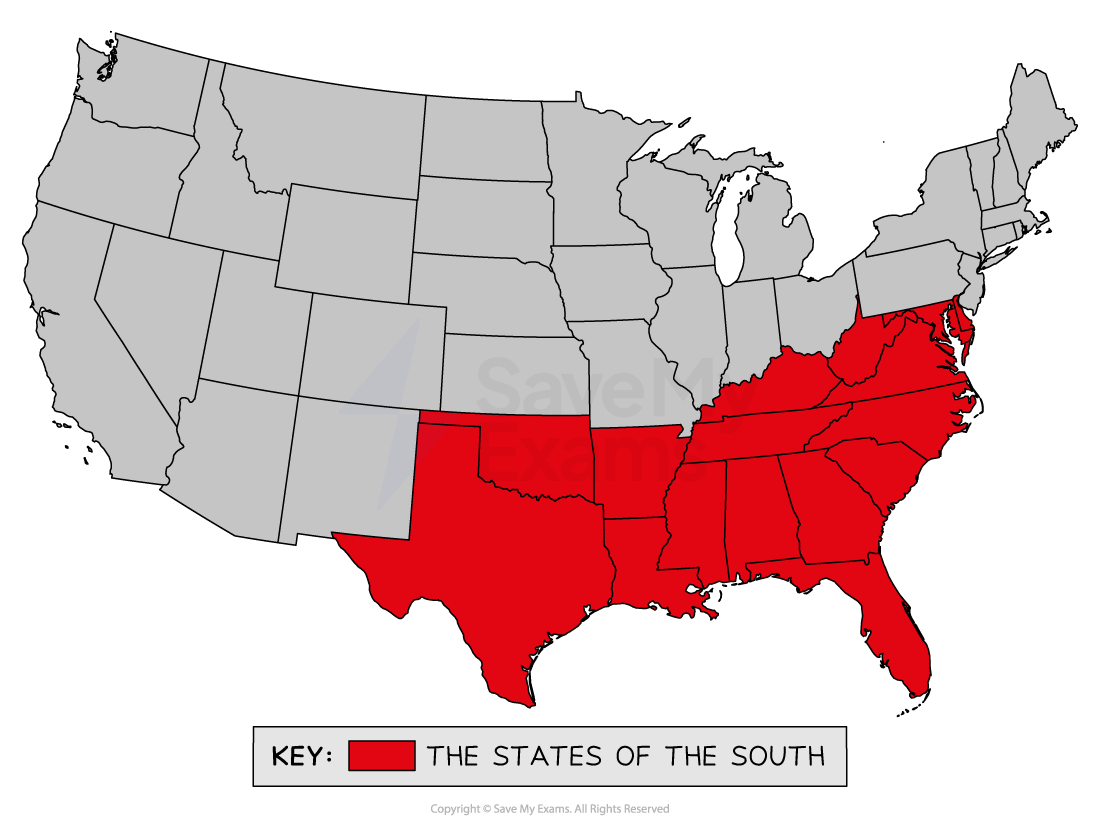
In 1950, most states had some segregation laws
In the South, ‘Jim Crow’ laws separated Black and White people in almost every part of life
In the North, there were fewer laws
However, racism and discrimination meant that Black Americans mostly lived, worked and went to school separately from White people
Very few Black Americans in the South could vote because of:
literacy tests
poll taxes
the threat of mob violence and unfair trials
The Supreme Court, Congress and the president had all failed to act because of:
the 1896 ruling in Plessy v. Ferguson
needing the support of Southern politicians
Segregation was widespread across the USA
It was legal and complete in the South and informal in the North
Segregation and discrimination
Segregation
Segregation means keeping groups of people apart
In the South of the USA in the 1950s, Black and White Americans were kept separate or segregated
They were prevented from mixing in most Southern states
Black and White Americans:
attended different schools
accessed different public facilities such as buses, cinemas, restaurants, hotels, beaches, waiting rooms and toilets
The ‘Jim Crow’ laws were a series of laws that targeted Black Americans
They affected people’s voting rights and enabled segregation across the South
The laws were named after an offensive slang term used to describe Black Americans
Discrimination
Discrimination means treating a group of people unfairly because of who they are
It can happen even when there is no law that requires it
In the North there were fewer legal barriers to equality
However, racism and discrimination still meant that Black Americans mostly lived separately from White people
Wages for Black workers were generally half of what a White person earned for the same job
The unemployment rate for Black Americans was higher than that of White Americans
Because of this, Black people could only afford to live in the poorest areas with very few White people
As a result, many facilities were segregated without any need for laws
Voting rights
In theory, Black Americans had been guaranteed the same voting rights as White Americans since 1870
Black Americans were a sizeable minority in many states in the South, making up 45% of the population of Mississippi in the 1950s
Therefore, they should have been able to vote politicians into power who would improve their lives and end segregation
To vote, people had to register
Most Southern states used methods to stop Black people from registering
A difficult literacy test, which tested people's ability to read and write, was used
Many Black Americans had very little education and did not even try
Many White people were exempt from the tests or passed them easily
A poll tax was charged
Most Black Americans could not afford to pay
Violence, or the threat of it, was used against Black Americans who tried to register
Violence and fear
As well as segregation and discrimination, Black Americans often faced violence, particularly in the South
Black men suspected of crimes were frequently attacked by White mobs who took the law into their own hands
Lynchings had declined by the 1950s, but Black communities still greatly feared them
Police were sometimes racist themselves and did nothing to stop attacks
They even took part occasionally
White people suspected of attacking Black Americans were usually found not guilty by all-White, all-male juries
Examiner Tips and Tricks
It is important to remember that the prejudice and discrimination suffered by Black Americans was not the same all over the country. Although racist attitudes were common among many White Americans all across the US, ‘Jim Crow’ laws were strongest and most complete in the South.
The influence of the Supreme Court and Congress
The Constitution guaranteed the equality of all American citizens
The Fourteenth Amendment of 1868 promised equal protection of the law
As a result, segregation should not have been allowed
The three branches of government could all have acted to enforce civil rights for Black Americans
None of them had done so by the early 1950s
Examiner Tips and Tricks
Use the three branches (the Supreme Court, Congress and the president) as a checklist. For each one, say what it could have done and why it did not.
The Supreme Court
The Supreme Court was independent
It did not rely on the support of the president or Congress
It had the power to ban segregation laws as unconstitutional
Instead, in 1896, the Court ruled in the Plessy v. Ferguson case that racial segregation did not break the Constitution
It ruled that the facilities available to both groups had to be ‘separate but equal’
The facilities were rarely equal
The ruling became a precedent
The precedent was used time and time again when civil rights groups tried to challenge segregation through the courts
Like other parts of government, the Supreme Court was influenced by the views of its judges
Many of them were against civil rights for Black Americans
Congress and the president
Congress often needed the support of Southern politicians, who were either racist themselves or did not want to annoy racist voters in their states
President Truman tried to get a civil rights bill passed in 1948
It was blocked by Republicans, for political reasons, and by Dixiecrats
Dixiecrats were a group of Southern Democrats who broke away from the Democratic Party in 1948 because they objected to desegregation
Even a strong president frequently needed the support of Southern politicians for other policies
Presidents who may have wanted change did not act to improve civil rights
How widespread was segregation in 1950s America?
Evidence that segregation was widespread
By 1950, most states had some segregation laws
Segregation was not limited to one region
In the South, segregation applied to almost all aspects of life
In the North, discrimination in wages, jobs and housing meant that facilities were often segregated even without laws
In many states, not just the South, Black and White pupils had to attend separate schools
Voting was also affected, because very few Black Americans in the South could vote
Evidence of differences and limits
The law differed between regions, because there were fewer legal barriers in the North
Segregation laws were enforced most strictly in the South
The experience of Black Americans in the North was different
Violence and the threat of lynching were mostly felt in the South
Conclusions
Three criteria help to judge how widespread segregation was:
how many places had it
how many parts of life it covered
how it was enforced
On how many places, it was very widespread
Most states had segregation laws
The North had segregation in practice
On how many parts of life, the South was the most extreme
Segregation covered almost every part of life
On how it was enforced:
the South used the law and violence
the North used wages and housing
Therefore, segregation was widespread across the whole USA
However, it differed in form and severity between the South and the North
Worked Example
Explain two effects of segregation on Black Americans in the South in the 1950s
(8)
Partial answer:
One effect of segregation was that very few Black Americans could vote. Southern states used literacy tests, poll taxes and threats of violence to stop Black people registering. Because so few could vote, Black Americans had little power to remove politicians who supported segregation. As a result, the 'Jim Crow' system stayed in place and Black Americans had fewer civil rights than White Americans.
Examiner Tips and Tricks
An answer that deals with only one effect is capped at 4 marks.
A strong approach to this question would be to focus on different areas of life that segregation affected. The example above covers legal rights, but you could cover economic or social effects.
Support each effect with a precise detail, such as the literacy tests, and then trace it forward to an outcome.

Unlock more, it's free!
Join the 100,000+ Students that ❤️ Save My Exams
the (exam) results speak for themselves:

Was this revision note helpful?